
Key takeaways
- High-performing social media teams include strategy, content, community, analytics, and paid roles scaled to your organization’s needs.
- Social teams connect daily execution to broader business goals like brand awareness, customer experience, and revenue.
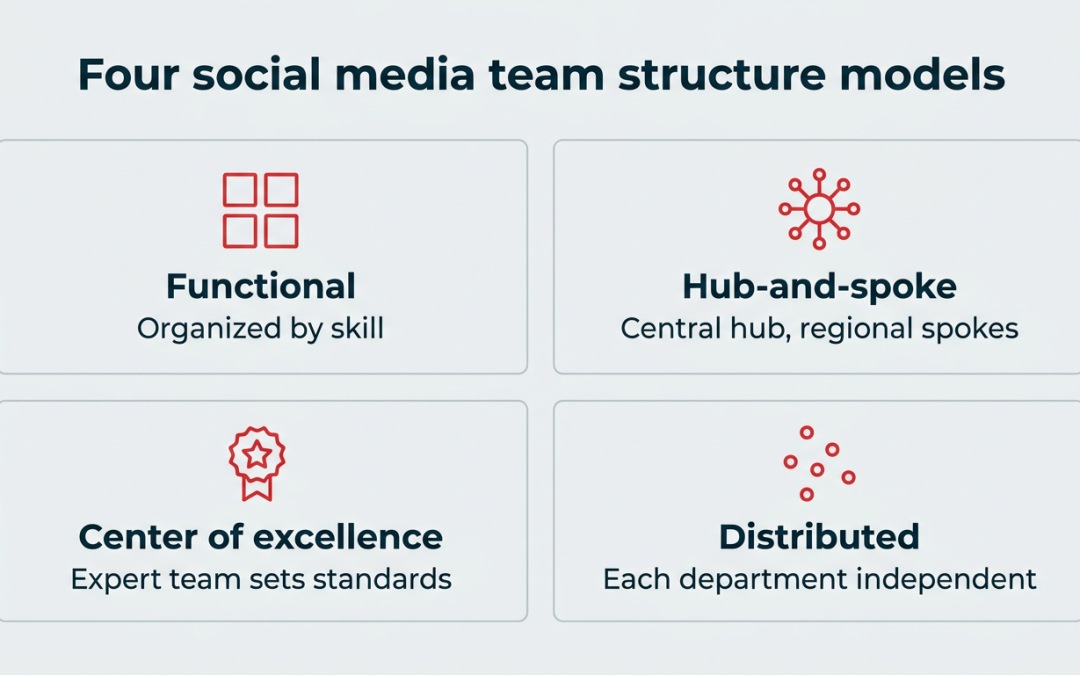
- Team structure matters as much as who you hire—hub-and-spoke, center of excellence, and functional models serve different organizational needs.
- Building the right team depends on your budget, goals, and skill gaps.
- AI is reshaping social media teams in 2026 by shifting what each role focuses on and how teams collaborate.
What is a social media team?
A social media team is responsible for planning, creating, publishing, and managing a brand’s social media presence.
A typical social media team includes:
- Strategists: Set goals and define content direction
- Content creators: Write posts and create visuals or videos
- Community managers: Respond to comments and direct messages (DMs)
- Analysts: Track performance and optimize strategy
- Social media managers: Oversee planning, publishing, and day-to-day execution across social media channels
- Paid social specialists: Manage ad campaigns and budgets
- Influencer managers: Handle creator collaborations and campaigns
Not every social media team looks the same. For example, a small business might have one or two people wearing multiple hats, while larger organizations have dedicated specialists for each role.
At the same time, some roles might be handled in-house, while others may be outsourced to freelancers or agencies, depending on the team’s size, budget, and needs.
The size and makeup of the team depend on the organization’s maturity. Startups often begin with a single social media manager who handles both strategy and execution, while organizations with established programs add specialists as volume, channels, and compliance requirements grow.
AI has changed the math here too. With AI-assisted drafting, tagging, and reporting, a smaller team can cover more ground, which makes the question less about headcount alone and more about which skills you genuinely need in-house. In short: A social media team is the group that owns your brand’s presence on social, sized and structured around your goals rather than a fixed template.
Bonus: Our free social media manager career toolkit includes resume, cover letter, and portfolio templates, along with a complete guide to social media job descriptions and frequently asked interview questions. You got this!
What does a social media team do?
A social media team is responsible for everything from daily posting to long-term strategy.
That means:
- Managing a content calendar
- Creating posts, videos, and visuals
- Scheduling and publishing social media posts
- Engaging with followers through comments and DMs
- Monitoring trends, mentions, and conversations
- Tracking performance and optimizing future content
But it’s not just execution. A strong social team connects social media to real business goals, whether that’s brand awareness, customer support, or sales.
At larger organizations, the remit stretches well beyond publishing. Social teams often own strategic functions that other departments depend on:
- Social listening: Feeding customer feedback and competitor intelligence to product and marketing teams
- Crisis management: Monitoring for risks and managing the brand’s response during sensitive events
- Social selling: Partnering with sales teams to identify and engage prospects
- Employee advocacy: Training and empowering employees to share brand content on their own profiles
In essence, the team handles the daily work of publishing and engagement while also feeding intelligence, risk signals, and revenue opportunities back into the wider business.
Social media team structures to consider
Before you decide who to hire, it helps to decide how the team will be organized. Your social media team structure shapes who owns strategy, how quickly content ships, and how consistent your brand looks across markets.
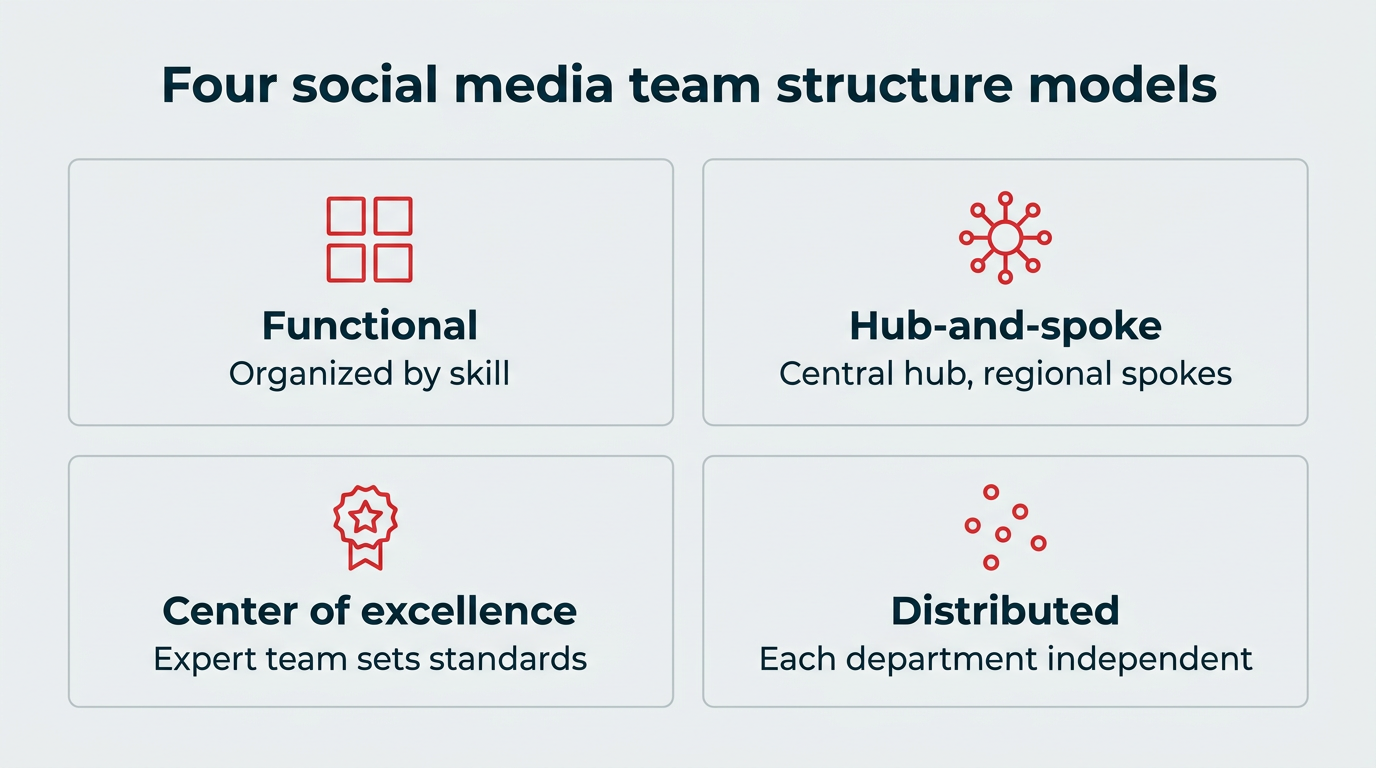
Here are four common models and where each one fits best.
Functional structure
In a functional structure, the team is organized by skill: content, community, analytics, and paid social each have a clear owner.
This works well for mid-size organizations with a dedicated social team and a single brand. The upside is clear ownership and deep expertise in each area. The tradeoff is that specialists can drift into silos, so someone needs to connect the work back to a single strategy.
Hub-and-spoke structure
A hub-and-spoke model puts a central team in charge of strategy, brand voice, and standards, while regional or business-unit teams handle local execution.
It’s a strong fit for multi-brand or multi-region enterprises that need global consistency and local relevance at the same time. The main cost is coordination: without shared calendars, approval workflows, and clear guardrails, the spokes drift.
Center of excellence
In a center of excellence model, a small expert team sets standards, builds playbooks, and provides tools for social practitioners who are embedded in other departments (like HR, PR, or customer care).
This is common in highly decentralized organizations where social is part of everyone’s job. It scales well but requires strong governance to keep the brand from feeling fragmented.
Distributed structure
In a distributed model, there is no central social team. Different departments manage their own social presence independently.
While this allows for maximum speed, it’s the riskiest model for brand consistency and compliance. Most organizations eventually move toward a hub-and-spoke or center of excellence model as they grow.
The right choice depends on your organization’s culture. Choose the structure that reduces friction rather than the one that looks most impressive on an org chart.
Key social media team roles and salaries
A high-performing social media team doesn’t happen by accident. Here are eight key social media team roles to consider, along with the skills, tools, and salaries that come with each.
Social media strategist
A social media strategist owns the overarching direction of your social program. They align social with business objectives, define KPIs, choose which channels to invest in, and report results to leadership.
The difference between a strategist and a manager comes down to focus. Strategists work on where social should go and why it matters to the business, while managers make sure the plan actually ships. On smaller teams, one person does both.
Skills:
- Social media strategy development
- Audience and market research
- Channel planning
- KPI setting and measurement
- Stakeholder communication
- Budget planning
Tools they use:
- Social media management and analytics platforms (like Hootsuite)
- Social listening and competitive intelligence tools
- Presentation and reporting tools
Reports to: Marketing Director or CMO
Social media manager
The social media manager is the backbone of any social media team.
This is a true generalist role. Social media managers understand social platforms, they’re the ones setting direction and calling the shots. They create the social media marketing strategy and work with the rest of the marketing team to make sure everything gets executed properly.
Skills:
- Social media strategy development
- Content planning
- Content creation
- Copywriting/copyediting
- Social monitoring
- Social listening
- Social media analytics
- Social media reporting
- Communication
- Management
According to Eileen Kwok, Hootsuite’s former Social & Influencer Marketing Strategist, other must-have skills/characteristics include “curiosity, tenacity, and creativity.”
“Being a Social Media Manager can be an overwhelming job,” says Kwok. “That’s why the ones that are naturally curious about all things social, have the desire to always learn and improve, and, most importantly, place creativity at the forefront of their work, are the ones that truly succeed.”
Tools they use:
- Social media management tools (like Hootsuite)
- Content creation tools (Canva, Adobe Creative Suite, Grammarly, and more)
Reports to: Marketing Director or CMO
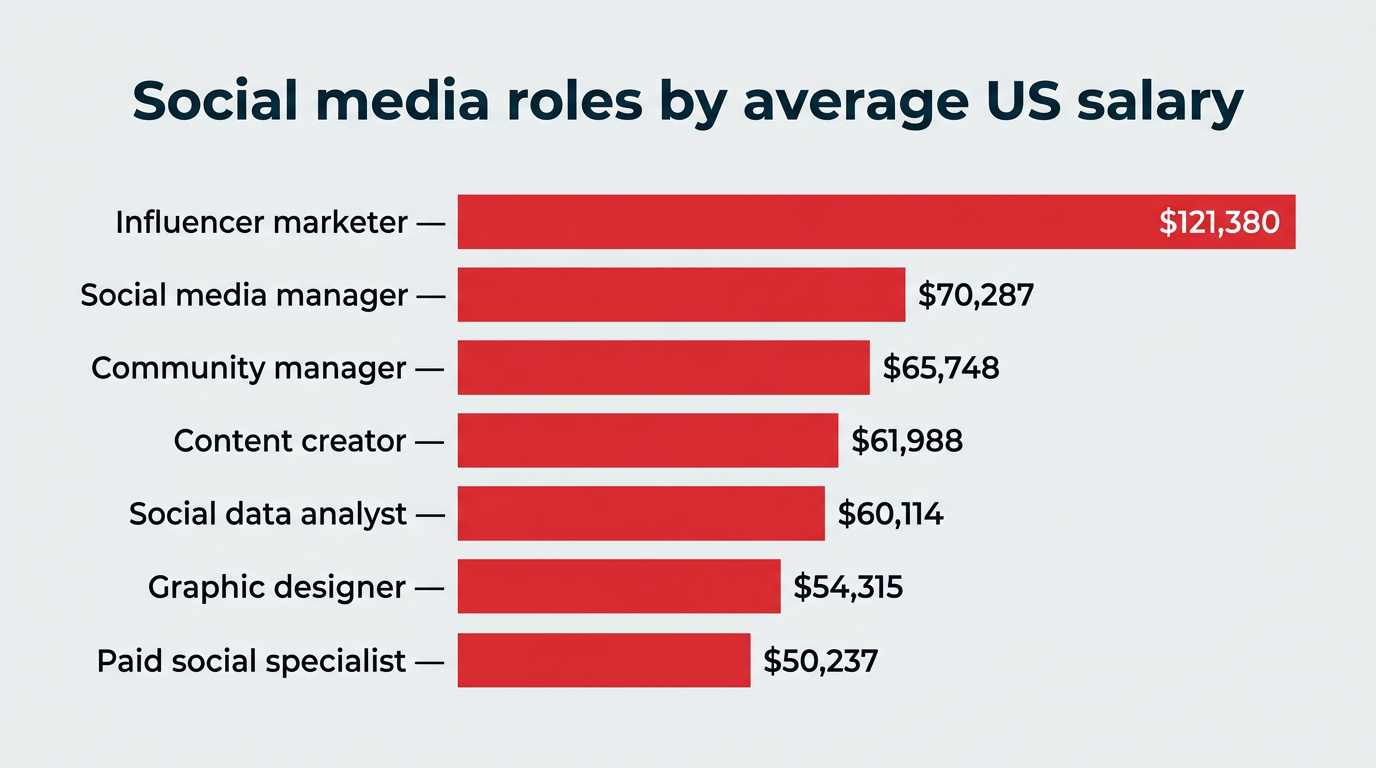
Average salary: $70,287
Content creator
A content creator focuses on producing the actual content that shows up on your brand’s social channels. This includes everything from graphics and captions to photos and video content.
This role is the engine behind your content. Depending on your team, they might specialize in one format (e.g., short-form videos like TikToks, Reels, or Shorts) or a mix of formats across multiple platforms.
But here’s the non-negotiable: a great content creator knows your brand voice inside and out. They also understand your target audience just as deeply, including their pain points, needs, and interests.
Skills:
- Content creation (video, photo, and graphic design)
- Copywriting/copyediting
- Storytelling
- Creativity
Tools they use:
- Video editing tools (iMovie, CapCut, or Final Cut Pro)
- Photo editing tools (Snapseed, VSCO, Lightroom, and more)
Reports to: Social Media Manager
Average salary: $61,988
Community manager
A community manager is the voice of your brand on social — and the person who actually interacts with your audience on social media.
They handle everything from replying to comments and DMs to building deeper relationships through communities, like Facebook Groups or Slack channels.
In many cases, they also manage a brand’s social inbox, making sure no mention or message goes unanswered.
Skills:
- Customer service
- Relationship building
- Communication
Tools they use:
- Social media management tools
- Social media monitoring tools (Hootsuite, Mentionlytics, and others)
- Social media inbox tools (Nest in Hootsuite Social OS, Sprout Social, Sendible)
Reports to: Social Media Manager
Average salary: $65,748
Paid social media specialist
A paid social media specialist manages your brand’s social advertising — a market projected to reach $338 billion globally in 2026. They handle in-depth audience targeting, ad creation, budgets, and ongoing optimization.
This role is highly analytical and distinct from other social roles. It’s all about digital marketing performance: testing what works, scaling what wins, and cutting what doesn’t. They also work closely with content creators to develop high-performing social media ads.
Skills:
- Social media ads
- Social media analytics
- Budget management
- Ad targeting
- Media buying
- Copywriting/copyediting
- Creative strategy
- Ad optimization
Tools they use
- Native ad management tools
- Social media advertising tools
- Social ad analytics tools (native platform tools or all-in-one solutions like Hootsuite)
Reports to: Social Media Manager/Marketing Director/CMO
Average salary: $50,237
Social data analyst
A social data analyst turns social media performance into insights you can actually use. They analyze behavior across your accounts and social media campaigns to make clear, data-driven decisions.
This role is all about the numbers. Analysts track key metrics, build reports, and present their findings to the rest of the team and leadership.
Bringing in a social data analyst also frees up your team to focus on execution — like content creation, engagement, and campaign planning — while the analyst focuses on turning data into direction.
Skills:
- Structured Query Language (SQL)
- Python
- Problem-solving
- Critical thinking
- Data analysis and visualization
- Dashboard and report building
- Communication
Tools they use:
- Social media analytics tools (like native platform tools or Hootsuite)
- Data visualization software (like Tableau, Looker Studio, or Google Charts)
- Spreadsheet tools (Microsoft Excel, Google Sheets, and more)
Reports to: Social Media Manager
Average salary: $60,114
Graphic designer
A graphic designer creates high-quality visuals that elevate your brand on social. These can include campaign graphics, infographics, and email marketing assets.
This role may seem like a luxury for a social media team, but it can be extremely important for visual businesses. Your graphic designer works alongside your content creator, ensuring all visuals are on-brand and high-quality.
Skills:
- Graphic design principles
- Typography
- Branding
- UX and UI design
- Creativity
- Communication
Tools they use:
- Professional design software (like Photoshop, Sketch, Illustrator, or After Effects)
Reports to: Social Media Manager/Paid Ads Specialist
Average salary: $54,315
Influencer marketer
An influencer marketer manages your brand’s influencer partnerships and campaigns, from finding the right creators to running the campaign end to end.
On smaller teams, this might fall under a social media manager’s role. But with US influencer spending exceeding $10 billion, having a dedicated influencer marketer becomes important for building and scaling those relationships.
It’s a cross-functional role that touches strategy, outreach, and execution, which means strong collaboration skills are key.
Skills:
- Influencer marketing strategy
- Relationship management
- Project management
- Negotiation
- Communication
Tools they use:
- Influencer marketing tools (Upfluence, Mavrck, CreatorIQ, and more)
- Social media analytics tools (like Hootsuite)
Reports to: Social Media Manager/Marketing Director/CMO
Average salary: $121,380
Role comparison at a glance
Here’s how the core social media team roles and responsibilities compare side by side.
|
Role |
Primary focus |
Key skills |
Reports to |
Average salary (US) |
|---|---|---|---|---|
|
Social media strategist |
Direction, KPIs, channel investment |
Strategy, research, measurement |
Marketing Director/CMO |
Varies by market |
|
Social media manager |
Planning and day-to-day execution |
Strategy, content, reporting |
Marketing Director/CMO |
$70,287 |
|
Content creator |
Producing social content (video, photo, graphics) |
Creation, storytelling, copywriting |
Social Media Manager |
$61,988 |
|
Community manager |
Audience engagement and relationship building |
Customer service, communication |
Social Media Manager |
$65,748 |
|
Paid social specialist |
Ad management and optimization |
Ads, analytics, budget management |
Social Media Manager/CMO |
$50,237 |
|
Social data analyst |
Performance insights and reporting |
Data analysis, visualization, SQL |
Social Media Manager |
$60,114 |
|
Graphic designer |
Visual brand identity and assets |
Design, branding, typography |
Social Media Manager/Paid Ads Specialist |
$54,315 |
|
Influencer marketer |
Creator partnerships and campaigns |
Outreach, project management, strategy |
Social Media Manager/CMO |
$121,380 |
The extended social media team: Cross-functional roles
At enterprise scale, the core team rarely works alone. An enterprise social media team depends on partners across the business to move quickly without creating risk.
- Legal and compliance: Reviews claims, disclosures, and regulated language, and signs off on contest rules and creator contracts
- HR and employer brand: Partners on recruiting content, employee advocacy, and social media policy training
- Sales: Uses social insights and social selling to source and warm up pipeline
- PR and communications: Aligns messaging during launches and manages escalation during a crisis
- Product: Feeds roadmap context to social and receives customer feedback and feature requests back
- IT and security: Manages account access, single sign-on, and permissions to protect owned channels
Mapping these relationships early means the social team knows exactly who to loop in, which keeps governance and compliance from becoming a bottleneck.
How to build your own social media team in 5 steps
Building a high-performing social media team starts with understanding your current resources, goals, and gaps. From there, it’s about putting the right people in place.
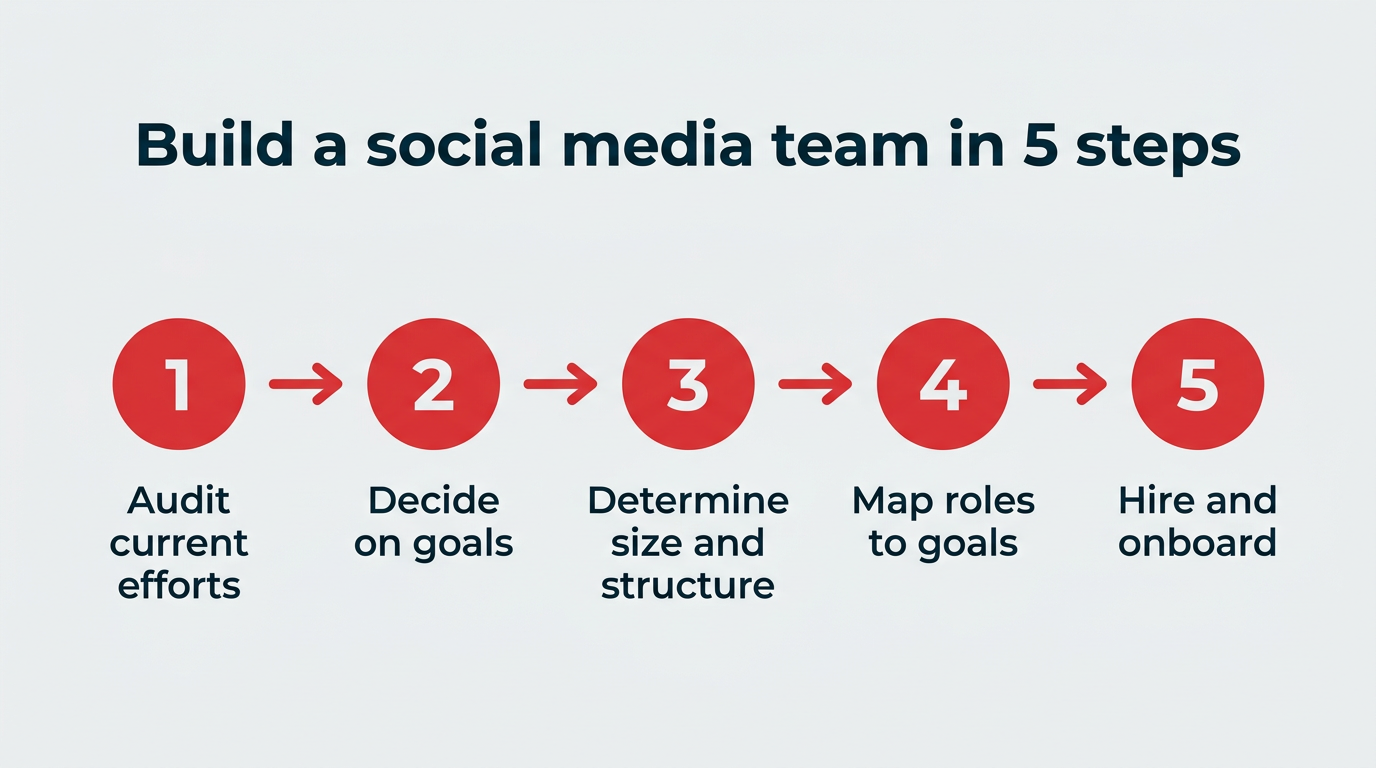
1. Audit your current social media efforts
Before you start hiring, take a look at what you’re already doing. What’s working? What’s not? What kind of content is resonating with your audience? Are there any networks you should pay more attention to or deprioritize in the future?
You also need to look at your budget. In a perfect world, every company would have one or more people in each of the roles we mentioned. But that comes with a huge cost.
So, what kind of budget do you have to hire? And how many roles are non-negotiable for your dream team?
Once you know where you’re starting from, you’ll have a better idea of the gaps you need to fill.
2. Decide on your social media goals
Next, get clear on what you want to achieve from your social media efforts. Your goals will determine which roles are a priority to fill.
For example, if your goal is to build community around your brand, you might prioritize hiring a community manager with experience managing spaces like Slack groups or LinkedIn communities.
If your goal is to drive conversions or revenue, a paid social media specialist may be a more immediate need.
“Set your expectations and get really clear on what you are looking for,” says Kwok. “Social media managers are often asked to cover a wide variety of tasks, but you should avoid looking for a one-size-fits-all unicorn. Instead, get clear on the goals you want to achieve and work backwards.”
And remember to be realistic. “Jot down your list of priorities and be mindful of what’s achievable from one person or a small team,” adds Kwok.
- Building brand awareness
- Improving brand reputation
- Driving website traffic
- Increasing sales
- Improving customer experience
3. Determine your team size and structure
How many people do you actually need? For smaller organizations, one or two generalists may be enough to manage both content creation and engagement. As your investment in social grows, you’ll likely need to expand into more specialized roles, like influencer or community managers.
Start by choosing the structure that fits your organization (functional, hub-and-spoke, center of excellence, or distributed), then size the team around it. A three-person team might include a strategist/manager, a content creator, and a community manager. A ten-person enterprise team usually adds a paid specialist, an analyst, an influencer manager, a designer, and a dedicated strategist, plus regional owners if you operate in multiple markets.
Use this table as a starting point for social media team size by stage:
|
Team size |
Typical composition |
Best fit |
|---|---|---|
|
1-3 people |
Social media manager (generalist), content creator, part-time community support |
Startups and lean marketing teams on 2-3 channels |
|
4-6 people |
Strategist or manager, content creator, community manager, paid specialist, shared designer |
Mid-market brands running organic and paid across 4-5 channels |
|
7+ people |
Dedicated strategist, multiple content creators, community managers, paid specialist, analyst, influencer manager, designer |
Enterprises with multiple brands, regions, or business units |
The key is to balance ambition with resources. It’s better to have a small, high-performing team than a large, disorganized one.
4. Map roles to your social media goals
Once you’ve decided on your goals and team size, it’s time to map specific roles to those goals. This will help you understand exactly what each person will be responsible for and how they’ll contribute to your overall success.
Here’s an example of how you might map roles to goals:
|
Goal |
Key responsibility |
Primary role |
|---|---|---|
|
Increased brand awareness |
Strategy and content creation |
Social Media Manager |
|
Improved brand reputation |
Customer service and communication |
Community Manager |
|
Higher web traffic |
Analytics and paid social |
Paid Social Media Specialist |
|
Increased sales |
Strategy and paid social |
Social Media Manager, Paid Social Media Specialist |
|
Improved customer experience |
Customer service and communication |
Community Manager |
|
Stronger social intelligence |
Data analysis, listening, and reporting |
Social Data Analyst, Social Media Strategist |
You can then prioritize the order you hire in or the roles you choose to fill based on the social media goals (and budget) you’ve already outlined.
5. Hire and onboard your team
Ready to hire? Begin by writing clear job descriptions that reflect the specific skills and responsibilities you mapped out from the last step. Then, create your job ads, post them online, and wait for the applications to roll in.
To make sure you’re bringing on the right people, pay attention to:
- Skills listed on their resume
- Platforms they’ve worked with
- Industries they’ve supported
- Specific roles they’ve held before
A short, paid test project can go a long way here. Ask candidates to build a mini content strategy or draft a few posts. It’s one of the fastest ways to see how they think and execute.
“Don’t be afraid to ask for examples of their work or to have them complete a small task as part of the interview process,” says Kwok. “This will give you a better sense of what they’re capable of and what they can bring to the table.”
Once you’ve made your hires, set them up for success from day one. Be sure to share key documents and resources, such as:
- A social media policy
- Brand voice guidelines
- Access to tools and social platforms
- Content templates and workflows
- Reporting frameworks and KPIs
These don’t need to be perfect. In fact, giving your new team room to refine and improve them is one of the fastest ways to build a stronger, more scalable process.
How to make the case for expanding your social media team
Getting approval for another hire usually comes down to how well you translate social performance into business language. Leadership rarely says no to a clear connection between headcount and revenue, risk, or reputation.
Here’s how to build that case.
- Lead with outcomes, not output: Show what social contributed to pipeline, retention, or customer care volume, not how many posts you shipped.
- Quantify the opportunity cost of staying lean: Name the channels you can’t staff, the response times you can’t hit, or the trends you’re missing because the team is at capacity.
- Show the risk of burnout: Social is a 24/7 function. If your current team is managing community, content, and strategy alone, show how that creates a single point of failure for the brand.
- Benchmark against competitors: If your main competitors have dedicated influencer or video roles and you don’t, use that to show where you’re losing share of voice.
How AI is changing social media team roles in 2026
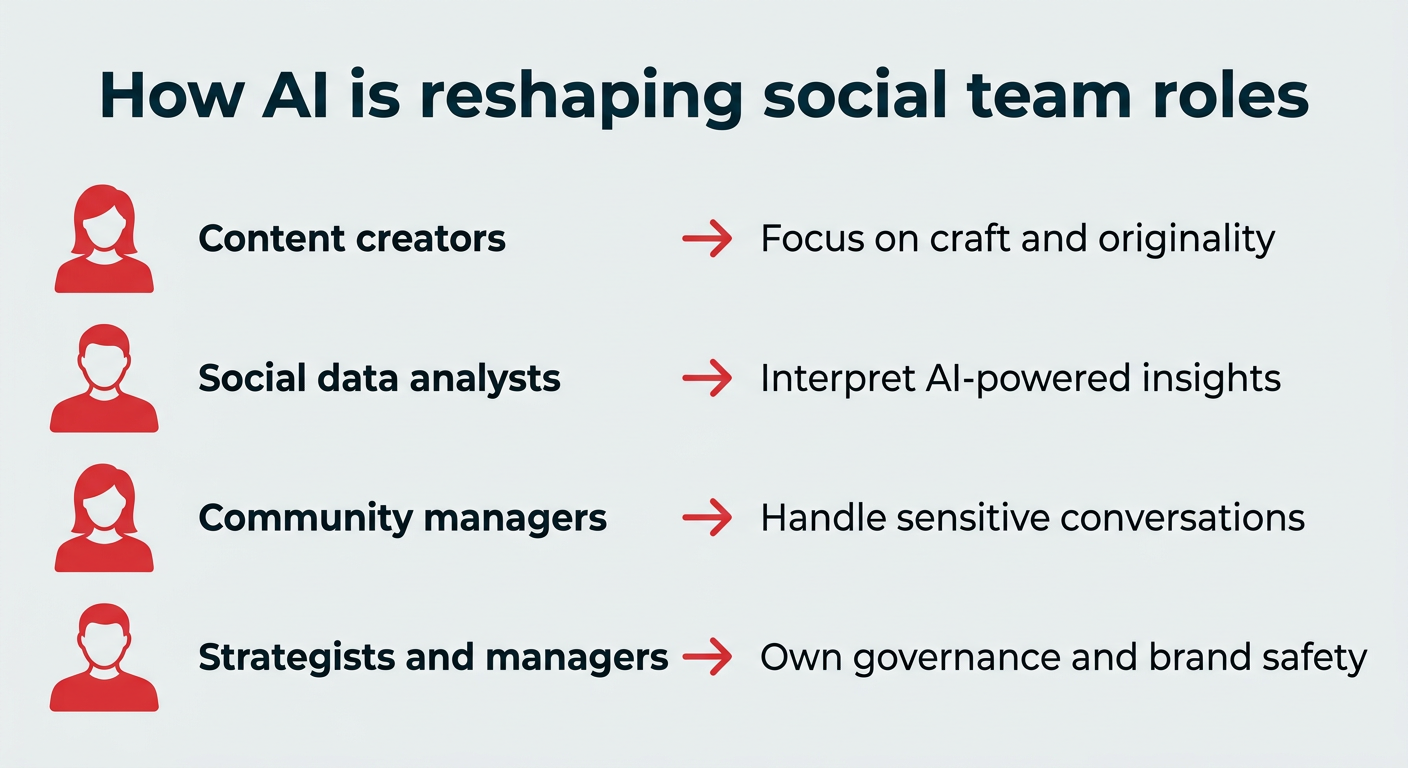
AI isn’t replacing social media teams; it’s changing what they do. In 2026, the most effective teams are using AI to automate the “work about work” so they can focus on strategy and high-value creativity.
Here’s how roles are shifting:
- Content creators: Use AI-powered ideation to move faster from concept to first version, then focus their time on craft and originality
- Social data analysts: Lean on AI-powered insights for pattern detection across large volumes of data, and spend more time interpreting what it means for strategy
- Community managers: Use automated triage and suggested replies to handle routine volume, and step in personally on sensitive or high-value conversations
- Strategists and managers: Spend more time on governance, brand safety, and deciding which AI outputs are good enough to publish
The skill mix is shifting too, driven by broader changes across social media. Alongside traditional social skills, teams increasingly need people who can write effective prompts, interpret data confidently, and set guardrails for how AI is used on brand accounts.
Structurally, this means small teams can cover more ground than they could a few years ago. But strategic and governance roles become more important, not less, because someone still has to own quality, compliance, and brand voice.
Essential tools and workflows for social media teams
Your social media team tools should reduce coordination work, not add to it. A high-performing team needs a single source of truth for three things: what’s being published, who’s talking to customers, and how it’s all performing.
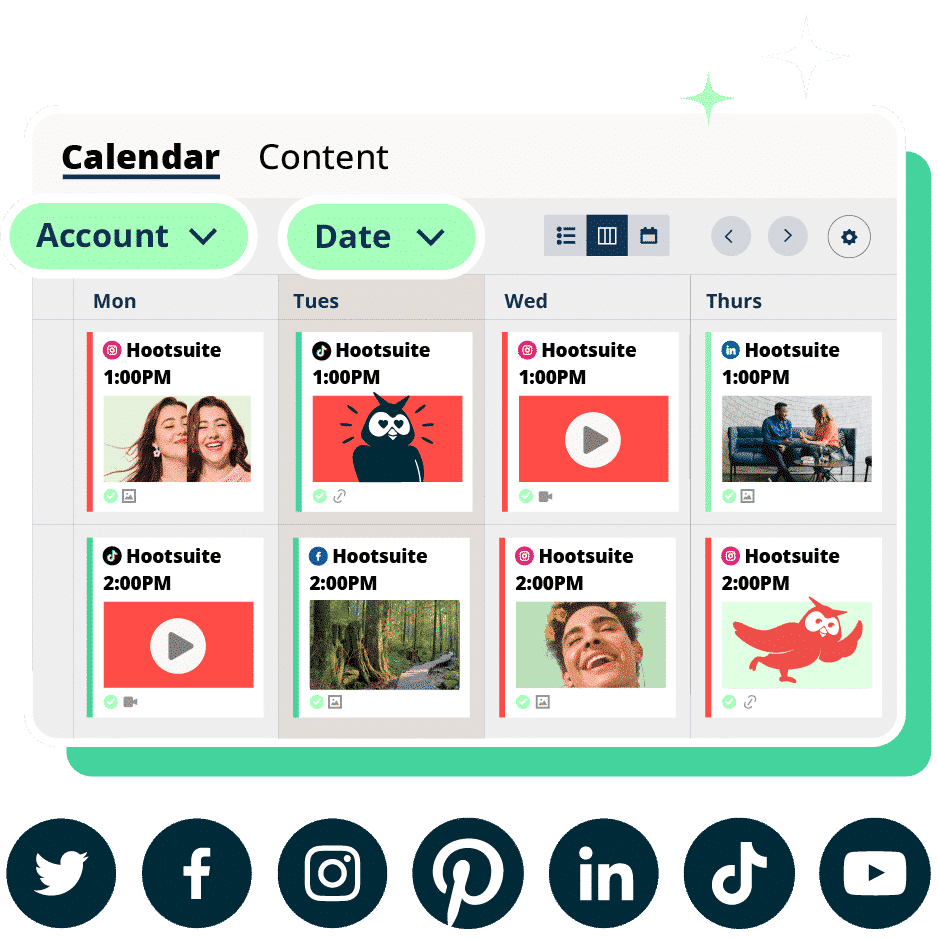
- A shared content calendar: This prevents double-posting and ensures a consistent mix of content across channels.
- Unified engagement tools: A shared inbox ensures that no DM or comment falls through the cracks, regardless of who is on shift.
- Connected analytics: Performance data should be accessible to the whole team so your analyst isn’t exporting spreadsheets to answer basic questions.
For teams operating across regions or brands, permissions and approval workflows keep publishing governed as you scale.
Whatever stack you choose, the goal is the same: fewer handoffs, clearer ownership, and one source of truth for what’s published and how it performed.
FAQ: Social media team
What roles and responsibilities make up a high-performing social media team?
How do enterprises structure social media teams across regions and functions?
What tools and workflows do social media teams need to collaborate effectively?
How do you scale a social media team without losing brand consistency?
What is the 5 5 5 rule for social media?
How much does it cost to hire a social media team?
What is the ideal social media team size?
Should I hire an in-house social media team or an agency?
Save time managing your social media marketing strategy with Hootsuite. Publish and schedule posts, find relevant conversions, measure results, and more â all from one dashboard. Try it free today.
The post How to build a social media team in 2026 appeared first on Social Media Marketing & Management Dashboard.