
Key takeaways
- A social listening strategy is a structured plan that connects social data to specific business goals, not just a list of keywords you happen to track.
- The strongest strategies include five things: Clear goals, prioritized keywords and channels, defined metrics, a regular review cadence, and a plan for sharing insights across teams.
- AI-powered social listening surfaces patterns faster than manual monitoring. Tools like Hootsuite Social OS can flag sentiment shifts and emerging trends across languages and channels.
- Real brands use social listening to guide product development, source UGC, catch crises early, and inform content decisions.
What is a social listening strategy?
A social listening strategy is a plan for using social listening to gather information that can help your business succeed. It defines what you track, why you track it, how often you review it, and who sees the results.
Like any good strategy, a social media listening strategy starts with clear goals. From there, it’s all about planning how to gather the right data to support those goals.
You’ll also need to include a plan for analyzing your data and sharing your results and strategic recommendations.
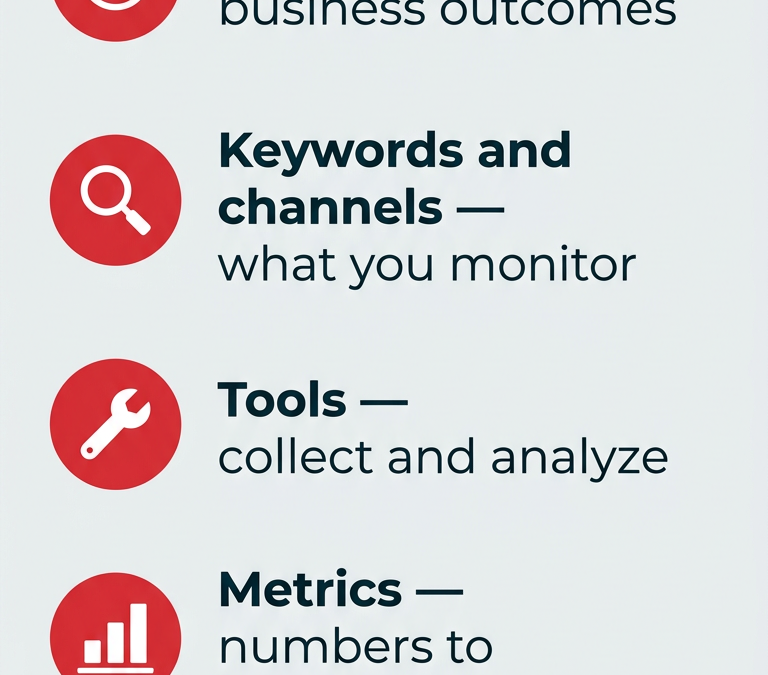
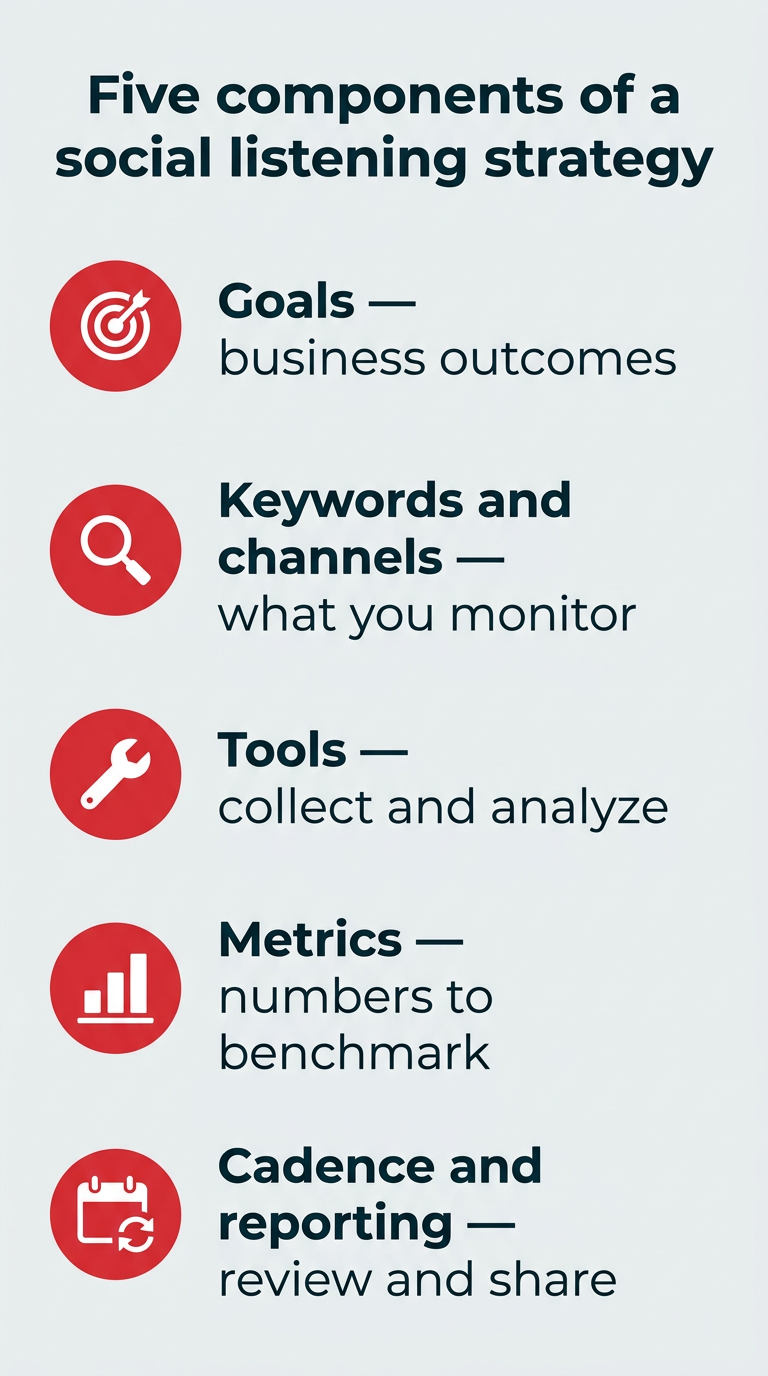
In practice, a complete social listening strategy usually covers five components:
- Goals: The business outcomes your listening supports, from reputation management to product research.
- Keywords and channels: The brands, products, competitors, topics, and platforms you monitor.
- Tools: The listening and monitoring platform you use to collect, filter, and analyze the data.
- Metrics: The numbers you report on and benchmark over time.
- Cadence and reporting: How often you review data and who receives which insights.
The difference between a strategy and ad-hoc listening comes down to intent. Ad-hoc listening answers questions after someone asks them. A strategy decides in advance which questions matter, then builds a repeatable process for answering them.
What is the difference between social listening and social monitoring?
Social listening and social monitoring are related, but they answer different questions. Monitoring tracks individual mentions and conversations so you can respond to them. Listening analyzes patterns across those conversations so you can make better decisions.
Here’s how the two compare:
|
Dimension |
Social monitoring |
Social listening |
|---|---|---|
|
Focus |
Individual mentions, comments, and DMs |
Patterns, themes, and sentiment across many conversations |
|
Scope |
Usually your own brand and tagged mentions |
Your brand, competitors, industry, and untagged conversations |
|
Timeframe |
Real time and day to day |
Trends over weeks, months, and quarters |
|
Output |
A reply, a resolved ticket, an escalation |
An insight, a recommendation, a strategic shift |
|
Typical owner |
Community and customer care teams |
Social, insights, product, and leadership teams |
Most organizations need both. Monitoring keeps your response times fast, while listening tells you what those responses add up to. A good strategy treats monitoring as one input into your broader listening program rather than the whole program.
Why do you need a social listening strategy?
A social listening strategy helps you listen with purpose. It keeps your efforts focused, actionable, and tied to real business impact.
That focus matters more than it used to. With social media reaching 5.75 billion users in 2026, social listening is one of the fastest ways to understand what customers think — and without a plan it’s easy to drown in mentions while missing the signals that count.
Here’s how a strategy makes all the difference:
Focus your listening on what matters most
Instead of tracking every possible conversation, a strategy helps you decide what’s actually worth tracking. With clear goals in mind, you can zero in on insights that support smarter decisions.
Unfocused listening tends to create the opposite problem. You end up with thousands of mentions, no clear priority, and a team that stops opening the dashboard.
Turn data into direction
A social listening strategy creates a clear path from insight to action. Rather than collecting data and letting it sit in a dashboard, you can translate what you hear into actionable intelligence and next steps.
For example, if sentiment around your checkout process drops for three weeks straight, that insight becomes a ticket for the product team rather than a chart nobody reads.
Move from reactive to proactive
Without a strategy, social listening can feel like putting out fires. You only respond when something goes wrong.
But with one, you can spot trends, changes in brand sentiment, and early warning signs of potential issues before they snowball. You know which conversations require quick action, and which point to bigger shifts.
Tie social listening to real business impact
A strategy makes sure your social listening efforts connect to real business goals. You’re not collecting data for the sake of it. You’re using what you learn to improve customer experience, protect your brand name, keep a positive online presence, and more.
That connection also helps you defend the program internally. When more than half (56%) of social marketers say their bosses don’t understand social media, tying listening insights to business impact is how you change that perception.
TL;DR: A social listening strategy brings focus, purpose, and direction. It turns social data into valuable insights that actually move the business forward.
What are the core social listening techniques?
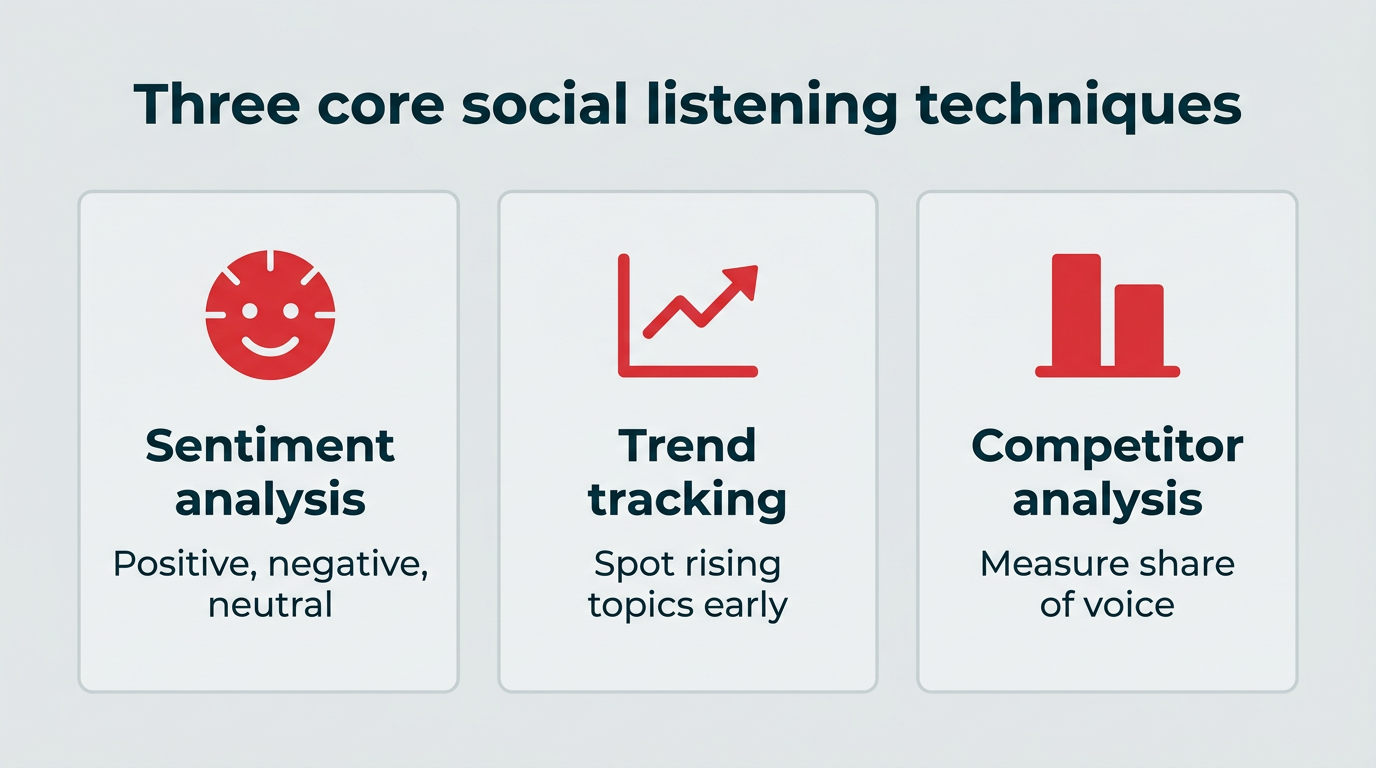
Before you build your strategy, it helps to understand the techniques you’ll actually be using. Most social listening programs rely on the same three methods, applied to different goals.
What is sentiment analysis?
Sentiment analysis classifies conversations as positive, negative, or neutral so you can see how people feel, not just how often they mention you. Modern tools use natural language processing to interpret tone, sarcasm, and context across large volumes of posts.
For strategy purposes, the value is in the trend line rather than any single post. A steady sentiment score tells you your brand health is stable. A sharp dip tells you something changed, and gives you a starting point for finding out what. Pairing sentiment with volume is even more useful: a spike in mentions with falling sentiment usually means a problem, while a spike with rising sentiment often means a campaign is working.
What is trend tracking?
Trend tracking looks for topics, hashtags, and phrases that are gaining momentum in your industry before they hit their peak. That early signal is what makes social listening useful for planning rather than just reporting.
Content teams use trend data to decide what to create next. Product teams use it to spot demand for features, formats, or ingredients customers are asking about repeatedly. The key is separating short-lived spikes from sustained shifts, which is why a consistent review cadence matters more than a single snapshot.
What is competitor analysis?
Competitor analysis applies the same listening methods to the brands you compete with. You track their mentions, sentiment, campaign reactions, and share of voice alongside your own.
Done well, this is one of the highest-value uses of social media intelligence. Complaints about a competitor’s product show you gaps you can fill. Praise shows you what customers in your category value. And share of voice gives you a benchmark that leadership actually understands.
How do you build a social listening strategy in 6 steps?
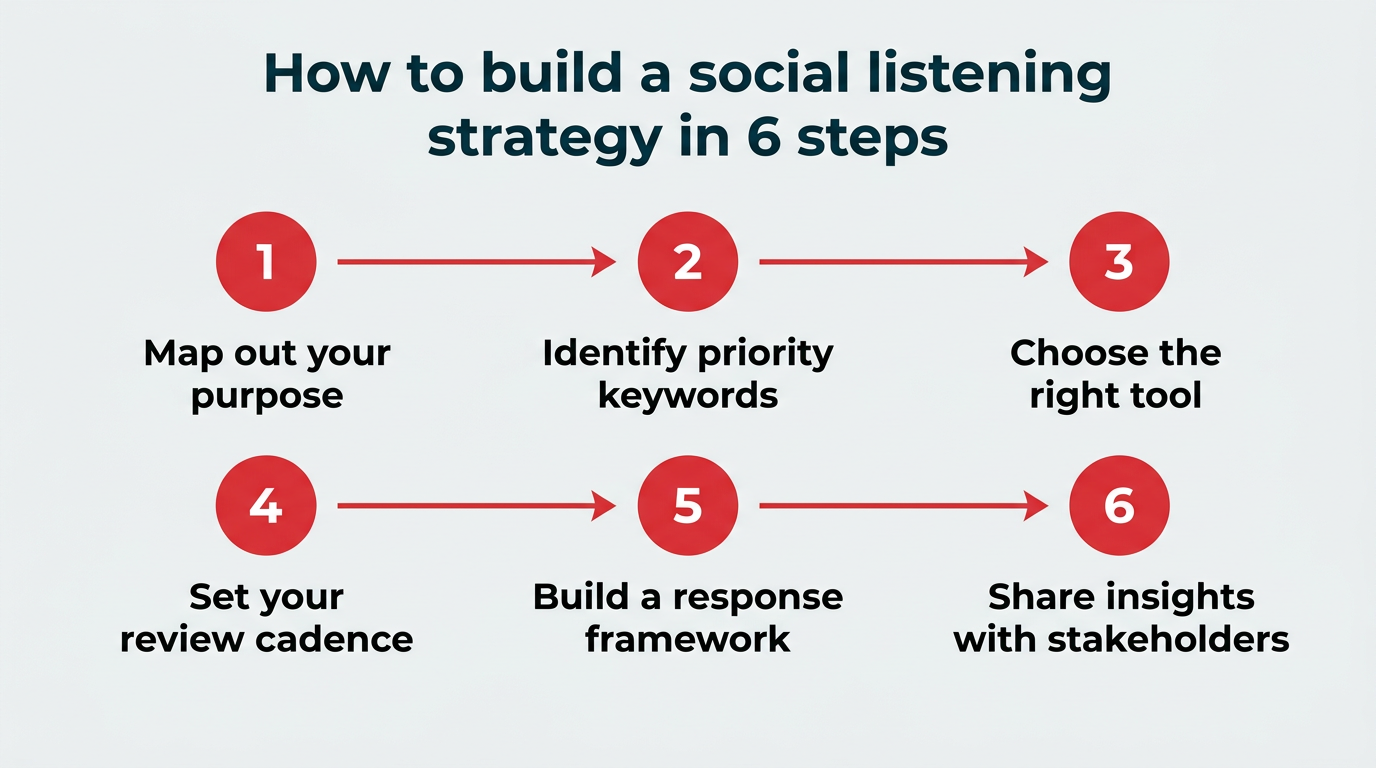
You can build a strong social listening strategy by following these steps:
- Map out your purpose
- Identify priority keywords and topics
- Choose the right social listening tool
- Set your review cadence
- Build a response framework
- Share insights with stakeholders
1. Map out your purpose
To use social listening strategically, you need clear goals for your social listening plan.
For instance, you could use social listening for:
- Reputation monitoring
- Crisis prevention and management
- Audience or market research (pain points, expectations, customer feedback)
- Lead generation
- Competitive intelligence
- Customer engagement
- Brand awareness
- Understanding brand perception
- Sourcing user-generated content (UGC)
- Identifying potential partners and influencers
You don’t have to limit all of your social listening activities to one goal. But you do need to pay attention to what’s most important.
Start by reviewing your organization’s existing strategic goals and KPIs, not just the social team’s goals. After all, social listening can help teams across your org, from customer support to product and digital marketing.
Then, map social listening directly to those organizational goals. Identify the priority areas where social listening can have the greatest impact.
In the process, you’ll develop your own social listening KPIs. These are the backbone of your social listening strategy.
2. Identify priority keywords and topics
Next, plan out the keywords and topics to monitor.
For instance, say you’re focused on reputation monitoring. You’ll want to track mentions of your brand, product names, and executive names.
Or, maybe you’re focused on competitive intelligence.
In this case, you’ll want to watch all the same types of relevant keywords, but related to your top competitors.
It’s also a good idea to follow broader conversations around your industry and specific niche. This approach supports ongoing competitor analysis.
Lastly, clarify which channels to prioritize for your social listening plan. With the right social listening tools, you can monitor multiple social channels from one dashboard. But it’s still worth discussing where you’ll dig up the most useful information.
3. Choose the right social listening tool
Social listening creates a lot of data, so you need the right social listening platform to collect, filter, and analyze what people are saying. Otherwise, you’re left with an overwhelming bowl of data soup.
When you’re comparing options, look for five things:
- Channel coverage: Does it track the platforms your audience actually uses, plus news, forums, and review sites?
- Sentiment analysis: Can it interpret tone at scale, and in the languages your markets speak?
- Real-time alerts: Will it tell you about spikes and sentiment shifts before someone else does?
- Reporting: Can you build reports different stakeholders will read without extra manual work?
- Integrations: Does it connect to the publishing, care, and analytics systems your team already runs on?
Every Hootsuite plan includes social listening tools, and Lumen, the insights and listening app inside Hootsuite Social OS, tracks conversations across all major social channels, including Facebook, Instagram, LinkedIn, X, TikTok, Bluesky, and more.
You can use it to search trending hashtags, brands, and events worldwide, or narrow in on your own brand, products, and competitors. From there, Lumen helps you analyze:
- Key metrics: Are more people talking about you this week? What’s the vibe of their posts? Lumen doesn’t just track what people are saying, it uses sentiment analysis to show how they really feel.
- Top themes: How are people talking about you? What are the most popular positive and negative posts about? Which relevant conversations are you showing up in?
- Results: Ready to get into specifics? The results view shows a selection of popular posts related to your search terms, filtered by sentiment, channel, and more.
On Enterprise plans, listening goes deeper with sentiment over time, top influencers in your space, and audience demographics.
If you want to compare a wider set of platforms first, we’ve rounded up the best social listening tools to help you find the right fit.

#1 Easy Social Listening
Brand mentions, trending topics, and sentiment at your fingertips. Enhance your social strategy with the insights that matter.
4. Set your review cadence
Determine how often you’ll review your social listening data. The right cadence will depend on your goals.
Some social listening data requires (at least) a daily check-in. For example, say you’re using social listening to find customer questions or high-priority conversations. Obviously, you’ll want to check in often.
If you’re using social listening to gather data for longer-term strategy decisions, you can check in less often. That said, you still want to establish a cadence to benchmark changes over time.
You can also use automated alerts in your social listening tool to notify you of spikes in conversation or unexpected changes in social sentiment. That way, you don’t have to rely on someone being logged in at the right moment to catch a problem early.
5. Build a response framework
Once you start listening, you need a plan for how to act on what you find. Not every insight calls for the same response, so it helps to decide this ahead of time. A simple response framework sorts what you hear into three tiers.
- The first type of reaction is day-to-day engagement. These include customer questions, brand mentions, and other conversations that your social team can handle directly.
- Next is the crisis-response reaction. This happens when your social listening strategy flags a potential PR or brand crisis brewing on social media. In this case, the social team should put a crisis management response plan into action.
- Finally, decide how you’ll respond to bigger-picture insights. Social listening will surface trends, patterns, new competitors, and bigger shifts over time. You may not need to react right away, but they should feed into your long-term planning and strategy.
Larger teams should also decide who approves what. Documenting which responses need legal, PR, or executive sign-off, and routing them through governed workflows, keeps fast replies from turning into compliance problems.
6. Share strategic insights with stakeholders
Social listening can help the whole business, but only if the right people see the insights.
That 56% gap in how bosses understand social media is exactly why cross-team reporting matters. Sharing what you’re learning, and why it matters, is how listening earns budget.
A good social listening tool (like Hootsuite) makes this easier by turning data into clear reports. You can share audience insights, rising topics, or industry trends.
It helps to match the format to the audience:
- Real-time alerts: For care, PR, and crisis stakeholders who need to act within hours.
- Weekly summaries: For the social and content teams making near-term decisions.
- Monthly or quarterly reviews: For leadership, product, and CX teams who care about trends, not individual posts.
Not sure how to turn data into clear takeaways? This is an area where AI can really help.
Wisdom, the AI layer in Hootsuite Social OS, combs through large volumes of social data to surface the themes and shifts worth acting on, so your reports lead with findings instead of raw numbers.
3 real social listening strategy examples
Let’s take a look at three social listening strategy examples. These case studies highlight how real brands use social listening to guide business decisions.
As you read, notice how each one maps back to the steps above. Every brand started with a clear purpose, tracked specific topics, and had a plan for who acted on the findings.
1. Yves Rocher: Social listening to guide product development
Yves Rocher is a French beauty brand focused on natural cosmetics and personal care products. The brand must strike a balance between quality and price. At the same time, they want to be at the forefront of developments in the natural beauty industry.
They implemented a social listening strategy with three key goals:
- Understand consumer behaviors related to beauty products and routines
- Gain insights from the scientific community to guide decisions about ingredients and packaging
- Track media coverage to understand public opinion on beauty and cosmetic topics
For instance, Yves Rocher uses social listening to monitor perception of specific ingredients. This allows the brand to identify changing expectations early. They then have time to adjust formulas or develop new products.
They also use social listening to learn about new materials that might make packaging more eco-friendly.
The brand identified some key insights to guide its social media marketing strategy. For example, consumers are no longer focused on using cosmetics to hide flaws.
Instead, they now view beauty products as a component of self-care. They want an inclusive brand that embraces individuality. This insight was crucial in revamping their social media strategy.
2. Zoo Zurich: Sourcing visitor feedback and UGC
Here’s the thing about being a major tourist attraction: people will post a lot of social content about their experiences with your brand. But since they’re not specifically seeking an interaction with you, they won’t always tag you in their posts.
That was the case for Zoo Zurich, a major leisure attraction in Switzerland.
Brand reputation is especially important to Zoo Zurich. It is a nonprofit organization that relies on donor support.
When the social team got serious about tracking mentions of the brand on social media, they soon realized that much of the online conversation about the institution was happening out of view. Visitors were not using tags or brand hashtags.
Identifying this visitor feedback became a driving purpose of Zoo Zurich’s social listening strategy. As did uncovering missed opportunities to engage with social media users.
They now use a social listening tool to get daily reports of all new mentions (tagged or not). They also developed a UGC campaign using the hashtag #FollowerFotoDerWoche (follower photo of the week). Many of the photos shared by visitors later became inspiration for a social media post or UGC feature.
3. Dubai TV Channels Network: Data-driven content production
It seems obvious that social listening data could guide social content creation. But what about brands whose main offering is content? For them, this data can steer production decisions, too.
Dubai TV Channels Network created a social listening strategy with two main goals in mind:
- Gauge customer sentiment. Understand overall satisfaction with the network and steer marketing campaigns.
- Get real-time feedback on individual shows as they air. Then, use this information to guide future production decisions.
Social listening gives Dubai TV Channels Network rich data about audience reactions to a show. They know how viewers feel about everything from plot lines to specific characters. They gather this data across multiple social media platforms in several languages.
Dubai TV Channels Network’s social listening reports display positive and negative sentiment changes after each episode airs. Then, the social team sets up reports to send automatically on a weekly basis to relevant stakeholders. (They also send monthly reports to departments that don’t need real-time data.)
Based on the ability to gather such rich, actionable insights, the organization shifted its strategy to prioritize audience feedback to optimize future seasons.
FAQ: Social listening strategy
What is a social listening strategy?
What is the difference between social listening and social monitoring?
How does social listening help improve brand reputation and customer insights?
What are best practices for creating a social listening strategy for global brands?
What metrics matter most in a social listening strategy?
How can social listening tools be used for competitive analysis?
How often should you review social listening data?
Can ChatGPT do social listening?
What are the best social listening tools for enterprises in 2026?
How do you measure the ROI of social listening?
Save time managing your social media marketing strategy with Hootsuite. Publish and schedule posts, find relevant conversions, measure results, and more â all from one dashboard. Try it free today.
The post How to build a social listening strategy in 2026 appeared first on Social Media Marketing & Management Dashboard.