
Key takeaways
- Social media compliance tools help enterprises manage regulatory risk, approval workflows, archiving, and audit readiness across every social channel.
- The right tool depends on your industry, team size, and regulatory requirements, so there is no single best option for every organization.
- AI governance is now a core compliance requirement, not an optional add-on, as teams use generative AI to create and publish social content.
- Implementation success depends on cross-functional ownership (marketing, legal, IT) and practical onboarding, not just the technology itself.
What are social media compliance tools?
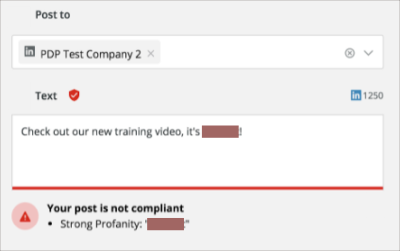
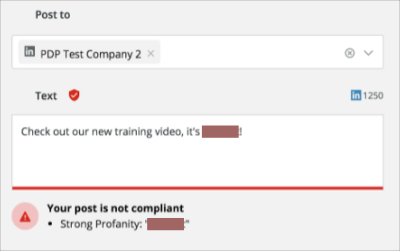
Social media compliance tools are software platforms that help organizations operate within legal parameters, company guidelines, and platform-specific rules on social media. Specialized features help enterprises stay compliant, including:
- Automated content screening and alerts
- Real-time monitoring
- Archiving
- Pre-approved content and workflows
Certain industries are more regulated than others, including healthcare, finance, and government. Tools help internal teams publish without risking fines or regulatory breaches.
What does compliance look like in practice?
In a social media context, compliance tools are systems built to minimize risk when publishing digital content.
This could mean:
- Catching, flagging, and archiving a post with prohibited language
- Making sure disclosures or disclaimers meet standards
- Logging edits so auditors can keep track of activity
- Locking down permissions so only approved people or teams can publish
A real-world example: In healthcare, protecting patient dignity and confidentiality is non-negotiable. That’s why clinics need strict staff social media policies and compliance controls.
When a former employee at a Santa Barbara clinic posted a video mocking patients, the clip went viral. Sutter Health launched an investigation. They terminated the employees involved and reinforced social media policies. The organization avoided fines, likely due to its clear, enforceable social media compliance policy.

Source: Santa Barbara Independent
How compliance tools differ from generic social media management platforms
Compliance tools focus on risk management and mitigation, which generic social media tools don’t cover. But many compliance tools also include standard features like planning, publishing, and reporting.
Despite that, a compliance tool’s main job is to be compliant on social media. “I prefer tools that do their primary job well over do-it-all suites,” says Jason Sanders, Senior Digital Marketing Lead at UBC.
“Social media management tools need to post our content perfectly, allow us to personally engage with our community humanely at scale, seamlessly manage review and approval workflows, and generate useful reports.”
Here’s how the two categories compare at a glance:
| Capability | Generic social media management tool | Social media compliance tool |
|---|---|---|
| Content scheduling and publishing | Yes | Yes (with pre-publish review gates) |
| Approval workflows with legal/compliance sign-off | Limited or manual | Built-in, multi-tier governance |
| Automated risk and policy violation detection | No | Yes (keyword flagging, lexicon-based screening) |
| Tamper-proof archiving and audit trails | No | Yes (regulatory-grade recordkeeping) |
| Role-based permissions and access controls | Basic | Granular, policy-enforced |
Common features compliance tools have that generic social media tools do not:
- Automated content risk screening
- Approval workflows with governance control
- Real-time monitoring for policy violations
- Archiving and audit trails
- Policy enforcement capabilities and access controls
Compliance tools also deliver a distinct return on investment for enterprise teams. Avoiding fines is part of it, but the bigger payoff is protecting your brand reputation and its relationship with its audience. Gartner predicts enterprises will spend $30 billion combating misinformation and disinformation by 2028.
The real ROI of compliance tools? Sanders jokes it’s “Emails from legal.”
But he goes on to say that, “The true measurement is negative feedback or engagement from our audiences. Fines are one of the consequences, but when you do it right, your leading indicator should be ensuring your audience receives factual, accurate information so they can make informed decisions.“
Why do enterprises need social media compliance tools in 2026?
Enterprises need compliance tools because they now operate across more platforms, regions, and teams than ever before, and regulatory scrutiny has intensified significantly over the past decade.
Social is no longer “just marketing.” It’s an extension of:
- Corporate communications
- Customer service
- Investor relations
- Risk management
Every post, comment, DM, and approval has legal, financial, and brand reputation risks. Compliance tools give enterprises the guardrails they need to move fast without breaking laws, contracts, or trust. Here’s why they’re essential:
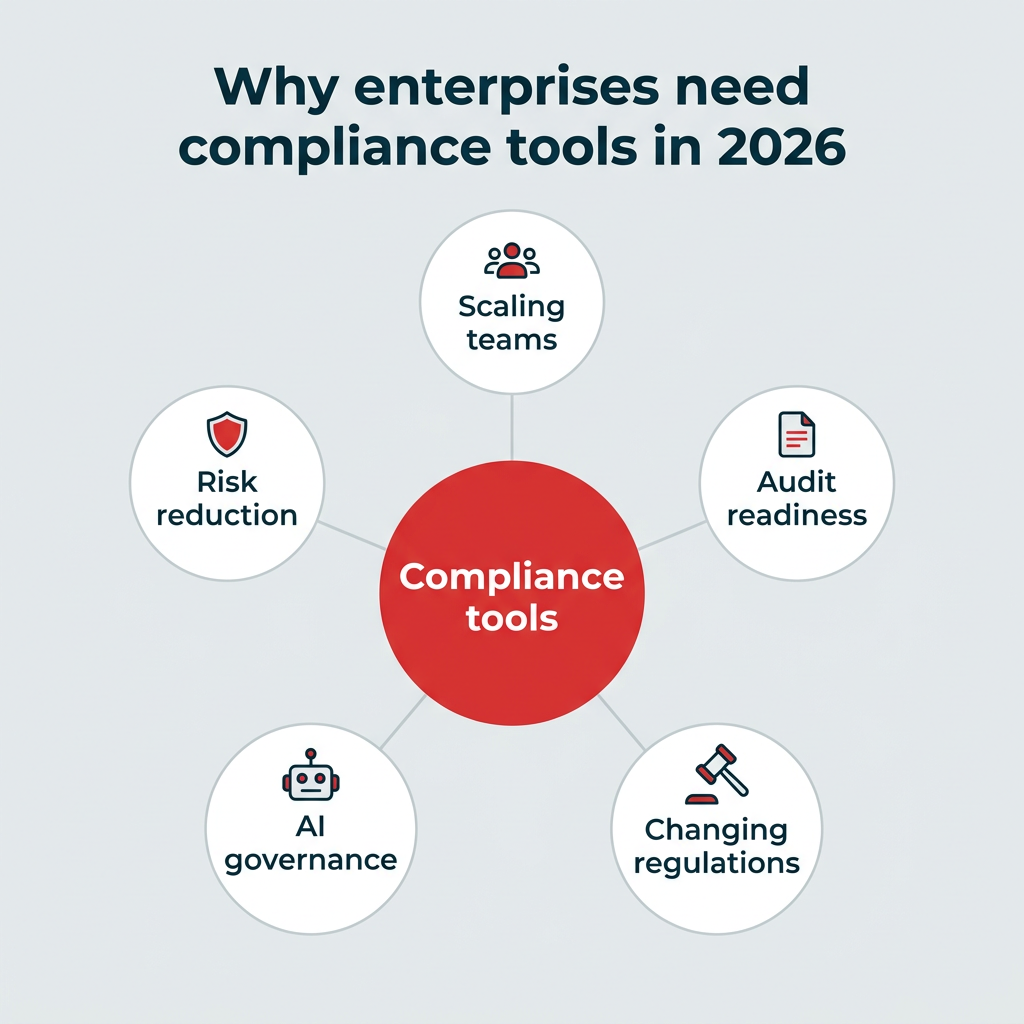
- Scaling distributed teams: As organizations grow across regions, compliance tools centralize governance so local teams can publish without creating regulatory exposure.
- Meeting archiving and audit requirements: Regulations in financial services, healthcare, and government require tamper-proof records of social media activity. Manual tracking doesn’t scale.
- Keeping up with rapidly changing regulations: Privacy laws, platform policies, and advertising rules shift frequently. Tools that update compliance rulesets help teams stay current.
- Managing AI-generated content responsibly: As teams adopt AI for content creation, compliance tools ensure AI-generated posts still go through proper review and meet regulatory standards.
- Reducing legal and financial risk: Automated screening, approval workflows, and real-time monitoring catch problems before they become fines, lawsuits, or reputational crises.
- Empowering speed without sacrificing safety: Pre-approved content libraries and streamlined workflows let teams publish quickly while staying within policy.
What are the most common social media compliance risks?
Most compliance incidents come from a short list of recurring problems, and knowing them makes it easier to see which tool features you actually need. Here are the risks enterprise teams run into most often.
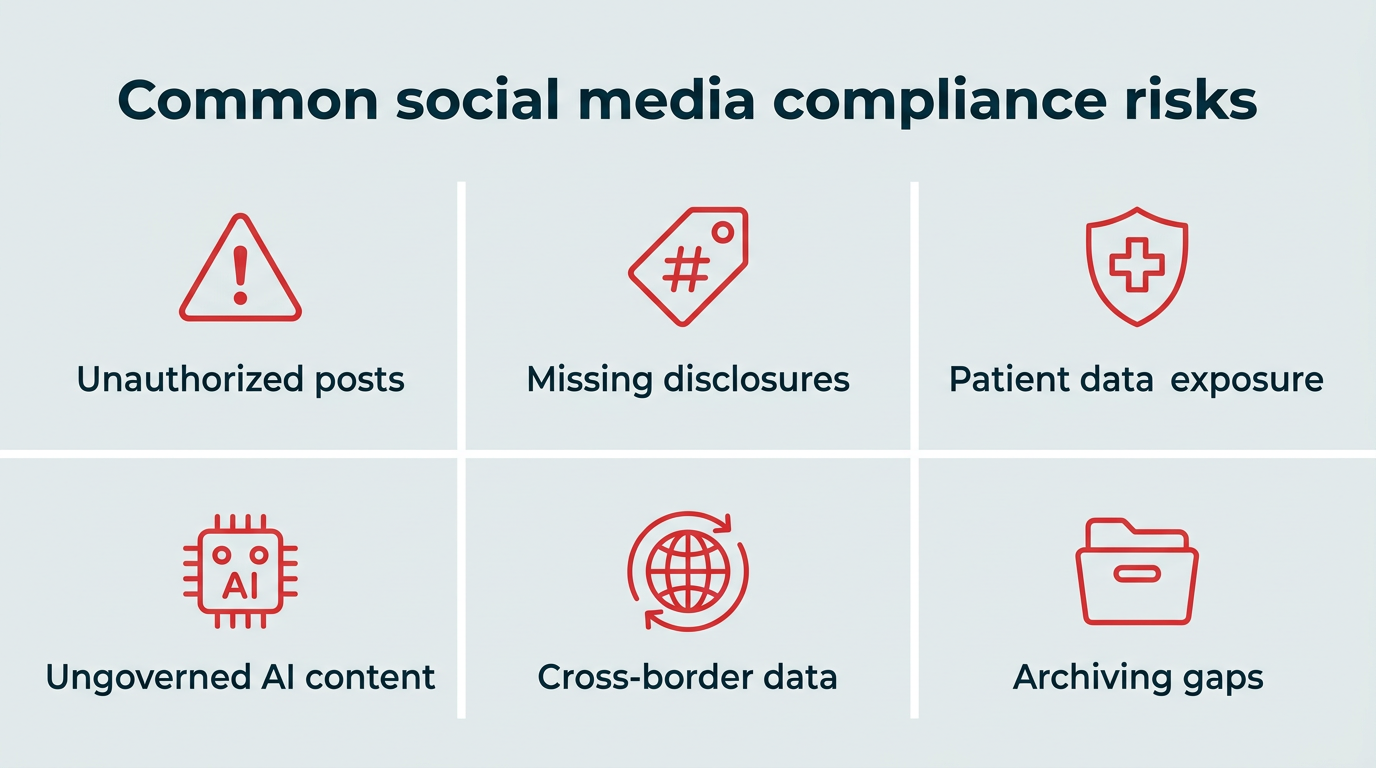
- Unauthorized employee posts: Staff with access to brand accounts, or staff posting about work on personal accounts, can create legal and reputational exposure in minutes. The Sutter Health incident above is a clear example.
- Missing FTC disclosures: Influencer partnerships and sponsored content require clear disclosure of material connections. Brands remain responsible for what their partners publish.
- Patient information exposure: In healthcare, sharing identifiable patient details without documented consent is a HIPAA violation, not just a bad look. Even a background detail in a photo can trigger one.
- Ungoverned AI-generated content: Generative AI can produce claims, statistics, or promotional language that never passed a compliance check. Without review gates, that content reaches the public unverified.
- Cross-border data transfers: Collecting engagement or customer data in one region and storing it in another can breach GDPR, LGPD, or PIPEDA requirements around data residency.
- Failure to archive regulated communications: Financial services and public sector organizations must retain posts, comments, and DMs for set periods. Deleted or unlogged content can turn a routine audit into an enforcement action.
- Rogue or abandoned accounts: Old regional pages, former employee logins, and unofficial accounts sit outside your governance model and often outside your monitoring, too.
- Unmoderated comments and DMs: User replies can contain personal data, unauthorized advice, or defamatory claims that your organization is expected to manage.
Each of these risks maps to a specific tool capability, whether that’s screening, permissions, archiving, or monitoring, which is why feature fit matters more than brand name.
What regulations apply to social media compliance in 2026?
The regulatory landscape for social media varies by industry and region, but enterprise teams typically encounter a few major frameworks. Understanding which rules apply to your organization is the first step toward choosing the right compliance tool.
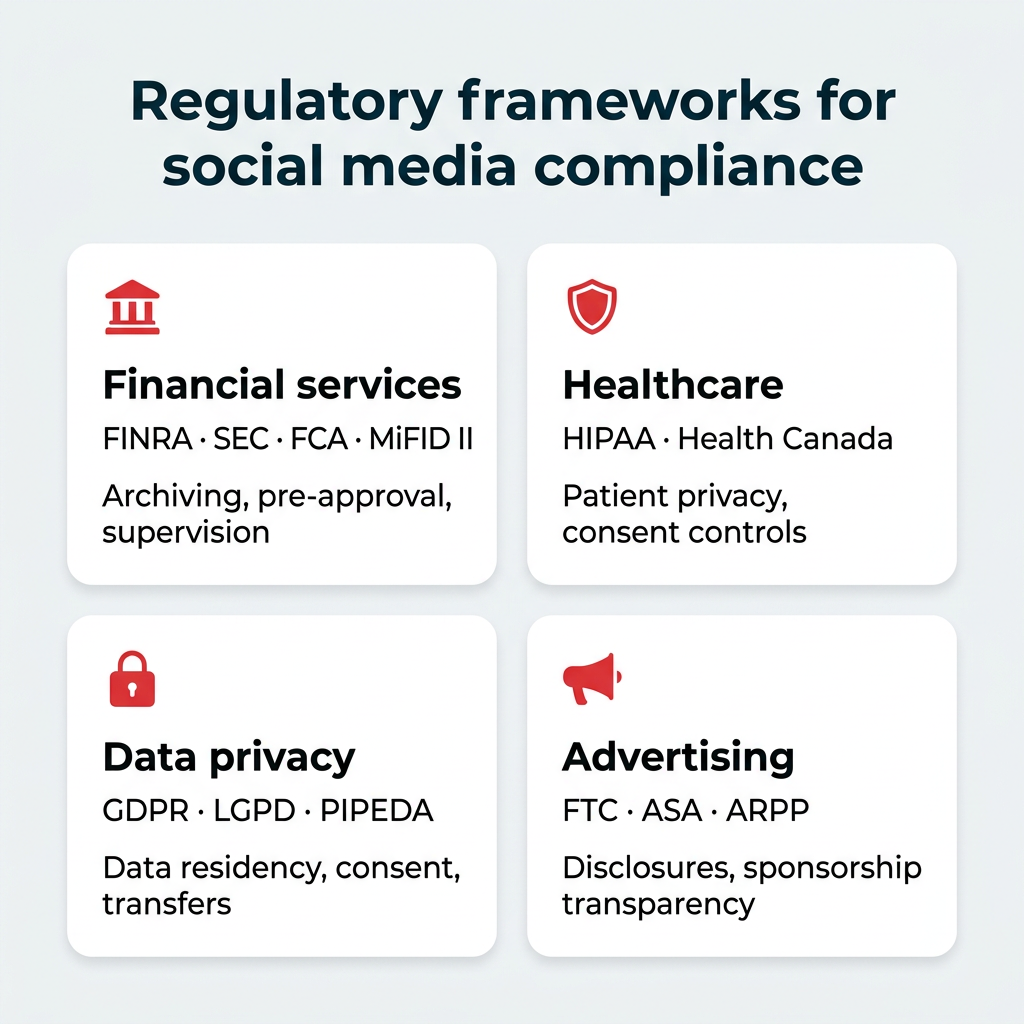
Financial services (FINRA, SEC, FCA, MiFID II)
Financial firms face some of the strictest social media compliance requirements. In a recent enforcement action, an online brokerage agreed to pay a $350,000 FINRA fine for influencer monitoring lapses. FINRA’s targeted influencer sweep has since resulted in five formal enforcement actions.
In the U.S., FINRA and the SEC require firms to archive all social media communications, pre-approve certain types of posts, and supervise employee activity on social platforms.
In the UK and EU, the FCA and MiFID II impose similar obligations around recordkeeping and fair communication. Key requirements include:
- Pre-approval of public-facing social media communications
- Archiving all posts, comments, and direct messages for mandated retention periods
- Supervision of registered representatives’ social media activity
- Clear disclosures on promotional content
Tools like Red Oak, Smarsh, and Global Relay are purpose-built for these requirements, especially for advisors and broker-dealers.
Healthcare (HIPAA, Health Canada)
Healthcare organizations must protect patient privacy on social media. In the U.S., HIPAA violations for sharing protected health information (PHI) without consent can result in fines ranging from $145 to over $2.19 million per violation category, per year, according to the HHS HIPAA penalty schedule (45 CFR §160.404), with the current inflation-adjusted amounts set out at 45 CFR §102.3.
Even well-intentioned posts, like celebrating a patient’s recovery, can violate privacy law if consent isn’t documented. The Sutter Health case study earlier in this article shows how quickly a social media incident can escalate in a healthcare setting. Compliance tools with strict permission controls and content screening help prevent these violations before they happen.
Data privacy and advertising (GDPR, FTC, LGPD, PIPEDA)
Data privacy regulations affect every enterprise that collects or processes personal data through social media. The GDPR (EU), LGPD (Brazil), and PIPEDA (Canada) all impose requirements around data residency, consent, and cross-border data transfers.
On the advertising side, the FTC requires clear disclosure of sponsored content, influencer partnerships, and material connections. Non-compliance isn’t theoretical. Cumulative GDPR fines have now exceeded €7.1 billion, with social platforms among the most heavily penalized organizations, so enforcement is active and penalties are significant.
Compliance tools with data residency options, disclosure templates, and automated flagging help enterprises navigate these overlapping requirements across regions.
What features should you look for in a social media compliance tool?
Choosing the right compliance software starts with knowing which features actually matter for your organization. Everyone has their non-negotiables when it comes to social media compliance tools.
For Sanders, it’s “simple design and workflow. Often, I’m working with a variety of colleagues at different social media skill levels, and being able to convey the importance of compliance as well as ensuring they understand the actual process is crucial to maintaining consistency and reducing errors.”
Sanders has three main criteria he looks for when vetting enterprise-ready compliance tools:
- Brand recognition. “If I haven’t heard of your company, I trust the tool less,” says Sanders. “There are so many startups that make grand promises but fail to deliver. I can’t spend my time evaluating a tool unless I’ve heard about it before.”
- Recommendations from peers in marketing communities and colleagues at UBC.
- Recency. Look for “anecdotes on Reddit posted within the last year,” says Sanders. “It’s amazing how quickly things shift, and a platform can fall behind or take the lead.”
Here are the features to evaluate when you’re narrowing down your options.
| Feature | Why it’s important |
|---|---|
| Permissions and role management | Prevents unauthorized publishing. Limits access to sensitive accounts. Keeps distributed teams aligned with governance rules. |
| Approval workflows and publishing controls | Ensures legal, brand, and compliance reviews happen before anything goes live. Critical for regulated industries and executive comms. |
| Archiving and record-keeping for audits | Creates tamper-proof logs of posts, edits, approvals, and messages. Meets regulatory requirements and supports internal or external audits. |
| Monitoring and flagging of regulated content | Automatically detects risky language, missing disclosures, or policy violations. Teams can intervene before issues escalate. |
| Real-time takedown and remediation controls | Allows compliance teams to quickly remove or revert non-compliant posts and comments. This is crucial during audits, crisis moments, or regulatory incidents. |
| Integration with CRM, legal, or compliance systems, and analytics | Connects social activity to customer data, legal workflows, and compliance reviews. This enables faster decisions and centralized oversight. |
| Scalability for multi-region and multi-language teams | Supports global operations, regional regulations, and localized content governance without adding manual overhead. |
| Vendor support and regulatory updates | Ensures the tool adapts as policies, platforms, and privacy laws evolve. This reduces the risk of falling out of compliance. |
| Reporting, dashboards, and KPIs | Gives leaders visibility into compliance performance, approval timelines, risk trends, and gaps in governance. |
| Pre-approved content libraries | Gives teams a source of compliant, legally reviewed content they can use instantly. This reduces bottlenecks, rewriting time, and review cycles. |
| Customizable lexicons and compliance rulesets | Compliance teams can tailor risk detection to industry-specific regulations. Examples include FINRA, HIPAA, FCA, MFDA, SEC, FTC, or Health Canada. |
| Data residency and geo-specific storage options | Allows enterprises to comply with GDPR, LGPD, PIPEDA, and other regional data-sovereignty laws by controlling where data is stored. |
| Incident reporting | Lets compliance teams log violations, track remediation, and produce evidence of corrective action for regulators or internal audit. |

A buyer’s checklist for evaluating compliance tools
Not every feature carries the same weight. What counts as a must-have depends on whether you operate in a regulated industry or simply need governance at scale.
Must-haves for regulated industries (financial services, healthcare, government, insurance):
- Tamper-proof archiving with defined retention periods
- Pre-publish screening against customizable lexicons
- Multi-tier approval workflows with legal sign-off
- Supervision of employee and representative accounts
- Data residency controls for the regions you operate in
Must-haves for general enterprise teams:
- Role-based permissions across brands, regions, and accounts
- Approval workflows that don’t slow publishing to a crawl
- Real-time monitoring and alerting on brand risk
- Audit-ready activity logs
Nice-to-haves worth paying for at scale: pre-approved content libraries, incident reporting dashboards, and integrations with your CRM or legal systems. If a tool covers your must-haves and integrates with what you already run, it’s usually a stronger choice than a broader platform that fits none of your workflows well.
How AI is changing social media compliance
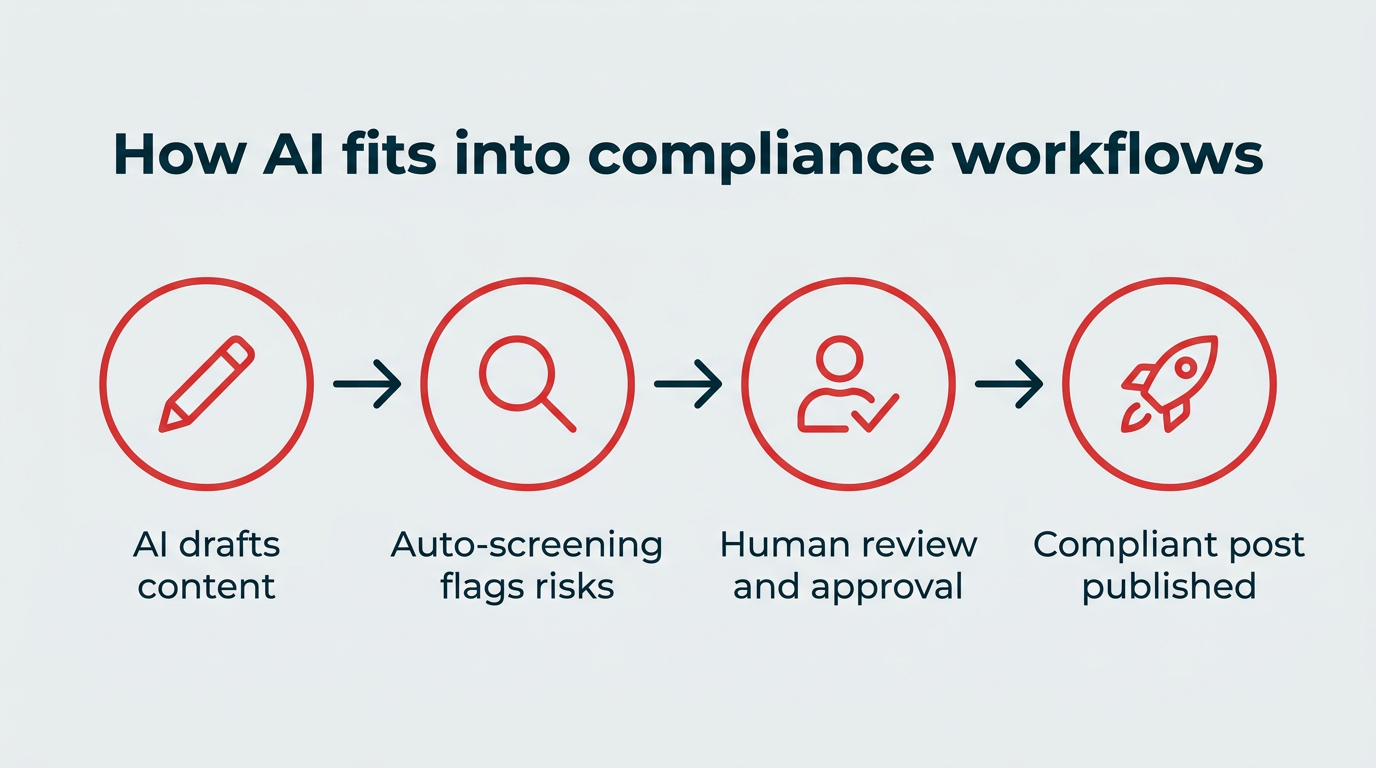
AI is reshaping compliance work in two directions at once: it makes screening faster, and it creates new content that needs screening. Both matter in 2026.
On the detection side, instead of manually reviewing every post, enterprises can use AI-powered tools to automate content screening, flag policy violations in real time, and detect risky language patterns before content goes live. AI can also surface risk in places humans rarely check, like comment threads and DMs at volume.
On the generation side, AI introduces new governance challenges. As teams use generative AI to draft social content, compliance tools need to verify that AI-generated posts still go through proper review and meet regulatory standards, include required disclosures, and align with brand guidelines.
FINRA’s 2026 Annual Regulatory Oversight Report now explicitly expects firms to govern GenAI outputs in customer-facing communications. Ungoverned AI output is a real exposure: a model can invent a performance figure, drop a required disclaimer, or produce advice your legal team would never approve.
Here’s what to look for when evaluating AI capabilities in a compliance context:
- Screening that runs pre-publish, not just after content is live
- Detection tuned to your industry lexicon, not a generic profanity filter
- AI-drafted content routed through the same approval gates as human-written posts
- Logged records of what AI generated, who reviewed it, and what changed
- Listening and alerting that flags emerging brand or regulatory risk in real time
Inside Hootsuite Social OS, this works as connected systems rather than separate bolt-ons. Wisdom supports AI-assisted content creation, Vigil applies the governance layer so nothing publishes outside policy, Perch handles publishing and scheduling, and Lumen surfaces the listening and insights signals compliance teams need to act on quickly.
For teams with heavier regulatory obligations, the Proofpoint integration adds pre-publish compliance review on top.
The short version: look for AI capabilities that augment your compliance process rather than bypass it.
What are the best social media compliance tools for enterprises in 2026?
The best social media compliance software for your organization depends on what you need it to do: publish, screen, archive, supervise, or all four. Here are nine options worth shortlisting, starting with platforms that combine management and governance and moving into specialist archiving and supervision tools.
1. Hootsuite Social OS

Best for: Enterprise and mid-market teams that need compliance controls alongside full social media management. Hootsuite Social OS scales from single-team setups to multi-brand, multi-region operations with complex approval chains. It brings publishing, governance, and listening into one set of connected systems.
Key compliance features:
- Approval workflows. You can make sure the right people review and approve content before it goes live.
- User permissions and governance. You’ll get centralized control over who can post to which social profiles. You can give certain people access to specific social media accounts.
- Vigil as the native governance layer, applying policy checks and role-based controls across everything your teams publish through Perch.
- Real-time compliance violation flagging. With a Proofpoint integration, you can prevent non-compliant posts from getting published.
Hootsuite offers extensive integration options. Take the City of Greater Bendigo, which stayed compliant with Australia’s strict data protection laws by using Hootsuite’s Brolly integration. Hootsuite has plenty of other use cases for data privacy, social media strategy, and reputation management.
Wisdom helps teams draft content faster, while Lumen surfaces brand risks that compliance teams need to act on. Parliament extends governed publishing to employee advocacy programs.
Pros:
- Deep integration ecosystem, including Proofpoint for pre-publish compliance review
- Granular role-based permissions and multi-tier approval workflows
- Scales from mid-market to enterprise with flexible plan tiers
Cons:
- Advanced compliance features like Proofpoint integration require an Enterprise plan
- Does not include built-in tamper-proof archiving (pair with a dedicated archiving tool for regulated industries)
Price: Standard starts at $99/user/month, Advanced at $249/user/month, and Enterprise is custom-priced
Skill level: Beginner to intermediate.
2. Proofpoint
Best for: Those in regulated industries like financial services or healthcare. If you need archiving, record-keeping, and risk mitigation, Proofpoint is for you. For Hootsuite Enterprise users, Proofpoint integrates directly into your workflow.
Key compliance features: Automated classification of content for violations. Removal or rollback of problematic content. Pre- and post-publish review.
Pros:
- Purpose-built for regulated industries with deep compliance automation
- Seamless Hootsuite Enterprise integration for pre-publish review
- Supports both pre- and post-publish content screening
Cons:
- Not a standalone social media management tool; requires pairing with a publishing platform
- Custom pricing can be opaque for smaller teams evaluating options
Price: Custom, quote-based pricing.
Skill level: Beginner to intermediate, depending on your needs.
3. Smarsh
Best for: Financial services firms that need to capture, archive, and supervise communications across social, email, and messaging channels in one place.
Key compliance features: Capture of social posts, comments, and DMs across major networks. Supervision and review queues built for FINRA and SEC obligations. AI-assisted surveillance that flags risky language for compliance review.
Pros:
- Covers social alongside email, chat, and collaboration tools in a single archive
- Well-established with financial services compliance teams and examiners
- Supervision workflows reduce manual review volume
Cons:
- Not a publishing platform, so you’ll still need a social media management tool
- Breadth of modules can make scoping and pricing complex
Price: Custom, quote-based pricing.
Skill level: Intermediate to advanced.
4. Global Relay
Best for: Enterprise-grade archiving and supervision for banks, broker-dealers, asset managers, and other heavily regulated organizations.
Key compliance features: Long-term, tamper-evident archiving of social and electronic communications. Search and export tools built for regulatory requests and litigation hold. Supervision and analytics across captured channels.
Pros:
- Strong recordkeeping credentials with financial regulators across multiple jurisdictions
- Handles very large archive volumes and long retention periods
- Fast search and export for audits and investigations
Cons:
- Focused on archiving and supervision, not day-to-day social publishing
- Onboarding typically requires IT and compliance involvement
Price: Custom, quote-based pricing.
Skill level: Intermediate to advanced.
5. Hearsay Systems
Best for: Advisor and agent networks in banking, insurance, and wealth management, where hundreds or thousands of licensed individuals publish on their own local channels.
Key compliance features: Pre-approved content libraries that field reps can publish from safely. Supervision and review workflows for individual advisor accounts. Activity logging tied to individual representatives.
Pros:
- Built specifically for distributed advisor and agent field networks
- Content libraries keep local publishing on-policy without constant review cycles
- Integrates with common financial services CRM systems
Cons:
- Overbuilt for organizations without a licensed field network
- Usually paired with a separate corporate social platform and an archiving tool
Price: Custom, quote-based pricing.
Skill level: Intermediate.
6. Red Oak
Best for: Financial firms in regulated sectors, such as broker-dealers or advisors who need to be compliant with FINRA and the SEC.
Key compliance features: Dual-console setup where marketers can have a separate console from administrators. Highly configurable lexicons and workflows.
Pros:
- Purpose-built for FINRA and SEC compliance in financial services
- Dual-console design separates marketing and compliance workflows cleanly
- Highly configurable lexicons for industry-specific risk detection
Cons:
- Narrow industry focus means it’s not a fit outside financial services
- Requires upfront configuration of workflows and policies
Price: Quote-based pricing.
Skill level: Mid-level because you will need to configure your workflows and policies.
7. MirrorWeb
Best for: If you need archiving and audit trails of social conversations across multiple channels. This tool is well-suited for government, financial, tech, healthcare, insurance, and legal industries.
Key compliance features: Unified capture of many social media platforms, including LinkedIn, X, Facebook, Instagram, TikTok, and YouTube. The platform also provides a full-context archive and compliance search.
Pros:
- Captures content across a wide range of social platforms in a unified archive
- Full-context search makes audit preparation faster
- Strong fit for public sector and FOIA/open-records requirements
Cons:
- Not a publishing or social management tool; focused purely on archiving and compliance
- Initial workflow configuration can be complex
Price: Customizable enterprise pricing.
Skill level: Mid-level to intermediate. Setup can be tricky if you’re configuring workflows.
8. Pagefreezer
Best for: Public sector agencies, legal teams, and regulated organizations that need website and social media archiving for FOIA, open records, and litigation hold.
Key compliance features: Automated capture of social posts, comments, and edits with timestamps. Evidentiary-quality exports for records requests and legal proceedings. Website archiving alongside social channels.
Pros:
- Records-request workflows built for government and legal use cases
- Captures deleted and edited content, not just what’s currently live
- Covers both web and social in one archive
Cons:
- Archiving-only, with no publishing or engagement features
- Less relevant for brands outside public sector or litigation-heavy contexts
Price: Custom, quote-based pricing.
Skill level: Beginner to intermediate.
9. Sprinklr
Best for: Large enterprises needing full global scale, like Fortune 500 companies. Sprinklr is for large organizations with dedicated teams for social operations, governance, analytics, and compliance.
Key compliance features: Ability to monitor a wide range of social networks. Advanced AI for trend prediction and enterprise compliance, such as System and Organization Controls 2 (SOC 2).
Pros:
- Broad network coverage for global enterprises
- Enterprise-grade AI for trend prediction and compliance monitoring
- Unified platform for social, marketing, and customer experience
Cons:
- High price point puts it out of reach for mid-market teams
- Steep learning curve and long implementation timelines
Price: Custom, quote-based pricing. Sprinklr does not publish enterprise pricing.
Skill level: Advanced.
How to choose the right social media compliance tool
Now that you’ve seen the options, the question is which combination fits your situation. There’s no single “best” compliance tool for every organization. The right choice depends on your industry, team structure, regulatory requirements, and existing tech stack. Use this scenario-based guide to match your situation to the right tool or set of tools.
| Scenario | Best primary tool | Typical tech stack with Hootsuite |
|---|---|---|
| Global brand with lots of markets + complex approvals | Hootsuite Social OS | Hootsuite + Proofpoint |
| Fortune 500 company in heavily regulated industry with many networks | Sprinklr | N/A |
| Mid-to-enterprise level organization in a heavily regulated financial institution (SEC/FINRA, FCA, IIROC) | Hootsuite Social OS | Hootsuite (publishing) + Proofpoint (pre-review) + Smarsh or Global Relay (archive, optional) |
| Small advisor or broker firm in financial industry | Red Oak | Hootsuite (day-to-day social) + Red Oak (monitoring) |
| Public sector / FOIA & open-records requirements | MirrorWeb or Pagefreezer | Hootsuite (day-to-day social) + MirrorWeb or Pagefreezer (archiving) |
| Advisor or agent networks in banking or insurance | Hearsay | Hootsuite (brand + corp channels) + Hearsay (field channels) + Global Relay (archive) |
| Employee advocacy with compliance baked in | Parliament | Hootsuite + Parliament + Proofpoint |
If you’re in a heavily regulated industry, you’ll likely need a combination of tools: one for day-to-day publishing and management, and one or more for archiving, supervision, and pre-publish review.
How to build a social media compliance workflow
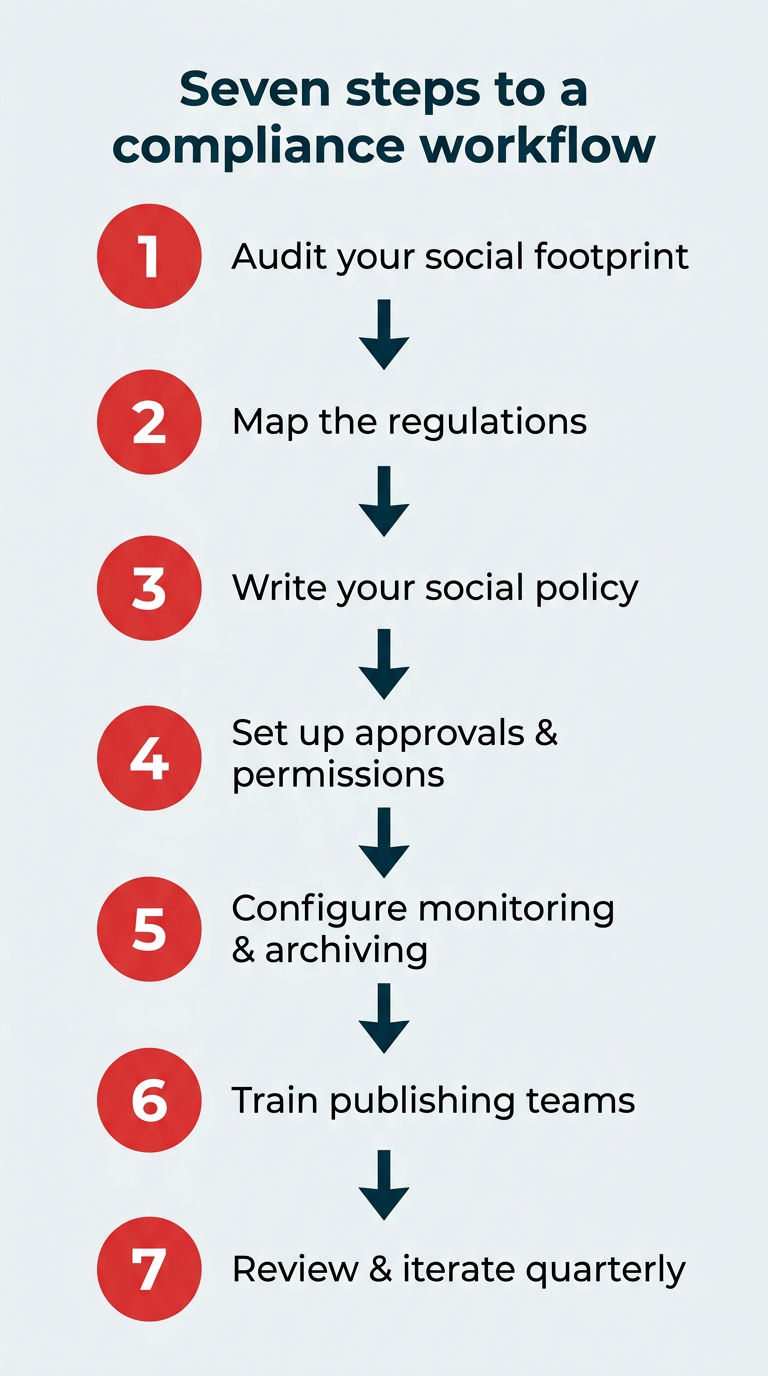
Buying a tool is the easy part. Operationalizing compliance means putting a repeatable process around it. Here’s the short version:
- Audit your current social footprint
- Map the regulations that apply to you
- Write or refresh your social media policy
- Set up approval workflows and permissions
- Configure monitoring, flagging, and archiving
- Train the teams who publish
- Review and iterate on a set cadence
Here’s what each step involves.
1. Audit your current social footprint
List every account associated with your brand, including regional pages, dormant accounts, and profiles run by individual employees or franchisees. You can’t govern what you haven’t inventoried. Note who has access to each one and whether that access is still appropriate.
2. Map the regulations that apply to you
Work with legal or compliance to confirm which frameworks govern your activity by industry and region. A U.S. broker-dealer with EU customers is subject to FINRA, SEC, and GDPR requirements at the same time. Document retention periods, disclosure rules, and supervision obligations for each.
3. Write or refresh your social media policy
Your policy should state clearly what employees can and cannot post, what requires approval, and what happens when the policy is breached. Keep it specific enough to act on. A vague policy gives teams nothing to check their work against.
4. Set up approval workflows and permissions
Configure role-based permissions so only approved people can publish to sensitive accounts, then build approval chains that route content to legal or compliance where required. Match the number of review tiers to actual risk. Over-engineering approvals is the fastest way to get teams working around the system.
5. Configure monitoring, flagging, and archiving
Load your industry lexicon into your screening tool so risky terms and missing disclosures get flagged before publishing. Set up capture of posts, comments, edits, and DMs at the retention periods your regulators require. Confirm the archive is tamper-evident and searchable, not just a folder of exports.
6. Train the teams who publish
Everyone with publishing access needs to understand the policy, the workflow, and the reasoning behind both. Sanders’ point about simple design applies here: if colleagues at different skill levels can’t follow the process, they’ll make errors regardless of what the tool can do. Run refreshers when policies or platforms change.
7. Review and iterate on a set cadence
Schedule a quarterly review of flagged content, approval bottlenecks, incident reports, and any regulatory changes. Adjust lexicons, permissions, and workflows based on what the data shows. Compliance is a standing operational responsibility, not a one-time implementation project.
FAQ: Social media compliance tools
What is a social media compliance tool?
Why do enterprises need social media compliance tools?
How much do social media compliance tools cost?
What features should I look for in a social media compliance tool?
Can social media compliance tools prevent GDPR or HIPAA violations?
Do I need a separate tool for archiving and compliance?
What are the best social media monitoring tools for compliance?
How do social media compliance tools handle AI-generated content?
What industries need social media compliance tools the most?
How do I get started with social media compliance?
Save time managing your social media marketing strategy with Hootsuite. Publish and schedule posts, find relevant conversions, measure results, and more â all from one dashboard. Try it free today.
The post 9 best social media compliance tools for 2026 appeared first on Social Media Marketing & Management Dashboard.