
What is an employee advocacy program?
An employee advocacy program is a structured initiative that encourages employees to share company-approved content on their personal social media accounts to extend brand reach and build trust.
It’s a powerful part of any social media marketing and content strategy. Instead of relying only on your brand’s accounts to do the talking, employees post about your company on platforms like LinkedIn, X, or wherever they’re already active.
Sometimes that content is promotional, like a new campaign, product launch, or company milestone. Other times it’s cultural, offering a peek into what it’s actually like to work at your company.
The reason it works is simple: people trust other people more than they trust corporations. In fact, 88% of consumers say trusting a brand is an important or critical purchase criterion, on par with quality and value, according to Edelman.
When your employees share authentic stories, it humanizes your brand, boosts your organic reach, and helps you connect with your target audience in ways standard corporate messaging just can’t.
Successful employee advocacy programs are built on:
- Clear marketing goals
- Measurable KPIs to track performance
- Easy-to-share content and guidelines for employees
The benefits for the company are wide-reaching:
- Increased brand awareness,
- Improved reputation,
- Boosted engagement, and
- Talent recruitment, to name a few.
In short, every employee share strengthens both your internal company culture and your external trust, turning your team into your most credible marketing channel.
Informal advocacy vs. structured programs: what’s the difference?
The difference between informal advocacy and a structured program comes down to intention.
- Informal advocacy: Spontaneous and personal. Genuine, but unpredictable. You can’t count on it, measure it, or repeat it.
- Structured programs: Intentional, consistent, and built to scale, because employees get the tools, content, and guidelines they need to share regularly.
Most successful employee advocacy programs include:
- Curated content hubs: Where employees can access pre-approved content
- Training and resources: To help staff build their personal brand while staying on-message
- Incentives or recognition: That encourage ongoing participation
- Measurement and analytics: To track reach, engagement, and business impact
A platform like Parliament, the employee advocacy app inside Hootsuite Social OS, makes this simple. Employees get a curated feed of pre-approved content they can post in a few taps, while admins measure performance across every share, gamify participation with leaderboards, and keep posts aligned with brand and legal guidelines.
Summary: Informal advocacy is spontaneous and personal. Structured programs are intentional and strategic.
Why do companies invest in employee advocacy programs?
Companies invest in employee advocacy programs because they drive real business outcomes: wider reach, stronger reputation, better recruitment, and more pipeline, all at a fraction of the cost of traditional marketing.
To understand what this looks like in practice, we chatted with Victoria Samways, Marketing & Brand Manager at Major Tom, and a long-time user of Hootsuite’s employee advocacy tools.
“Our employees are very powerful brand ambassadors,” says Samways. “Each employee can easily have hundreds of connections on LinkedIn alone. Multiply that by the number of employees a brand has, and that’s a large audience.“
Here are the top employee advocacy benefits:
- Expanded brand reach and awareness
- Stronger talent attraction and recruiting
- Improved brand reputation and trust
- Higher organic engagement
- Sales pipeline and lead generation
- Career and personal brand benefits for employees
1. Expanded brand reach and awareness
Collectively, employees have a wide social reach. Tapping into your employees’ networks is one of the easiest ways to reach new audiences without spending a dollar on paid media. And it also feels more authentic.
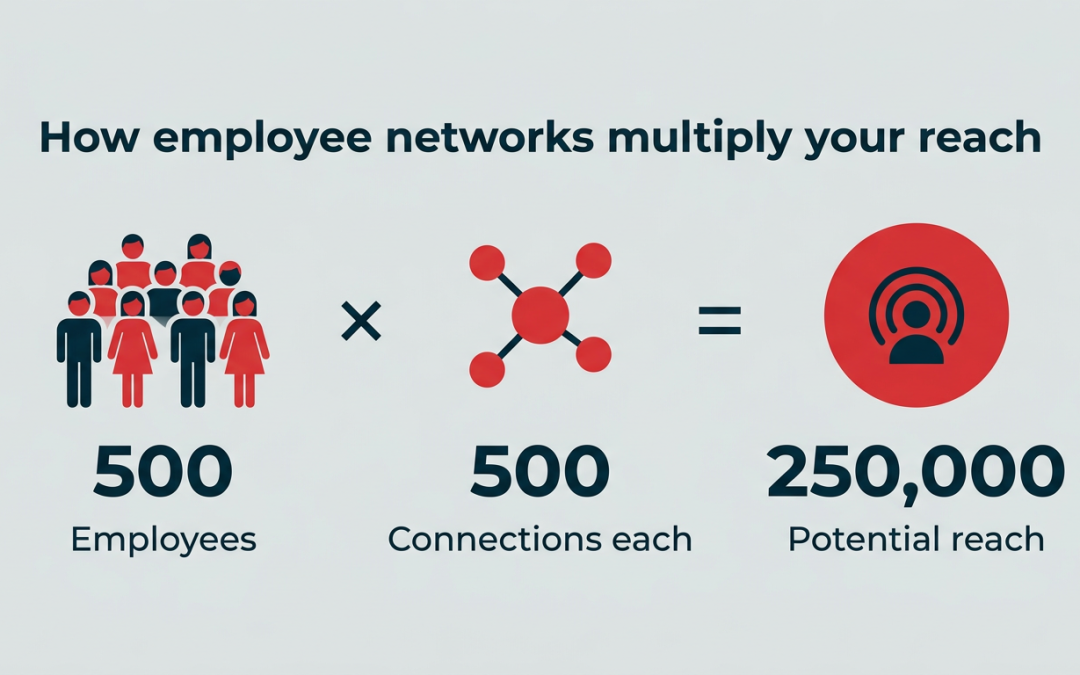
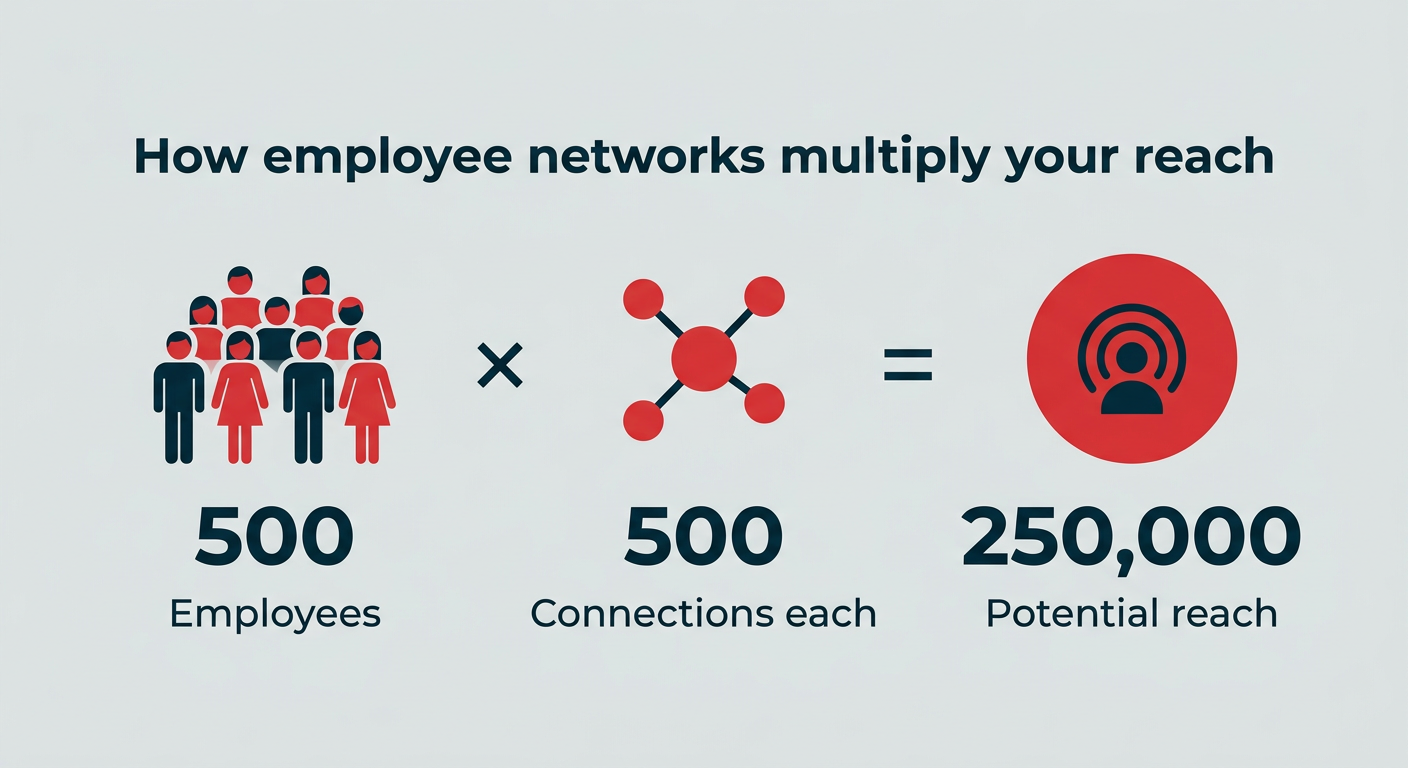
The math is straightforward. A company of 500 employees with 500 LinkedIn connections each has access to a potential audience of 250,000 people, most of whom will never follow the brand page. That’s why brand reach is usually the first metric advocacy programs move.
2. Stronger talent attraction and recruiting
A careers page can promise great culture all day long, but a real employee sharing what it’s actually like to work there? That’s way more convincing.
When teams post authentically about their work (wins, projects, team moments, or even just what a typical day looks like), it offers a genuine peek at the employee experience.
That kind of insider view is hard to fake, and it could be the difference between a candidate applying or scrolling past. As you’ll see in the DaVita example below, advocacy-driven employer branding can lift application volume by triple digits.
3. Improved brand reputation and trust
Humanizing your brand is easier when real people do the talking. Employers are the most trusted institution at 78% according to the 2026 Edelman Trust Barometer, so when employees genuinely enjoy their work and share it, that trust translates into external credibility.
Even posts that aren’t directly about your brand still have a positive knock-on effect. People don’t tend to post about places they dislike (unless it’s to complain), so any positive mention becomes a subtle vote of confidence.
4. Higher organic engagement
Employee advocacy boosts organic engagement because algorithms tend to reward personal accounts over company pages. Metricool’s analysis of 673,000+ posts found that personal profiles achieve a 63% higher engagement rate than company pages, meaning employee-generated content consistently earns more likes, comments, and shares than the same post from a brand handle.
That engagement compounds over time, improving visibility, credibility, and ROI.
Samways saw this firsthand: “We launched our first webinar-related campaign after rolling out the advocacy initiative. It quickly became our second-best channel to generate net-new signups to our webinar. It was only surpassed by paid social, which required budget.”
The result? A 30+% increase in webinar attendees, at hardly any additional cost.
5. Sales pipeline and lead generation
Employee advocacy supports sales and lead generation because social selling works better when content comes from trusted connections.
Posts shared by employees shorten the sales cycle, warm up leads, and create pipeline opportunities that cold outreach simply can’t.
In Hinge Marketing’s research, “nearly 64% of advocates in a formal program credited employee advocacy with attracting and developing new business.” On top of that, nearly 45% attribute new revenue streams to employee advocacy.
Samways saw similar results. To promote a client case study, Samways’ team launched a campaign using Hootsuite’s advocacy tools, UTM tracking codes, and high-quality content, and the results spoke for themselves.
Major Tom netted 100k in the sales pipeline, directly attributed to advocacy.
“Through this, advocacy landed within our top 5 traffic sources for the campaign,” says Samways. “Thanks to the UTM tracking links, over the coming weeks, we saw a healthy amount of leads that we attributed back to this campaign. Which resulted in over $100k in our pipeline with a higher-than-average win rate.”
6. Benefits for employees
Advocacy isn’t a one-way street, and programs that only sell the company’s upside tend to stall. When employees share industry insights and company news, they’re also building a professional reputation that follows them for the rest of their career.
- Personal brand growth: Consistent posting helps employees become recognizable voices in their field
- Career advancement: Visibility with peers, clients, and recruiters opens doors that a résumé alone won’t
- Network expansion: Regular sharing attracts new connections, inbound conversations, and speaking or hiring opportunities
- Thought leadership positioning: Ready-made content lowers the barrier to publishing expert commentary
The data supports the pitch. Almost 86% of advocates in a formal employee advocacy program reported that their involvement in social media had a positive impact on their career, according to the same Hinge Marketing study.
That makes advocacy an easier sell internally, because employees aren’t just doing marketing a favor.
How to build an employee advocacy program
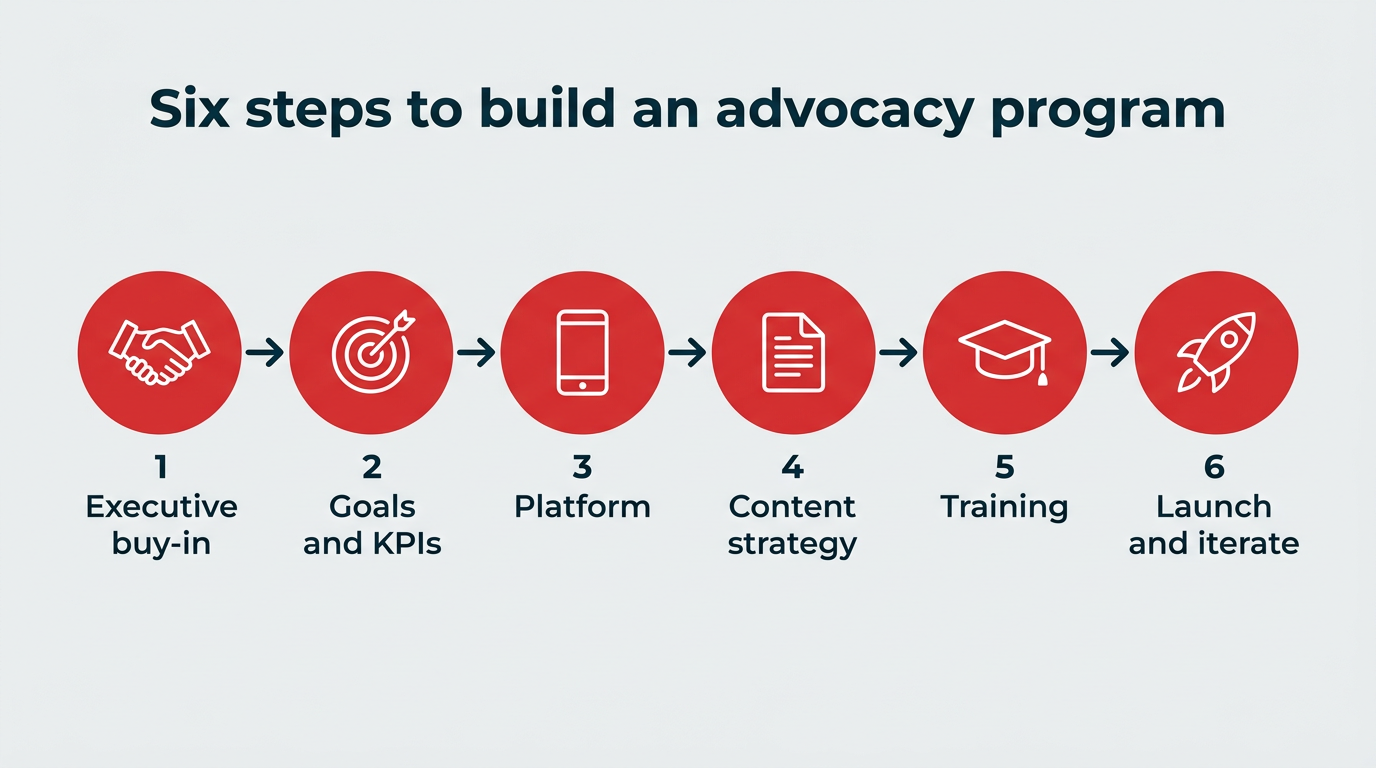
Building an employee advocacy program comes down to six steps, and the order matters. Skip executive buy-in and you’ll struggle for budget. Skip training and you’ll get a handful of nervous reposts and little else.
Here’s the framework:
- Get executive buy-in
- Set clear goals and KPIs
- Choose an employee advocacy platform
- Build a content strategy employees want to share
- Train and onboard employees
- Launch, incentivize, and iterate
1. Get executive buy-in
Executive buy-in is what separates a program with budget and visibility from a side project that quietly dies in month three. Leadership support also sets the tone: when executives post, participation rates across the company tend to follow.
Frame the program as a business investment rather than a social media experiment. Use the numbers from real programs (250% revenue growth, $100K+ in attributed pipeline, 136% more job applicants) to set expectations, then propose a 60 to 90 day pilot with one department and one clear goal. A small, measured pilot is far easier to approve than a company-wide rollout, and it gives you internal proof points for the expansion conversation.
2. Set clear goals and KPIs
Pick one or two primary goals before you pick anything else. Advocacy can support brand awareness, recruiting, sales pipeline, or engagement, but a program trying to do all four at once rarely does any of them well.
Tie each goal to a metric you can actually report on. Recruiting goals map to applicant volume and career site referrals. Pipeline goals map to UTM-tracked leads and closed revenue. Awareness goals map to reach and earned media value. We break these down in the measurement section below.
3. Choose an employee advocacy platform
An employee advocacy platform is what makes the program repeatable. Without one, you’re pasting links into Slack and hoping for the best, with no way to measure what happened next.
Look for content curation, approval workflows and compliance controls, analytics that tie shares to outcomes, gamification to sustain participation, and an interface employees can use on their phones in under a minute. Parliament covers all of these inside Hootsuite Social OS, so advocacy sits alongside your publishing, inbox, and analytics in connected systems rather than in a separate tool.
4. Build a content strategy employees want to share
Your content strategy should answer one question: would an employee be proud to put this on their own feed? If the answer is no, participation will stay low no matter how slick your platform is.
Mix four content types, aligned with your broader social media strategy, so there’s something for every role and interest:
- Thought leadership: Expert commentary, research findings, and POV pieces
- Company news: Launches, milestones, awards, and campaign announcements
- Behind-the-scenes culture: Team moments, employee spotlights, and day-in-the-life posts
- Industry insights: Third-party articles and trends your audience already cares about
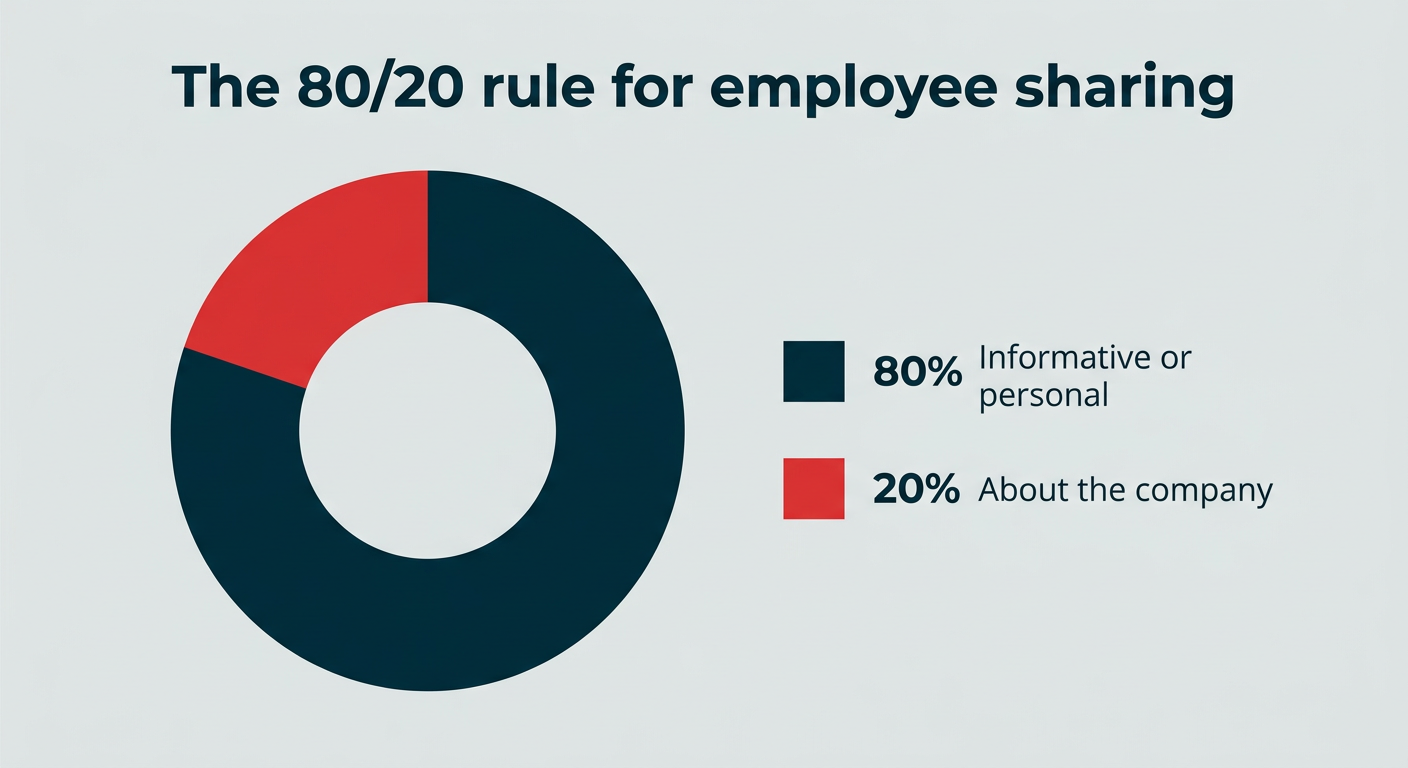
Dell’s 80/20 rule is a useful guardrail: 80% of what employees share is informative or personally interesting, and only 20% is directly about the company. The balance keeps feeds from reading like a sales pitch. Always leave room for employees to add their own commentary, too, because personalized posts consistently outperform straight reposts.
5. Train and onboard employees
Most employees don’t hold back because they’re unwilling. They hold back because they’re unsure what’s okay to post. Training removes that hesitation and protects the brand at the same time.
Cover social media guidelines and disclosure requirements, brand voice basics, and practical coaching on profile optimization and writing a good post. Dell runs employees through its Social Media and Communities University before they share anything, and Armanino uses brand bootcamps and social workshops. Both approaches do the same job: they give people the confidence to post in their own voice without second-guessing every word.
6. Launch, incentivize, and iterate
Launch with a small, enthusiastic group rather than a mandatory all-hands rollout. Early advocates generate the examples and internal word of mouth that pull the rest of the company in.
Then keep momentum going. Hootsuite’s own recognition program offers prizes and incentives for regular participation, and leaderboards turn sharing into friendly competition. Refresh your content library on a set cadence, review performance monthly, and retire topics that aren’t getting shared. Programs stall when the content hub goes stale, not when employees lose interest in advocacy itself.
How do you measure employee advocacy success?
You measure employee advocacy success by tracking a small set of metrics that connect participation to business outcomes. Share counts alone won’t get your program renewed, so pair activity metrics with outcome metrics from the start.
The core metrics to track:
- Adoption rate: The percentage of invited employees who sign up and actively share
- Engagement rate: Likes, comments, and shares per advocate post, compared to brand page posts
- Earned media value: The equivalent paid cost of the reach your advocates generated
- Referral traffic: Clicks and sessions from advocate shares, tracked with UTM parameters
- Pipeline attribution: Leads, opportunities, and revenue traced back to advocacy-sourced traffic
- Content performance: Which topics and formats get shared most, so you can double down
|
Metric |
What it measures |
Benchmark from this guide |
|---|---|---|
|
Adoption rate |
Program participation and stickiness |
Athletico: 95% first week, 79% ongoing |
|
Engagement lift |
Performance vs. brand-owned posts |
Athletico: 39% increase across channels |
|
Earned media value |
Paid equivalent of advocate reach |
DaVita: $1.5M+; Armanino: $232,375 |
|
Referral traffic |
Clicks driven to owned properties |
Armanino: 14,707 website clicks |
|
Pipeline attribution |
Revenue influenced by advocacy |
Major Tom: $100K+ in pipeline |
|
Recruiting impact |
Applicant volume from social |
DaVita: 136% more LinkedIn applicants |
Set a baseline before launch, then report on the same metrics monthly or quarterly. Attribution is the piece most programs skip, so add UTM parameters to every link in your content library from day one. Without them, proving employee advocacy ROI becomes guesswork.
11 employee advocacy program examples for 2026
Now for the inspiration. From tech giants to global retailers, these employee advocacy examples prove that when employees get behind the mic, the brand message hits harder.
|
Company |
Industry |
Platform |
Standout result |
|---|---|---|---|
|
Hootsuite |
SaaS |
Parliament |
250% YoY revenue growth from advocacy |
|
Armanino |
Accounting and consulting |
Hootsuite |
19.2M reached, up 638% YoY |
|
Dell Technologies |
Information technology |
EveryoneSocial |
150,000+ shares in one year |
|
Athletico |
Healthcare |
Hootsuite |
95% adoption in week one |
|
Antalis |
Paper and packaging |
Hootsuite |
300% increase in share of web traffic from social |
|
Starbucks |
Food and beverage |
Starbucks Partner program |
Employer-of-choice reputation |
|
Salesforce |
SaaS |
Haiilo |
2,033% ROI on the program |
|
Morgan Philips Group |
Recruitment |
Sociabble |
8,000 leads generated |
|
DaVita |
Healthcare |
Hootsuite |
136% more LinkedIn applicants |
|
Croda |
Chemicals and life sciences |
Hootsuite |
5,000+ web conversions |
|
Adobe |
SaaS |
EveryoneSocial |
3M+ expanded social reach |
Hootsuite
Industry: Software as a Service (SaaS).
Program focus: Brand awareness, recruiting top talent, and revenue growth.
How it works: It’s only fair that we practice what we preach. Hootsuite runs its own employee advocacy program through Parliament. To make the program actually stick, Hootsuite leaned on three priorities:
- Make content relevant across all departments
- Diversify topics
- Introduce strong adoption and recognition tactics
A cross-department Content Council makes sure posts feel relevant to every team. A recognition program keeps things fun with prizes and incentives for regular participation. And a mix of training, onboarding resources, and push notifications keeps employees engaged and consistent.
Key results:
- 250% year-over-year growth in revenue generated
- 86% sign-up rate (+8% YoY), and a 94% adoption rate (+9% YoY)
- 4.1 million impressions in Q1 from employee posts
- 94% of organic employer-brand impressions came from employee shares
Takeaway for businesses: Regularly refresh and broaden your content mix to appeal to different employee groups (if we can do it, so can you!). Advocacy thrives when employees see content that’s personally relevant. And when participation is recognized, not just expected.
Meet the Suite
Understand what matters, decide what to do next, and take action across every social workflow — all from one connected suite.

Armanino
Industry: Accounting, business consulting, and technology.
Program focus: Brand awareness, talent recruitment, and thought leadership.
How it works:
Using Hootsuite, Armanino created content hubs organized by industry and service themes. Employees receive training through brand bootcamps and social media workshops. Then, they can confidently share content while building their personal brand.
Key results:
- 14,707 website clicks from employee posts.
- 19.2M people reached with employee content (+638% year-over-year).
- $232,375 USD in potential ad value created.
Takeaway for businesses: Equip employees with both content and training. Don’t just hand them posts. Teach team members to adapt content into their own authentic voice. You’ll see stronger engagement, recruiting wins, and measurable brand lift. Armanino has 595 active advocates who customize posts into their own voice.
Dell Technologies
Industry: Information technology.
Program focus: Building trust, extending reach in B2B tech circles, empowering employee engagement, and compliance.
How it works: Dell runs one of the largest employee advocacy programs in the world, and they take training seriously. Before employees share anything, they go through Dell’s Social Media and Communities University, which teaches them how to post responsibly. From there, employees are free to share Dell’s thought leadership, product updates, and corporate social responsibility initiatives.
Dell also follows the 80/20 content rule covered earlier in this guide, which keeps posts from feeling like a constant sales pitch.
Key results:
- During the first year, Dell drove more than 150,000 shares within its employee advocacy platform. This yielded 45,000 additional clicks to Dell’s website.
- In total, Dell’s reach has exceeded an audience of 1.2 million.
Takeaway for businesses: Give employees content they personally connect with, not just corporate talking points. When you build an advocacy experience where people can actually explore and share what interests them, buy-in follows naturally.
Athletico
Industry: Healthcare.
Program focus: Brand awareness, community engagement, and employee empowerment.
How it works: Athletico uses Hootsuite Enterprise and its advocacy tools to find social media–savvy employees and turn them into brand advocates. Regular content planning sessions keep the pipeline fresh, with a mix of brand-owned posts, thought leadership, and awareness campaigns.
Key results:
- 95% adoption rate in the first week of launching the program.
- 40% increase in reach from employee advocacy.
- 39% increase in engagement across all channels.
- 79% ongoing adoption rate of the program.
Takeaway for businesses: You don’t need a huge marketing team to see real results from advocacy. When you tap engaged employees and provide them with structured support and ready-to-share content, reach and engagement follow.
Antalis
Industry: Papers, packaging, and visual communication.
Program focus: Employer branding, recruiting, and sales enablement.
How it works: Antalis launched an employee ambassador program with Hootsuite, with a strong focus on training and support from day one. That way, staff could confidently share pre-approved content without second-guessing what was okay to post.
A central content library paired with regional governance made it easy for employees across functions (from marketing to sales teams) to find posts relevant to their expertise. To speed up adoption, Antalis also tapped into peer learning from other Hootsuite customers and kept ongoing training on the calendar.
Key results:
- 87% adoption rate for the employee ambassador program.
- 2,400 shares of advocacy content last year.
- 300% increase in share of web traffic to the campaign site from social media.
Takeaway for businesses: Give employees easy access to relevant, high-quality company content they’re proud to share.
Starbucks
Industry: Food and beverage.
Program focus: Reputation management, employer branding, and community engagement.
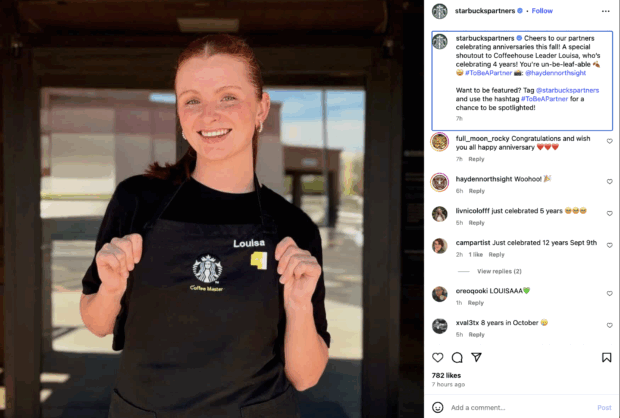
How it works: Starbucks encourages employee advocacy through its Starbucks Partner program. Employees (or “partners,” as the company calls them) share stories about workplace culture, company initiatives, and community involvement.
Advocacy happens through a mix of structured programs and organic sharing. To keep partners engaged, Starbucks provides content resources, training, and regular recognition.
Source: Starbucks Partners
Key results: Starbucks does not publish share or reach figures for the partner program, so the value here is brand-building rather than direct attribution. The outcomes it points to are qualitative:
- Created an image as a values-driven brand.
- Reinforced its reputation as an employer of choice.
- Boosted engagement with local communities.
Takeaway for businesses: Starbucks shows that advocacy doesn’t have to be about products. When employees share stories rooted in company values, purpose, and community, advocacy becomes a genuine trust-builder for the brand.
Salesforce
Industry: Software as a Service.
Program focus: Global brand awareness, thought leadership, culture, and recruiting.
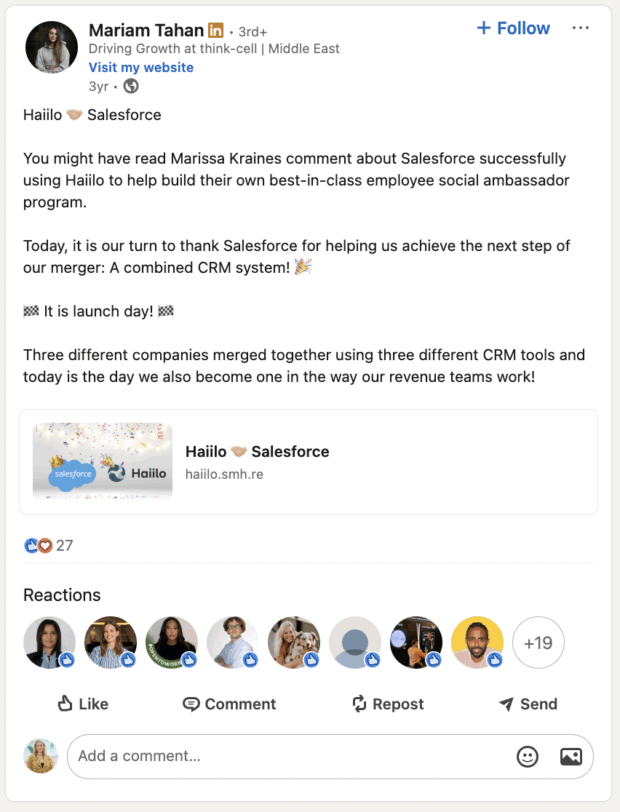
How it works: Salesforce revamped its Social Ambassador Program using the Haiilo platform, blending curated content, training, and gamification into one experience. Employees are auto-subscribed to channels based on their role and location, and they can personalize copy variations in multiple languages.
Source: Mariam Tahan
Key results: Source
- 2033% return on investment on the advocacy program.
- 25,141 users enrolled in 21 months.
- 742,000+ social shares.
- Employee advocates grew their networks 3x faster and saw 6x more profile views.
Takeaway for businesses: A great advocacy program balances structure with flexibility. Give employees a framework that protects your brand, but leave room for them to personalize and make the content their own. Ease and personalization are where real adoption happens.
Morgan Philips Group
Industry: Recruitment and talent management.
Program focus: Brand awareness, consultant expertise, global visibility.
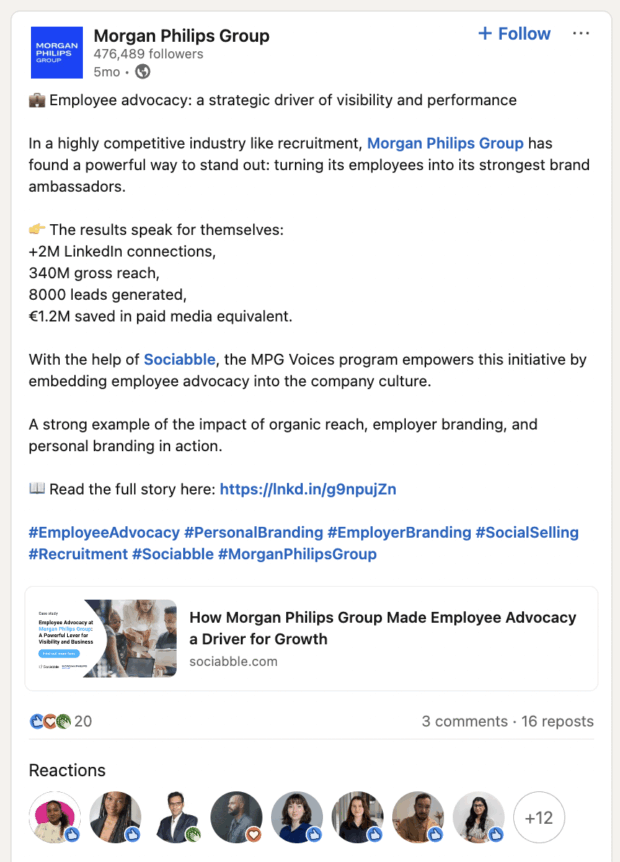
How it works: Morgan Philips Group uses Sociabble to empower its recruiters and consultants to share content about their work, sectors, and company news.
Source: Morgan Philips Group
Key results: (as reported by Morgan Philips Group)
- Over 2 million LinkedIn connections in 2024.
- 340 million gross reach with employee-shared content.
- 8,000 leads generated.
- €1.2 million saved in paid media equivalent.
Takeaway for businesses: Want to build visibility fast in a crowded market? Make it easy for employees to share content that reflects their domain knowledge.
DaVita
Industry: Healthcare
Program focus: Recruiting top nursing and patient care talent. Empowering employees to share authentic stories about culture, benefits, and career opportunities.
How it works: DaVita uses Hootsuite to power a 200+ employee ambassador program. Ambassadors get access to pre-approved, brand-safe content that highlights real teammate experiences, which recruiters and staff then share across their social media platforms to boost reach and credibility.
Key results:
- 24K+ shares of employee stories
- $1.5 million+ in equivalent ad value
- 136% increase in applicants coming from LinkedIn on their career site
- 27% year-over-year increase in job applications from social media
- 80% sustained adoption rate among teammates
Takeaway for businesses: By turning employees into storytellers, DaVita bridged the gap between recruitment and marketing.
“The people aspect of the content is important,” says Samways. “Employees are naturally more inclined to support a co-worker or team’s achievement rather than a more generic brand piece. This can range from a piece of content that puts a subject matter expert in the limelight to emphasizing the team behind a recent case study.”
Croda
Industry: Chemicals and life sciences
Program focus: Increase visibility, strengthen customer relationships, and amplify sustainability messaging.
How it works: Croda centralized 36 of its brand social channels using Hootsuite Enterprise, then added employee advocacy to the mix for sharing curated content. The combination brought consistency, efficiency, and measurable engagement to a setup that had been scattered across teams.
With advanced analytics and built-in security, Croda aligned its digital strategy around two priorities: amplifying sustainability messaging and strengthening customer relationships.
Key results: (program launched in 2019; results reported through 2023)
- 23 million LinkedIn connections reached via advocacy since 2019
- 5,000+ web conversions through employee advocacy content
- 50% increase in website conversions from social (Q2 2022 to Q2 2023)
- 150 to 200 active advocates, including executives and influencers within their sectors
- Improved efficiency and reduced duplicated efforts across marketing teams
Takeaway for businesses: Even in technical B2B sectors, employees can humanize your brand and drive real business results. Croda’s success comes down to three things:
- Centralized social activity across brands
- Easy-to-use advocacy tools that empower employees
- Messaging rooted in core values like sustainability
Adobe
Industry: Software as a Service (SaaS).
Program focus: Brand awareness, employee engagement, internal communications, and social recruiting.
How it works: Adobe uses EveryoneSocial. The platform gives employees a curated content library calibrated to different interests and roles. Employees can share posts, engage with each other, and follow content groups that resonate.

Source: Cathya Lopez
Key results: (as reported by EveryoneSocial)
- Over 900 employees are using the platform.
- Social reach expanded by over 3,000,000+ through those employee shares.
- Average reach per user is over 4,000 people via their own networks.
Takeaway for businesses: Have your content reflect employees’ roles or interests. Watch program adoption and participation rise.
What tools support employee advocacy at scale?
The tools that support employee advocacy at scale are dedicated advocacy platforms that handle content distribution, governance, and measurement in one place. Running a program on spreadsheets and Slack messages works for a pilot of 20 people. It falls apart at 200.
Here’s what to look for when you evaluate options:
- Content curation: A central library where employees browse pre-approved posts by topic or role
- Compliance and governance: Approval workflows, permissions, and audit trails, which matter most in regulated industries
- Analytics: Share, reach, click, and conversion data tied back to individual campaigns
- Gamification: Leaderboards, streaks, and recognition to sustain participation past month one
- Integrations: Connections to your publishing calendar, CRM, and internal comms channels
Parliament is the employee advocacy app inside Hootsuite Social OS, so advocacy runs alongside your publishing, listening, and analytics in connected systems rather than a separate login. Employees get a mobile feed of shareable content, and admins get governed workflows plus reporting that ties shares to outcomes.
FAQ: Employee advocacy program examples
What is an employee advocacy program?
What are examples of successful employee advocacy programs?
How do companies build and scale employee advocacy programs?
What makes an employee advocacy program successful?
How do businesses measure the success of employee advocacy programs?
What tools support employee advocacy programs at scale?
What are the three golden rules for advocacy?
How do you get executive buy-in for an employee advocacy program?
What content should employees share in an advocacy program?
What is the difference between employee advocacy and brand advocacy?
Save time managing your social media marketing strategy with Hootsuite. Publish and schedule posts, find relevant conversions, measure results, and more â all from one dashboard. Try it free today.
The post 11 employee advocacy program examples for 2026 appeared first on Social Media Marketing & Management Dashboard.