
Key takeaways
- Social media leadership skills combine strategic thinking, emotional intelligence, AI fluency, and cross-functional communication to guide enterprise teams toward business outcomes.
- The biggest shift in 2026 is leading AI adoption responsibly, balancing speed and governance without losing the human element.
- Strong social leaders measure success through team health, brand reputation, and business impact, not vanity metrics.
- Developing social media leadership skills requires structured feedback, clear decision-making frameworks, and a willingness to experiment and fail fast.
What are social media leadership skills?
Social media leadership skills are a blend of abilities, both learned and innate, that help leaders direct and inspire social media teams to succeed. They matter at every scale, but they matter most in enterprise environments where one decision can ripple across dozens of markets.
The core skills include:
- Strategic thinking: Connecting social activity to business goals like revenue, retention, and reputation, rather than treating channels as standalone projects.
- Emotional intelligence: Reading the room internally and externally, spotting burnout early, and handling sensitive moments without defensiveness.
- Communication aptitude: Explaining social performance in language the C-suite, legal, and frontline teams all understand.
- AI fluency: Knowing which tasks to hand to AI, which to keep human, and how to govern the output.
- Adaptability: Shifting plans quickly when platforms, policies, or culture change without losing the thread of the strategy.
- Creativity and innovative thinking: Creating room for teams to test new formats, including the ones that look strange on a slide.
- Collaboration and conflict management: Navigating competing stakeholder priorities and saying no when the request does not serve the strategy.
A successful social media leader’s skills must go beyond social media management. A true leader understands how to delegate and guide in real time through an evolving industry and culture. They know how to use a social strategy to achieve business goals.
It’s no surprise, then, that a recent IBM study found 69% of CEO respondents say their organization’s success is directly tied to maintaining a broad group of leaders with a deep understanding of strategy and the authority to make critical decisions. Social is no exception.
Shakivla Todd, a 4-time Shorty award-winning Social Media Strategist, says a great social leader must be “naturally culturally aware and in-the-know.”
“You don’t need to be chronically online. But you do need to be acutely aware of what’s happening as it pertains to current events and cultural moments.”
Cultural relevance isn’t just to stay ‘on trend,’ says Todd. It’s to “help lead your team through culturally sensitive moments. An exceptional social media leader should know how to read the damn room, everyone hates a tone-deaf brand.”
In short: social media leadership skills are the mix of strategic, human, and technical abilities that turn a capable social team into a business function executives rely on.
How is social media leadership different from management?
Social media leadership sets the direction; social media management executes against it. Both roles are essential, and most leaders have done both, but the day-to-day work looks very different.
Social media managers focus on executing a social media strategy. Their social tasks include:
- Creating and publishing compelling content
- Understanding how social networks like LinkedIn, TikTok, or Instagram work
- Engaging an audience
- Analyzing and optimizing performance
- Maintaining brand voice
Social media leaders, on the other hand, set a direction and keep everyone working toward it. They:
- Shape the long-term vision
- Advocate for resources
- Build systems that allow their teams to move quickly while staying aligned
A manager might be optimizing a campaign’s engagement rate. A leader is the one asking how that engagement ladders up to revenue, reputation, and retention.
|
Dimension |
Social media management |
Social media leadership |
|---|---|---|
|
Primary focus |
Execution and output |
Direction and outcomes |
|
Scope |
Channels, campaigns, calendars |
Teams, budgets, cross-functional systems |
|
Core metrics |
Reach, engagement rate, publishing cadence |
Brand health, pipeline contribution, team efficiency |
|
Decision-making |
Tactical, within set guidelines |
Sets the guidelines and approval frameworks |
|
Time horizon |
Daily to quarterly |
Quarterly to multi-year |
|
Key activities |
Content creation, community response, reporting |
Strategy, governance, hiring, executive communication |
In social, business leaders have to stay flexible. The industry changes fast, and you need to be able to pivot, using new trends and real data, to build initiatives that actually move the business forward.
“Keeping up with the swiftness of social media is an Olympic sport,” says Todd. “I’ve learned to be comfortable with uncertainty, and I don’t get too attached to plans.”
What does a social media director do?
A social media director sits between management and leadership, owning the strategic direction of social while staying close enough to the work to guide it. The role is usually where social media leadership skills get tested for the first time at scale.
Typical social media director responsibilities include:
- Strategy ownership: Setting the annual social strategy and making sure every channel maps to a business objective.
- Team oversight: Hiring, structuring, and developing the social team, including agency and freelance partners.
- Budget and resourcing: Building the business case for headcount, tools, and paid support.
- Executive reporting: Translating social performance into the metrics leadership already tracks.
- Cross-functional alignment: Keeping social connected to PR, customer experience, product, and legal.
- Governance: Owning approval workflows, access controls, and crisis protocols.
Why do leadership skills matter in enterprise social?
Enterprise social media teams work in a complex space with lots of moving parts. A strong leader helps them navigate it and keep social aligned with the broader business and brand.
Enterprise social is like conducting a symphony where half the orchestra is in another time zone. And the legal department keeps rewriting your sheet music. A strong social leader brings harmony. They:
- Connect departments
- Align priorities
- Protect their teams from the constant ping of competing agendas
“You must know how to say no,” says Todd.
“Everyone will have an opinion, a request, an idea. There’s only so much a social media team can do. Sometimes it might feel like you’re the fun sucker. But my philosophy is that you don’t need to be everywhere, everything, all at once. That goes for viral trends and emerging social media platforms alike.“
Core social media leadership skills for 2026
The skills list above is the foundation. These five are where enterprise social media leadership gets won or lost in 2026, because each one requires a leader to make calls nobody else in the organization is positioned to make.
Strategic thinking and goal alignment
Great social leaders know how to support big business goals with social strategies. At enterprise scale, that also means deciding which goals social will not chase, so regional teams aren’t stretched across a dozen competing priorities.
That means:
- Defining clear KPIs that tie social metrics to outcomes like revenue, retention, and reputation
- Keeping the brand grounded in purpose, not just performance
- Balancing chasing short-term wins like trendy content with long-term longevity, like a solid brand reputation
Leading AI adoption and governance
Leading AI adoption means deciding where AI belongs in your workflow before your team decides for you. Social teams were among the earliest AI adopters, which means most enterprise social leaders are now governing tools that entered the organization informally.
Leaders who handle this well tend to:
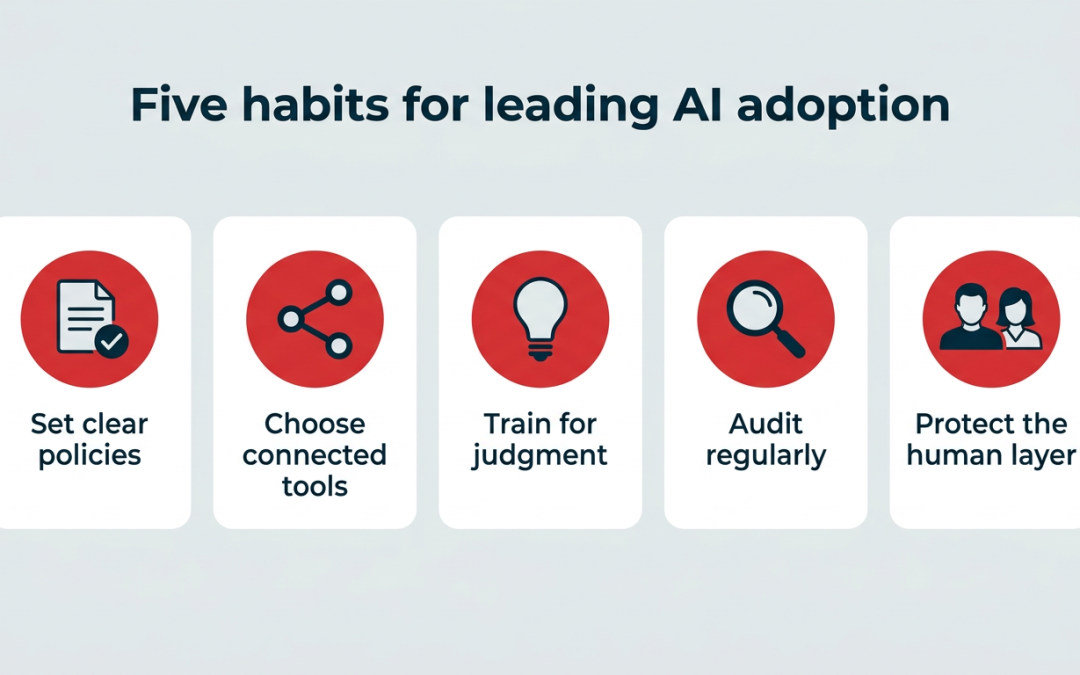
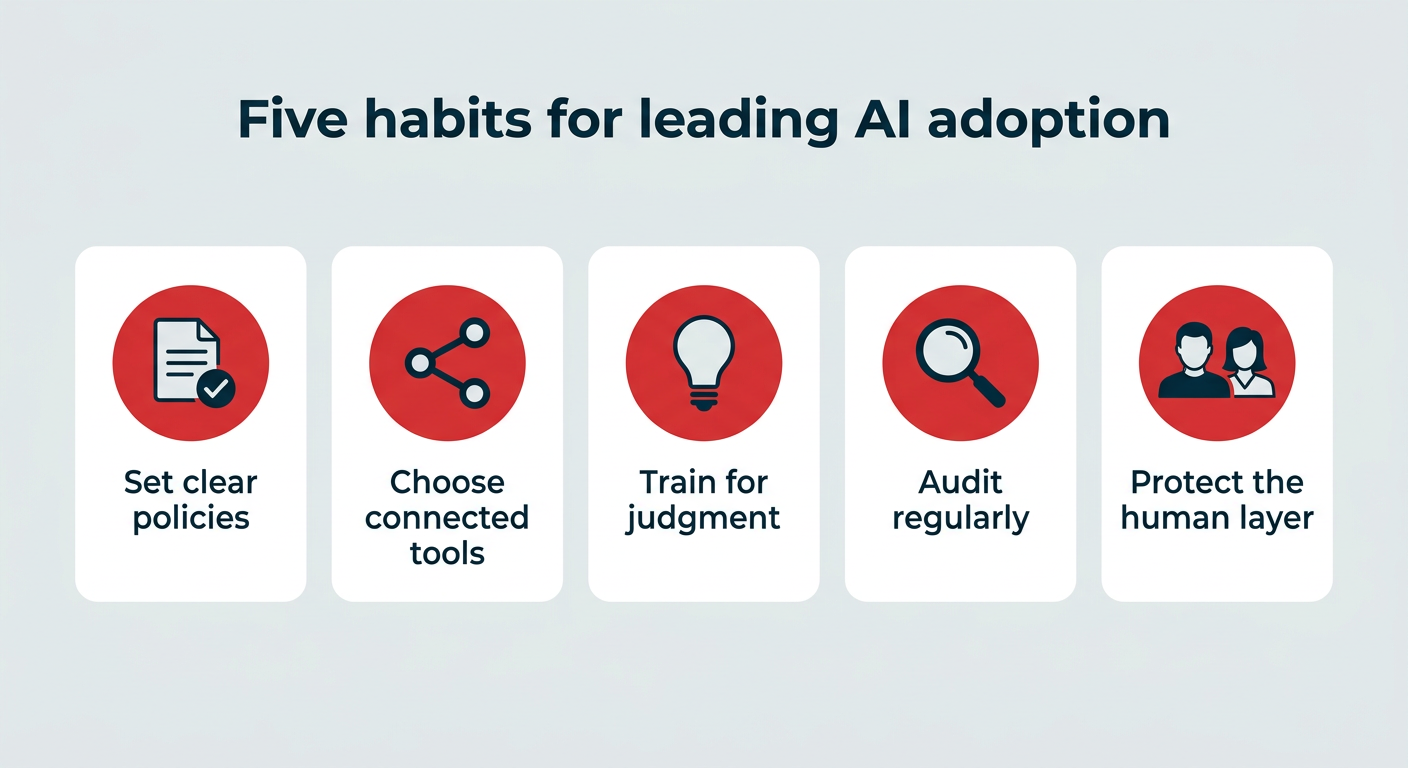
- Set clear policies: Define what AI can draft, what requires human review, and what should never be automated, such as crisis response or sensitive community replies.
- Choose connected tools: Favour platforms where AI sits inside governed workflows with approval chains and audit trails, rather than standalone tools that bypass review.
- Train for judgment, not prompts: Teach the team how to evaluate AI output against brand voice and factual accuracy.
- Audit regularly: Spot-check published AI-assisted content and track where it performs well or falls flat.
- Protect the human layer: Keep community management, cultural judgment, and relationship-building with people.
Social media governance and AI governance are now the same conversation, especially with AI-driven marketing automation expected to double by 2028. If your approval workflow doesn’t account for AI-assisted content, you have a gap.
Data storytelling and executive communication
Data storytelling is the skill of turning social performance into a narrative executives can act on. Numbers alone rarely move a budget conversation. Context does.
It can be easy to ignore data that doesn’t translate neatly into percentages. But the real, human emotions your brand elicits are a crucial part of success on social.
“Screenshot every meaningful comment, DM, and Instagram story mention,” says Todd.
“Show executives the actual conversations happening around your brand. This is the stuff that doesn’t fit neatly into a spreadsheet but demonstrates real human connection and brand sentiment.”
Those conversations happening across the internet are valuable data. And often more compelling than any vanity metric.
Crisis leadership and brand reputation
Your brand’s reputation is tried and tested online. Strong reputation management involves systems that help your brand stay consistent, credible, and calm. Especially during times when the internet isn’t.
That’s why the best social leaders:
- Create clear crisis protocols so no one’s panic-drafting an apology post
- Empower frontline teams with the communication skills to respond to all comments, good and bad
- Invest in social listening tools to catch issues before they blow up
- Build employee advocacy programs so trusted internal voices can carry the message when it matters
Lumen, the insights and listening app inside Hootsuite Social OS, helps here. You can monitor positive and negative sentiment at scale and see which topics are driving it.
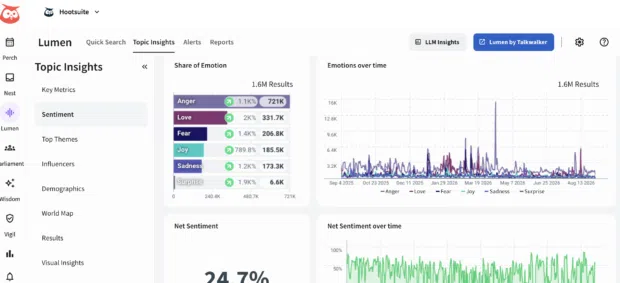
Lumen helps leaders monitor sentiment at scale to protect brand reputation.
Community engagement is massive for building a positive brand reputation.
“At Bobbie, we hit a scaling challenge when social engagement exploded after my first year. DMs, comments, and ad interactions surged as the company doubled down on customer retention and loyalty,” says Todd.
While Todd initially proposed hiring a community manager, budget constraints meant she had to pivot.
“My team analyzed our message patterns and realized the majority of DMs were product-specific questions that our Customer Experience team was better equipped to handle.”
Todd partnered with the Director of CX to integrate social communications into the CX team’s infrastructure.
“We redirected product inquiries to the CX team’s workflow, kept non-product inquiries like influencer outreach and partnerships with social, and established clear handoff protocols and response templates for consistency,” says Todd.
“This restructuring let the social team refocus on strategic content while ensuring customers got expert help from the right people. Sometimes scaling isn’t about adding headcount, it’s about working smarter across teams.”
Todd is also clear that community is where leaders should point their teams’ energy. “People never really wanted brands on social anyway. They wince whenever they scroll past an ad. Which means the odds are stacked against us when it comes to creating thumb-stopping, outstanding content.”
Cross-functional collaboration
Strong leaders can connect the dots between department silos. They:
- Partner with sales or customer experience teams to use insights in social strategy
- Align with HR and internal comms to build employee advocacy programs
- Work with product development teams so everyone has the right information
- Speak the language of the C-suite to make sure leadership knows the drill
Social intelligence is one of the easiest ways to earn that collaboration. Listening data pulled through Lumen can flag emerging product complaints for the product team, surface competitor messaging for sales, and highlight employer brand sentiment for HR.
How is social media leadership changing in 2026?
Social media leadership is changing because social is no longer just a marketing channel. With over $121 billion in US social ad spending in 2026, it’s a strategic business function that feeds product, service, recruitment, and reputation, and leaders are now accountable for all of it.
Four shifts are driving that change:
- AI is reshaping workflows: Drafting, tagging, and reporting are faster, so the leadership value moves to judgment and governance.
- Distributed teams are the default: Regional autonomy has to coexist with brand consistency.
- Platform volatility is constant: Performance gaps between networks widened through 2025, and algorithms, policies, and even platform availability can change inside a quarter.
- Compliance expectations are rising: Regulated industries now expect documented approvals and audit trails on social activity.
The practical effect is that the job has moved from posting to piloting an operating system. Insight only matters when it connects to a decision someone can act on, which is why leaders are prioritising connected systems over disconnected point tools.
Social leaders still need to keep one eye on industry trends and the other on their team, all while balancing brand goals and organizational politics in their digital marketing strategy. They’re juggling a lot of plates, like data, content, and the occasional ego. Without strong leadership, those moving parts start spinning in different directions.
How do leaders manage distributed teams across regions and functions?
Enterprise social teams are everywhere and nowhere all at once. You might have a London strategist, a Vancouver copywriter, and a content creator in Singapore.
Strong leaders build trust across time zones by:
- Setting clear guardrails so teams can create freely during their office hours
- Hosting regular syncs while keeping team culture alive
- Recognizing wins publicly, because connection beats micromanagement every time
How do leaders stay compliant in a fast-moving landscape?
Compliance doesn’t have to be the fun police. It can be the invisible framework that lets your team create with confidence. Leaders at the enterprise level know how to keep creativity flowing and stay on the right side of the regulators. They:
- Work closely with legal and risk teams early, not after the fact
- Build approval workflows that are fast, transparent, and easy to follow
- Train content strategy teams on evolving policies
- Extend those policies to AI-assisted content, including disclosure rules and review requirements
In regulated industries, a missed disclosure or an unapproved claim isn’t just an awkward post. It can trigger regulatory action. Vigil, the governance layer in Hootsuite Social OS, keeps rules, approvals, and audit trails attached to the work itself.
Rules don’t have to kill creativity. But confusion always will. Give your team clear guidance on brand and style guidelines, accessibility standards, and legal requirements, then let them work.
How do you develop social media leadership skills?
No one wakes up one day, suddenly ready to lead an enterprise social team. Social media leadership development is a skill set you build. Sometimes, in a trial by fire.
You may want to grow your own skills. Or mentor someone else into a leadership role. You can use these tips and tricks to develop social media leadership skills.
Conduct a leadership skills audit
Before you can grow, you’ve got to know what you’re working with. A leadership audit is basically a vibe check for your management style.
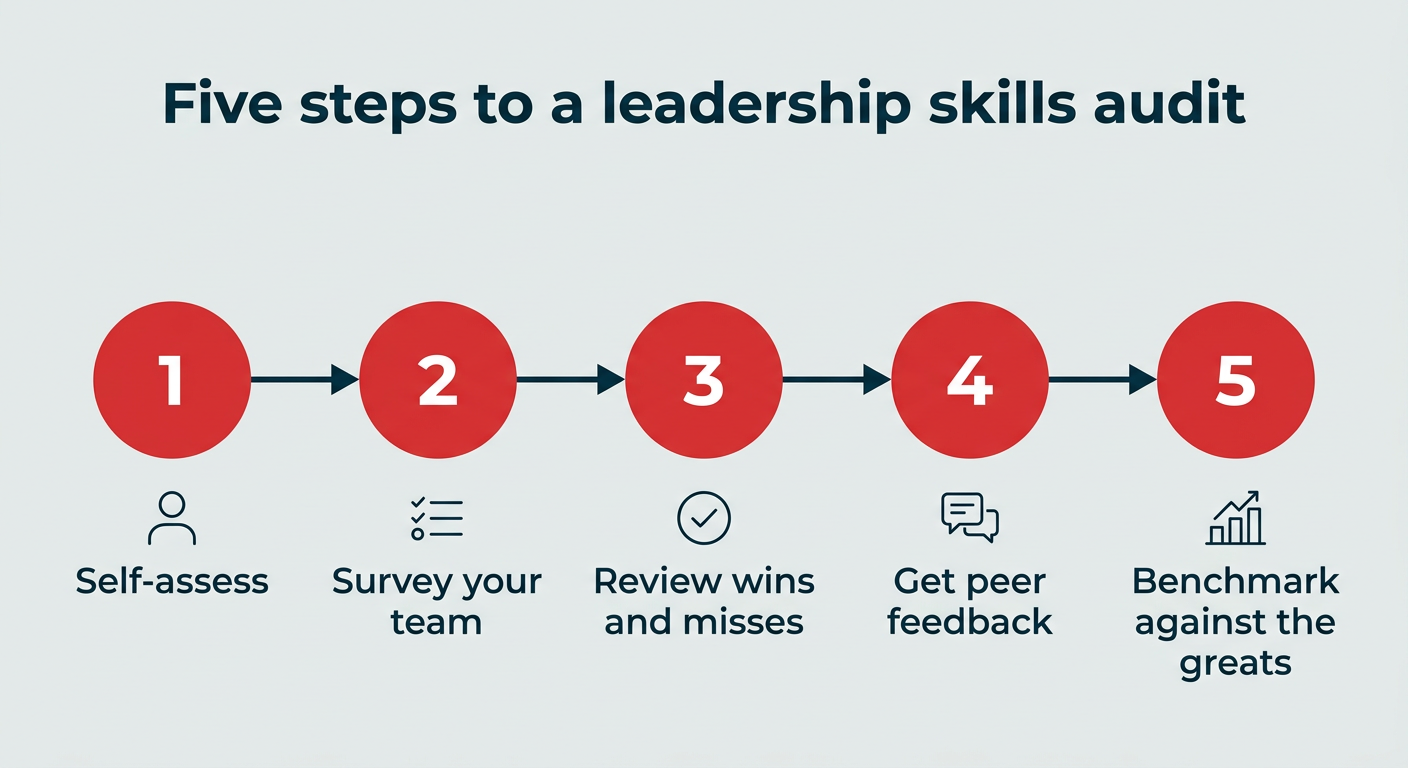
Ways you can conduct a leadership skills audit:
- Ask yourself questions designed to uncover strengths and weaknesses. Can you list 5 ways you empower your team? Can you list 5 ways you hinder them? If your answers make you cringe a little, congratulations. You’ve just found your growth areas.
- Send out an anonymous internal survey. Ask your team how supported they feel. How clearly priorities are communicated. And where they think processes get stuck.
- Review past wins and misses. Take a retrospective look at campaigns that soared or stumbled. You’ll gain insight into how your leadership style works and the ways it can improve.
- Get peer feedback. Other department heads see how you show up in cross-functional spaces. Ask what’s working and what’s meh.
- Benchmark against the greats. Compare your approach with the habits of respected leaders in social or marketing.
Implement frameworks for decision-making and approvals
No one wants to be the bottleneck in a project. Know how to build structures that free your team to make their own decisions.
- Create simple, repeatable guidelines. Build playbooks, templates, and decision trees so your team knows the “how” without needing constant approval.
- Define clear boundaries and goals. Give teams autonomy within guardrails.
- Delegate ownership, not tasks. Assign people full responsibility for areas or outcomes so they can make decisions confidently and proactively.
Coaching, mentorship, and feedback loops
Even leaders need leaders. The best social heads surround themselves with mentors and peers who aren’t afraid to speak up.
To grow your leadership muscles:
- Find coaches (internal or external) who challenge you
- Build feedback loops with your team. Ask what’s working and what isn’t.
- Offer mentorship downstream, so you’re always developing future leaders
This is also where team development lives day to day. Smart leaders offer coaching dedicated to building up individuals, spot burnout before it hits, celebrate the wins loudly, and build pathways for career growth so they keep their best talent.
“I measure success by how well we’re saying no to the right things,” says Todd.
“If my team is constantly overwhelmed and reactive, that’s a leadership failure on my part. But if we’re being strategic, protecting our bandwidth, and delivering quality work that actually moves the needle for the business? That’s when I know I’m leading effectively.”
Stay curious and experiment often
Great social leaders are curious. They ask questions, really listen, and create space for trust and new ideas. Stay curious about the world, not just social, and you’ll go even further.
“I pay attention to what’s happening not just in social media, but in culture, technology, and how people are communicating,” says Todd.
“That cultural awareness isn’t just about avoiding missteps. It’s about spotting opportunities and understanding where things are headed before they fully arrive.”
Curiosity only pays off if you act on it, which means getting comfortable with things not working. In social, perfection is a trap. Progress comes from testing, breaking things, and learning fast from your mistakes.
“I’m not afraid to experiment and fail,” says Todd. “Some of the best insights come from trying something, watching it flop, and understanding why.”
“Perfectionist leaders will struggle in this space. Or those who can’t handle the discomfort of not knowing if something will work. In social media, you have to be comfortable testing, learning, and moving on quickly.”
Know how to advocate for yourself
If you’re looking to grow into a leadership role, advocating for yourself is key. In a young field like social media, upward mobility can get stagnant.
“Those who want to grow into a leadership role often have to convince their company to promote them and hire someone new,” says Todd. “Start building your case early. Keep track of your successes and how they’ve positively impacted the business.”
Log your wins as they happen. Then, come performance review time, you have a folder of proven successes.
How do social media leaders measure success?
Social leaders don’t measure success by follower count. They measure success by impact. Your team’s performance and how people feel about your brand say far more than a vanity metric ever will.
But impact isn’t easy to measure, especially on social.
“I prefer to set expectations early about what success looks like on social media,” says Todd.
“It won’t always share the same 1:1 metrics as other marketing channels. The number of link clicks doesn’t always show how successful my team is at building brand love and trust online.”
A simple way to structure the conversation is to map what you track to the business outcome it supports:
|
Leadership metric |
What it tells you |
Business outcome |
|---|---|---|
|
Brand sentiment and share of voice |
How the market perceives you versus competitors |
Reputation and trust |
|
Crisis response time |
How fast your systems and protocols actually work |
Risk reduction |
|
Team efficiency (approval turnaround, delivery speed) |
Whether your workflows help or hinder |
Operational cost |
|
AI-assisted output and review rate |
Where AI is saving time without creating risk |
Productivity and brand safety |
|
Employee advocacy reach |
How well internal voices extend your message |
Recruitment and credibility |
|
Social-attributed pipeline and retention signals |
Social’s direct commercial contribution |
Revenue contribution |
Which KPIs and performance metrics should leaders track?
Great social leaders know strategy isn’t just about engagement rates or reach. It’s about what those numbers mean.
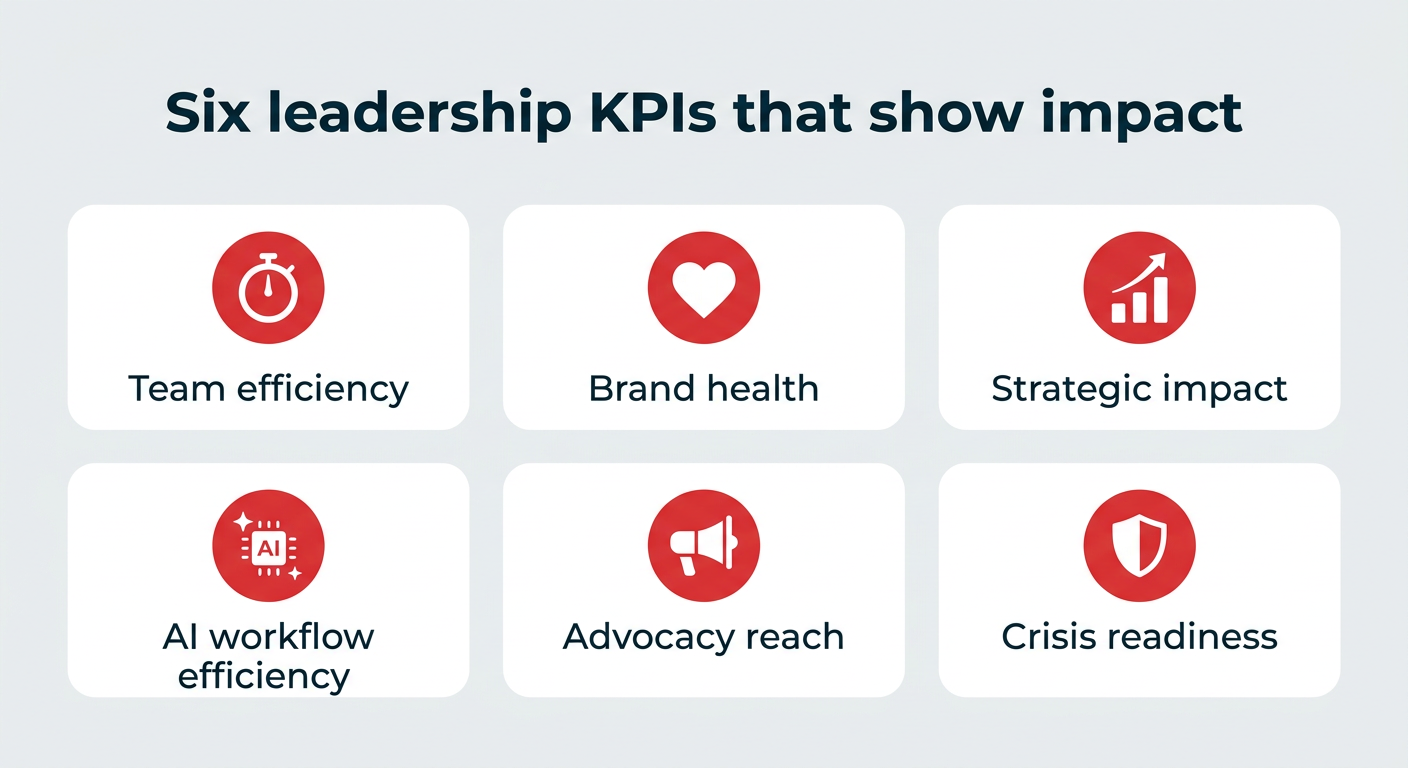
The best leaders show how the metrics tell a bigger story, like:
- Team efficiency: Turnaround time on approvals, campaign delivery speed, and collaboration rates
- Brand health: Sentiment, share of voice, and engagement quality, tracked through Lumen
- Strategic impact: Social contributions to the sales pipeline, recruitment, or customer retention
- AI workflow efficiency: How much drafting and reporting time AI saves, and how often output needs rework
- Advocacy reach: How far employee-shared content travels compared with brand-owned posts
- Crisis readiness: Time from detection to first approved response
These metrics show how your leadership style translates into real-world results.
“Show the numbers that matter, and lead with the biggest ones you have,” says Todd. “Focus on total impressions, follower growth, and engagement, specifically shares and saves, which signal that people find your content valuable enough to revisit or spread.”
“Compare those numbers to previous time periods and, if possible, to competitors to provide context.”
How do you link leadership to team and business outcomes?
The most effective social leaders connect their performance to others’ success. If your team’s thriving, your leadership is working.
You’ll know you’re on the right track when:
- Your team makes confident decisions without constant escalation
- Other departments ask for your team’s input early on
- Social insights shape company-wide strategy, not just the content calendar
What tools and dashboards help monitor impact?
You can’t manage what you can’t see. Great social leaders use data to guide, turning dashboards into compasses.
Leaders use social media tools to:
- Track campaign performance with custom analytics reports
- Keep projects on track with tools built for workflows and timelines
- Spot trends early in Lumen to anticipate opportunities or risks
- Tie activity to measurable business results
- Translate complex data into executive-friendly insights with Wisdom, the AI layer in Hootsuite Social OS
Pro tip: Automate the data pulls, but humanize the story. Translating what your tools are telling you is key.
How does Hootsuite support social media leadership?
Hootsuite Social OS gives enterprise teams the visibility, governance, and AI-powered insights they need to lead with confidence. Instead of stitching together publishing, listening, care, and compliance tools, leaders work in one connected system where intelligence connects directly to action.
Visibility and governance with Vigil
The bigger the organization, the easier it is for things to go sideways. Hootsuite gives social leaders a bird’s-eye view of every post, profile, and person, with Vigil handling social media governance across the whole operation.
You can:
- See everything at once, who’s posting what, when, and where
- Set roles and permissions so everyone’s empowered to do their work
- Create governance frameworks that protect brand consistency across regions and business units
Approvals, workflows, and compliance features
Approvals shouldn’t feel like waiting for a carrier pigeon. Publishing workflows in Perch keep content moving while Vigil keeps the brand on point and the legal department happy.
With Hootsuite, leaders can:
- Design multi-level approval chains so the right eyes see content before it goes live
- Automate routine steps to save everyone from inbox purgatory, including bulk scheduling and best time to post recommendations
- Document compliance effortlessly. Audit trails make regulators and risk teams very happy.
It’s structure without suffocation. Your team can move fast and stay in bounds.
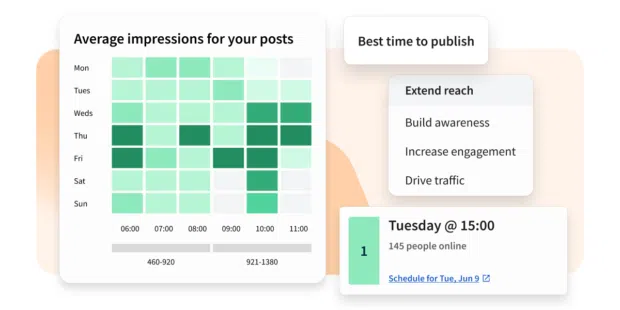
Best time to post recommendations help teams publish when their audience is most active.
Analytics, reporting, and AI-powered insights
Every good leader knows that what gets measured gets managed. Hootsuite analytics turns social data into insights that actually mean something.
You can:
- Track KPIs across regions, teams, and campaigns, all in one place
- Visualize performance trends and benchmark success over time
- Monitor brand health and emerging risks through Lumen
- Ask questions in plain language with Wisdom and get answers grounded in your live social data
- Generate tailored, executive-ready reports. These show how social drives business impact (and justify next year’s budget).
FAQ: Social media leadership skills
What are social media leadership skills?
How do they differ from social media management skills?
What are the responsibilities of a social media director?
Who should develop these skills in an organization?
How do social media leaders handle AI adoption on their teams?
What KPIs should social media leaders track?
How do leaders influence cross-functional teams?
How do you transition from social media manager to social media leader?
What tools help social media leaders succeed?
How do enterprise leaders scale social media impact globally?
Save time managing your social media marketing strategy with Hootsuite. Publish and schedule posts, find relevant conversions, measure results, and more â all from one dashboard. Try it free today.
The post Social media leadership skills for 2026 (+ KPIs to track) appeared first on Social Media Marketing & Management Dashboard.