
The social landscape is shifting faster than at any point in the past decade. 2026 is poised to redefine how brands show up online. Emerging platforms are gaining traction, algorithms are reshaping reach and consumers are demanding more human connection from the companies they follow.
Against this backdrop, marketers are recalibrating their strategies for a world where traditional brand accounts can’t do all the heavy lifting. Social teams are diversifying their organic ecosystems, investing in intelligence and analytics, and meeting audiences in the private spaces where real conversations already happen.
To help you prepare for what’s ahead, we asked industry leaders and creators to weigh in on what the future of social media will look like, and paired their predictions with marketer and consumer surveys we conducted this year.
1. More brands will join Substack, Bluesky and Reddit—for different reasons
It’s indisputable that most social media users are turning to alternative social media networks, especially younger consumers. According to Sprout’s Q2 2025 Pulse Survey, around half of all global social media users plan to increase their time on emerging, community-driven and creator-driven platforms. Millennials and Gen Z are even more likely.
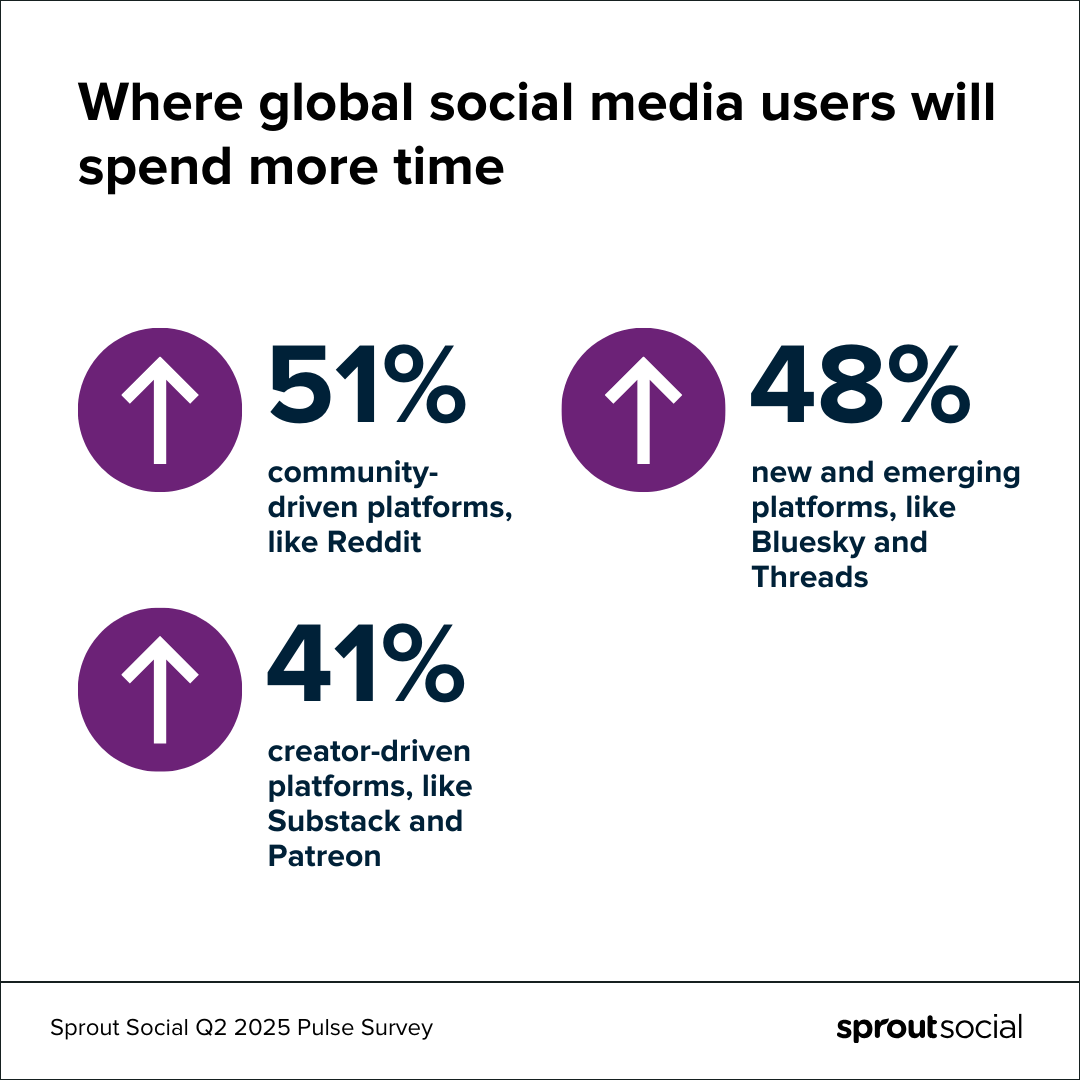
Interest in these networks is juxtaposed with algorithmic shifts on traditional networks. Users report their feeds have started to look like TV, with endless short videos starring people they don’t know. While that doesn’t mean people will turn away from traditional networks, it does mean they’re craving closed spaces to supplement those experiences.
They turn to Reddit for discussions about niche topics, and to get unfiltered answers and product reviews. To Bluesky for a decentralized, user-controlled feed. To Substack for long-form content and an intentional scrolling experience. Each network offers something different users can’t find elsewhere.
Sprout’s CMO Scott Morris summed it up like this: “The social spotlight is shifting from mass reach to meaningful connection. Platforms like Reddit, Substack and Discord are powering private groups and micro-communities that build loyalty and spark movements.”
Lia Haberman, creator economy expert and author of the ICYMI newsletter, has already noticed intense interest in Substack. “Interest in Substack will explode in 2026. As a Bestseller on the platform, I’m fielding constant calls and speaking requests. Every brand and agency marketer is scrambling to develop a POV, whether that means partnering with established writers or launching their own publications. The appeal is obvious: direct audience access, more intentional engagement with the content than the average social post and the opportunity to be part of the cultural zeitgeist. It’s giving 2020 TikTok energy, and no one wants to miss the rocket ship.”
2. Brands that formalize anti-AI content creation policies will grab headlines
AI content creation is expected to proliferate across feeds in 2026, but consumers are weary of brands turning production over to the machines. When we asked global consumers what their top concerns were related to brands on social media, their #1 answer was companies posting AI-generated content without disclosing it, per Sprout’s Q3 2025 Pulse Survey.
On the other hand, brands that prioritize human-generated content will stand out for the right reasons. 55% of social users said they are more likely to trust brands that publish human-generated content, and this rises to two-thirds of Gen Z and Millennials, according to the Q3 Pulse Survey. Look how UK retailer John Lewis’ 2025 holiday ad resonated compared to ads made with AI.
According to Sprout’s Q4 2025 Pulse Survey, consumers event went as far to say the #1 effort they want brands to prioritize in 2026 is crafting human-generated content.
Morris adds, “AI drives a new premium on authenticity. The flood of easily generated content and deepfakes will push consumers to seek out content that feels human-generated and real, shifting authenticity from a brand differentiator to a prerequisite for engagement.”
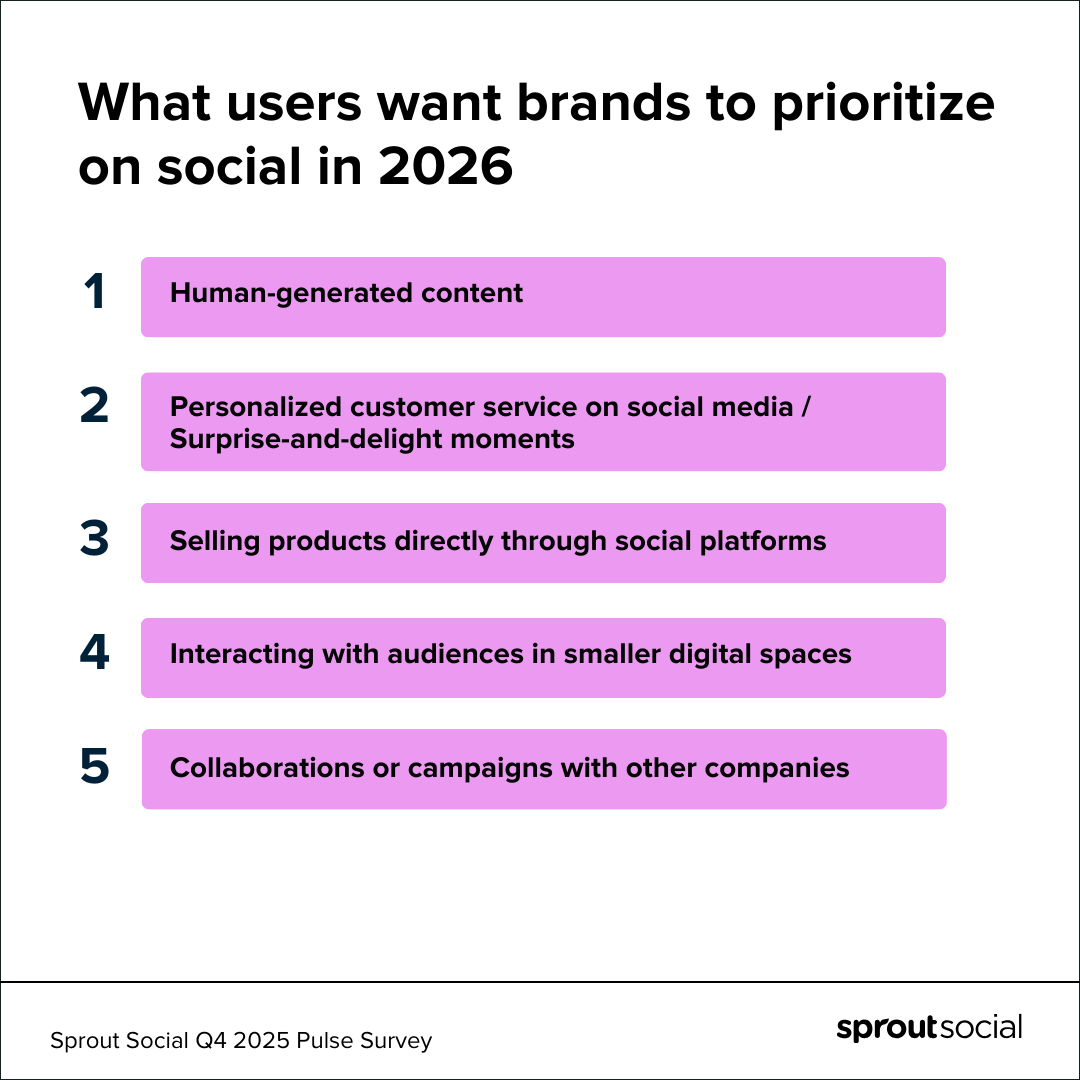
But that doesn’t mean consumers are against teams using AI in their workflows. The Q4 Pulse Survey also found that 69% of users are comfortable with companies using AI chatbots and tools to help humans refine their responses to deliver faster customer service on social. That’s true for 78% of Gen Z and Millennials. Marketers should invest the time savings AI offers back into human-led content creation.
3. The brand account takes a backseat
It’s not just your brand: Most marketers, even those who manage accounts with millions of followers, have seen a steady drop-off in engagement (or at least unreliable engagement) in the past year. Today’s algorithms on traditional social channels are built around discoverability and topical interest, and many brands still take a broad, evergreen approach to content creation.
While that approach isn’t wrong, marketers can’t put all of their eggs in this basket. They need to differentiate and invest in efforts like influencer partnerships and emerging networks. Like when Arby’s let the creators known as @ArbysBoys host an actual rave inside of one of their restaurants.
As Tameka Bazile, Creator and Associate Director of B2B Social & Content at Business Insider, said, “Brands will need to reimagine what ‘organic social’ means. Their future won’t be focused on the growth of traditional B2C brand handles, but by a more diversified organic social ecosystem, including influencer collaborations, B2B storytelling and exec-level personal brands. As consumer trust in brands continues to dissipate, audiences will gravitate toward individuals and communities that feel more human and transparent. Brands will have to adapt by building social strategies that extend beyond their owned channels and into the spaces—and voices—where their audiences already feel seen, and exchange of information feels more accessible.”
4. Social intelligence & analyst job listings will proliferate
55% of all social media users say most companies do a good job of listening to what audiences say on social media, but are less confident brands take their input seriously. Only 31% say brands do a good job of listening to and acting on consumer feedback.
Marketing leaders also recognize more could be done to harness social intelligence and apply it across their businesses. The 2025 Impact of Social Media Marketing Report found that of the 75% of marketing leaders increasing their headcount, more than half want to hire for specialized roles—including social analytics and listening. Sprout’s own Social Media Intelligence Manager told us about her unique career path earlier this year, and why betting on social intelligence means turning conversation into action.
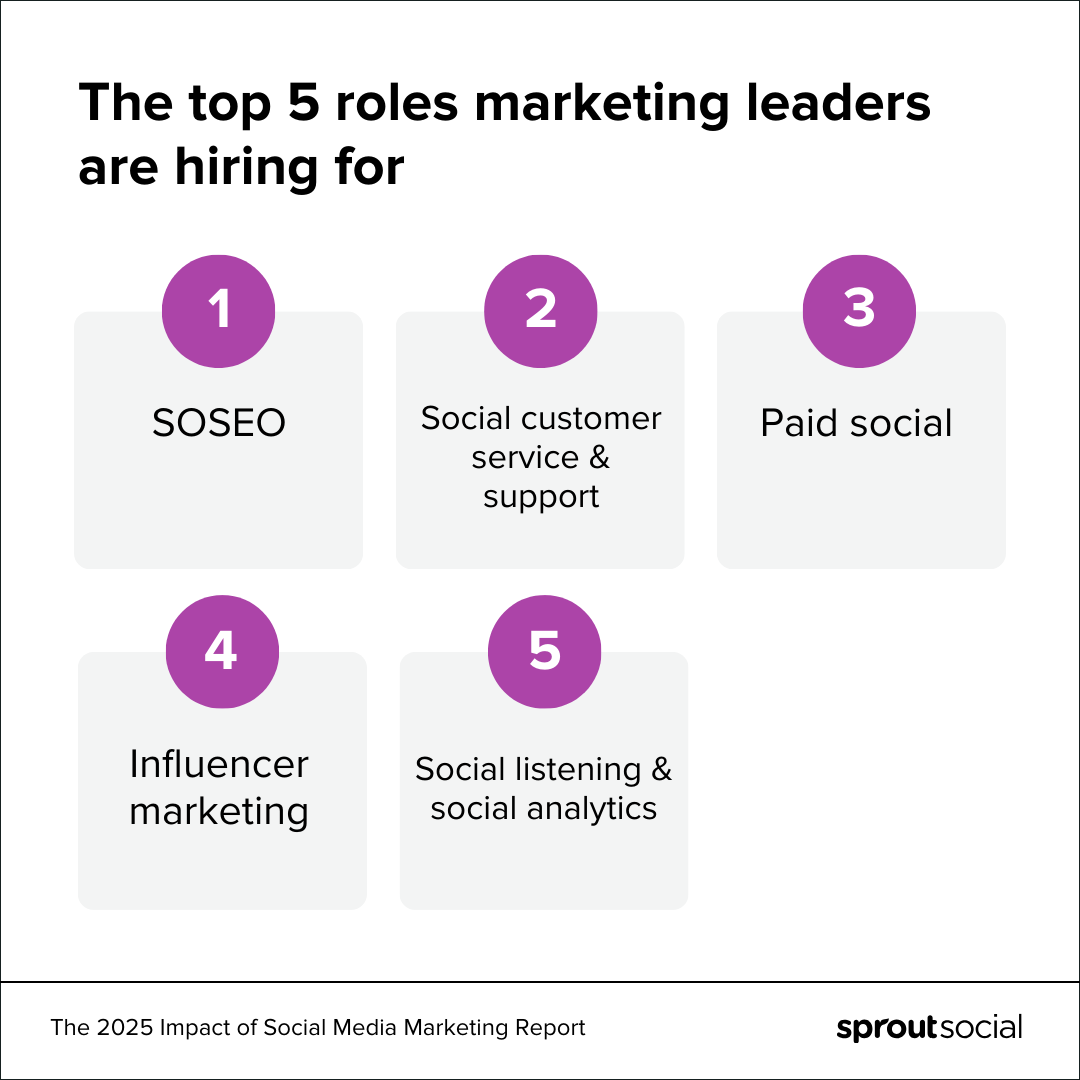
This investment in social intelligence signals how much the business value of social media is increasing. AdAge reported brands like Unilever, Amazon and Clorox are shifting billions to their social budgets, reorganizing their teams and letting social data dictate their work on other channels (like TV, out-of-home and retail). Leading CMOs are taking a social-first approach to their 2026 plans, which means they need these insights to fuel every department.
Kendall Dickieson, Freelance Social Media Consultant and writer of No Filter, commented on this evolution “Social is no longer operating in isolation. It’s becoming a core part of the broader digital ecosystem. As a result, social teams will be increasingly embedded in cross-functional planning, gaining visibility into brand initiatives from the outset and contributing to strategy earlier in the process.”
5. Brands will think smaller when it comes to community management
As mentioned, consumers are moving to more private spaces, like Discord, Reddit, Instagram Broadcast Channels and Facebook Groups. As consumers migrate, brands will follow. The Q4 2025 Pulse Survey found that one of the top five things global social media users say brands should prioritize in 2026 is interacting with audiences in smaller digital spaces.
Some social teams are just focused on listening to conversations about their brand and industry, while others are popping up in comment threads to answer questions and provide customer service. A smaller percentage are launching their own private spaces, like the 40,000-strong Facebook Group managed by Lodge Cast Iron.
Greg Swan, Senior Partner at FINN Partners agency, summed it up like this: “The future of social media for brands will re-center community, not just content. People want connection, transparency and real value from the brands they follow. And the AI slop isn’t helping the content overload. The next wave will focus less on how often a brand posts, and more on how well it listens, engages and builds lasting relationships. We’ll see more private communities, deeper investment in creator collaborations, and smarter use of AI to personalize content and customer experiences. The brands that win will treat social as a two-way street and a long-term investment in trust, not just a content calendar to fill.”
Kara Redman, CEO of Backroom brand strategy and activation agency, calls on marketers to adopt an empathy marketing ethos to create stronger communities. “[Brands should prioritize] more niche relatability to their specific customers. Less trend following, more curiosity about the people who get excited about your brand.”
6. Content creators go corporate
As in-house social media roles become more specialized, some career tracks will veer toward top-tier content creation, like Under Armour’s content studio. We also wrote about how we’re leaning into this on Sprout’s social team.
Angelo Castillo, the creator behind ProfitPlug, says, “Content creators will become the next coveted roles. Strategists, scriptwriters and producers will be highly sought after. Creative strategists who can blend data with storytelling will be especially competed for. The traditional social media manager role will split, with some focusing on community and analytics, others on content production.”
Many brands will also work with creators on a contractor basis. As Jim Lin, Director of Enterprise Social Media at Caterpillar, sums it up, “Creator-led content will surely become more prevalent in brand social media. Not influencers, but people who have certain creative skillsets (e.g., food photography, get ready with me, tutorials, etc.) Their value will not be their following or influence, but the content creation skills they possess. This adds more variety in locations, formats and subjects, but also fills the feed with a larger variety of people and content types.”
7. Marketers worldwide will have to confront social media age limits
Social media bans and age limit parameters will start taking effect over the next few weeks, impacting brands across sectors and countries. Overall, consumers support limitations on social usage, especially for minors. 78% support social media bans for children under 16, per the Q3 2025 Pulse Survey. This rises to 81% for parents.
Even consumers who don’t support bans still want stronger education about the risks of using social media, with 28% of global consumers asserting young people should be educated rather than enforcing a complete ban. Around one-quarter say access to social should only be restricted during certain hours.
When it comes to how social bans and age limit policies will be enforced, much is still unknown. When asked, half of consumers say verified ID checks should be conducted, according to the same Pulse Survey.
These bans are a harbinger that social media is becoming a more legitimate form of media. For brands, compliance can’t be an afterthought. Governance playbooks are required to ensure brand safety.
The future of social belongs to brands that evolve
The next era of social will be defined by intentionality. As consumers gravitate toward smaller spaces and human-first storytelling, brands need to adapt accordingly. Leaders are already investing in social intelligence, specialized talent and diversified ecosystems that empower them to listen more closely and act more meaningfully.
The throughline across all seven predictions is simple: The brands that win in 2026 will stay rooted in what audiences value most. Connecting with other people. And committing to showing up where conversations are happening, not just where content performs. Marketers who embrace these changes now will shape the next chapter of social, marketing and business overall, not react to it.
For a deep-dive into consumer behaviors shaping the future of social media, join Sprout, IKEA, Lia Haberman and Coco Mocoe to unpack practical tactics for 2026 planning.
The post The future of social media: 7 expert predictions for 2026 appeared first on Sprout Social.
