

Research shows that 32% of buyers discover new B2B vendors using generative AI chatbots. This is why an answer engine optimization (AEO) strategy for B2B businesses is essential. AI-driven answer engines help buyers discover, evaluate, and shortlist vendors. The same research found that buyers start with an average of 7.6 potential vendors and narrow this to 3.5 before making their final decision.

For B2B brands, this change introduces a new visibility challenge: if their expertise isn’t surfaced, summarized, or cited by answer engines, they risk disappearing from the earliest — and most influential — stages of the buying journey. Tools like HubSpot AEO make it possible to see exactly where your brand stands across major answer engines, how competitors compare, and what to do about it.
This guide covers what answer engine optimization means for complex B2B sales cycles, where AEO tactics overlap with SEO, and the practical tactics B2B teams must prioritize for AEO-driven visibility — visibility that influences buying committees and turns early discovery into measurable pipeline impact.
Table of Contents
- What is AEO for B2B?
- Why B2B Companies Need an AEO Strategy
- 9 AEO Strategies for B2B
- How to Measure the Success of a B2B AEO Strategy
- Frequently Asked Questions About AEO Strategy for B2B
- Building a Future-Proof AEO Strategy for B2B
What is AEO for B2B?
AEO for B2B is the practice of creating and structuring content so AI-powered answer engines can accurately understand, summarize, and cite expertise when B2B buyers ask questions.
Unlike B2C, B2B buying involves:
- Long sales cycles.
- Multiple stakeholders.
- Buying committees.
- Varied information needs.
A strong B2B AEO strategy ensures a brand shows up consistently and addresses the needs of every stakeholder.
With AEO for B2B, AI systems surface a B2B brand’s expertise at every stage of the decision process.
Why B2B Companies Need an AEO Strategy
B2B marketers have distinct reasons to prioritize AEO — reasons that go beyond general digital visibility. The following four explain why, with supporting data and field observations.
B2B buyer research is shifting from search engines to AI-powered answers.
B2B buyers are increasingly using generative AI tools to research problems, explore solution categories, and identify potential vendors.
As mentioned in the introduction, studies show that 32% of buyers discover new B2B vendors using generative AI chatbots; other top sources for discovery include web search (SEO, which is strongly related to AEO) and word of mouth.
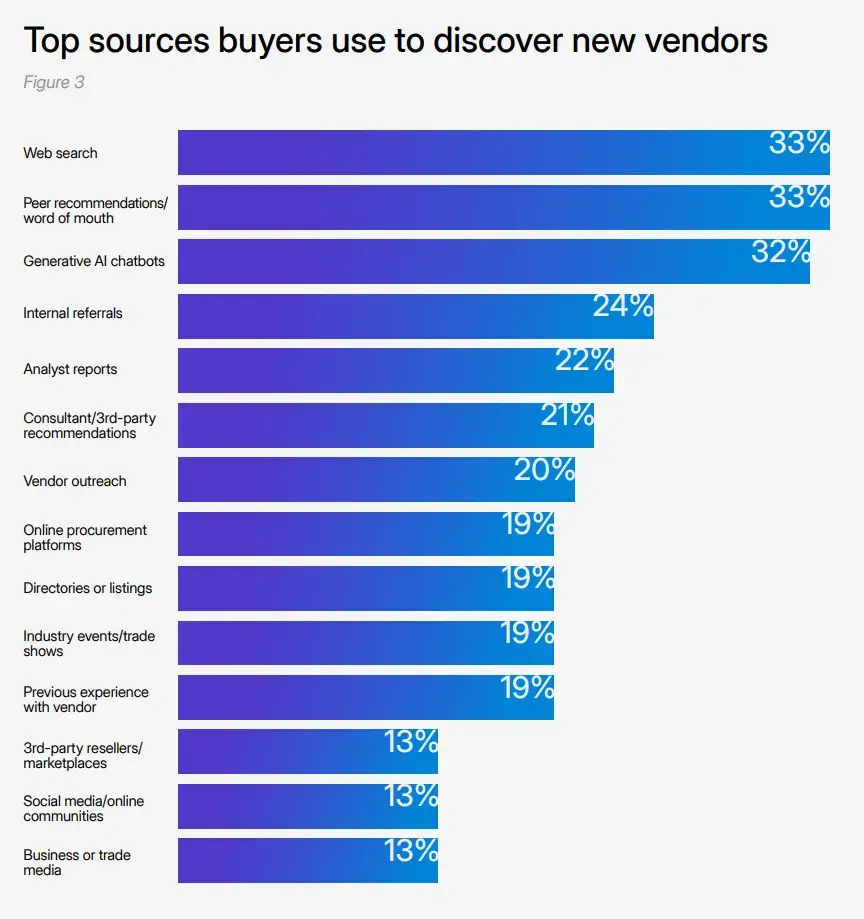
A significant portion of buyers are using generative AI, and that percentage is likely to grow. Another 33% of buyers use web search. For those using Google, that means AI Overviews — where citations are essential for top-of-SERP visibility.
The takeaway: If a B2B brand’s site isn’t available in generative AI chatbots, where 32% of prospects are discovering vendors, that brand could miss out on almost a third of opportunities.
AI is accelerating early-stage B2B decision-making.
Generative AI enables buyers to compare vendors and validate decisions with minimal touchpoints — in some cases, a vendor switch is completed within 15 minutes based on pricing criteria alone.
In his article, “AI tools are rewriting the B2B buying process in real time,” Constantine von Hoffman explains how generative AI is compressing buying cycles, even for large, committee-driven organizations.
He notes that “stakeholders can rely on AI-generated shortlists built around specified criteria, shifting the onus to vendors to maintain explicit, searchable and accessible content — especially pricing — on their websites.”
Hoffman interviewed Chris Penn, Co-founder and Chief Data Scientist at TrustInsight.AI. Penn provided an example where generative AI summaries helped him switch from his current vendor to a new one. Penn said he asked Gemini Deep Research to identify five new providers for a current SaaS vendor that had recently raised its prices. Within minutes, the AI had done the work, provided the shortlist, and Penn switched his vendor.
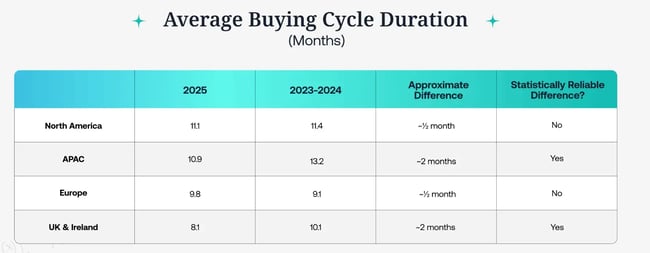
Research from 6sense confirms that AEO and generative AI compress the research phase.
Their research found that B2B buyer cycles are shortening across all regions except Europe. In some regions, the B2B buying cycle is reduced by up to two months.
I’m seeing high conversion rates from AI referral traffic for my clients.
Here’s an example: my client, a B2B catering company, converts 7.12% of their AI referral traffic and 1.37% of their traditional SEO traffic.
Here’s why I think this happens:
- AI agents send highly targeted, high-intent traffic because they’ve already interpreted the user’s needs, constraints, and context before recommending a site.
- Traditional SEO inevitably attracts unqualified traffic because ranking relies on broad, informational content that serves early-stage, ambiguous searches, not just conversion-ready users.
A caveat: AI search also includes broad informational content, but users aren’t clicking through to the website to review it. If they’re searching for informational search on AI search tools, then they’re getting their answer within the tool, leaving the clicks only for the bottom funnel click — the one that really matters.
AI answers shape trust, authority, and category leadership early.
AEO shapes perception early, particularly through AI Overviews within Google search.
AI search systems prioritize content that is clear, structured, and authoritative, often delivering “zero-click” answers that buyers consume without visiting a website.
A citation or reference inside an AI-generated answer matters more for visibility than ranking first on a SERP.
Here’s a real-world example:
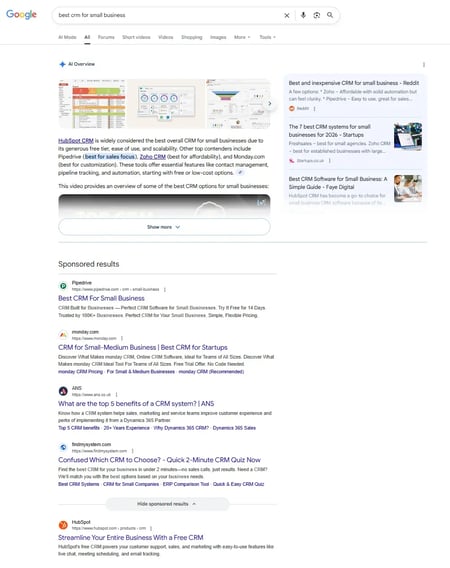
As seen in the previous screenshot, a search for “best crm for small business” returns HubSpot at the top of the SERPs, followed by four sponsored advertisements and, finally, the first organic listing, which is also HubSpot.
The AI overview is clear: “HubSpot CRM is widely considered the best overall CRM for small business…”
Without clicking a link, prospects are already forming an impression of vendors.
In my research, I’ve seen brands with solid SEO foundations lose narrative control to competitors who have leveraged structured content, relevance, schema, and explicit expertise signals to rank in AI Overviews without traditional SEO rankings. The most influential tactic is relevance, and I cover that in detail later.
The takeaway: An AEO strategy for B2B increases the likelihood that a brand’s expertise appears in Google’s AI Overviews and generative AI search experiences. That early visibility shapes how buying committees form shortlists and determines whether a brand is considered at all.
AI will always generate an answer about a B2B brand, even if the information is wrong.
Generative AI systems are designed to respond, and they respond with conviction every single time. When authoritative, up-to-date content isn’t available, answer engines will still synthesize a response using whatever signals they can find: forum posts, outdated blog content, Reddit threads, or anecdotal experiences.
The result is that AEO systems can produce inaccurate, incomplete, or biased information, with the same level of confidence as verified facts.
A common real-world example is pricing.
I’ve already seen cases where AI-generated answers cited my client’s pricing pulled from a Reddit thread. The price was incorrect, but my client didn’t want to list their pricing on their website — a decision I don’t agree with.
The AI didn’t distinguish between an anecdote and an official source; it simply filled the gap and answered the question. It didn’t make any comment on the source’s reliability.
It’s scary.
I’ve had to redact the details, but here’s what AI Mode replied:
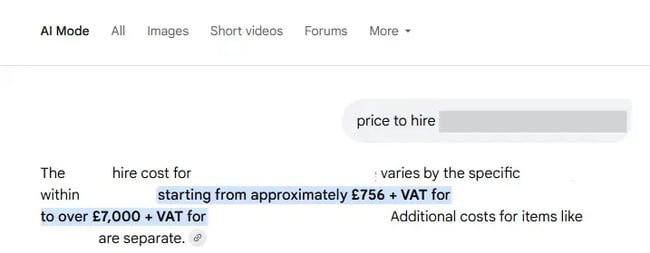
The information provided is incorrect by 195%. AI quotes a cost 195% lower than it should be, which could lead to unqualified traffic and enquiries from people who can’t afford the service.
I’m not the only one experiencing this; there are numerous threads from business owners dealing with incorrect citations, including this Google support thread.
The takeaway: If a B2B brand doesn’t control the source material, it doesn’t control the answer. An effective AEO strategy ensures that accurate, structured, and authoritative content exists for AI systems to reference, reducing the risk that misinformation, competitor narratives, or one-off complaints define a brand in early-stage buyer research.
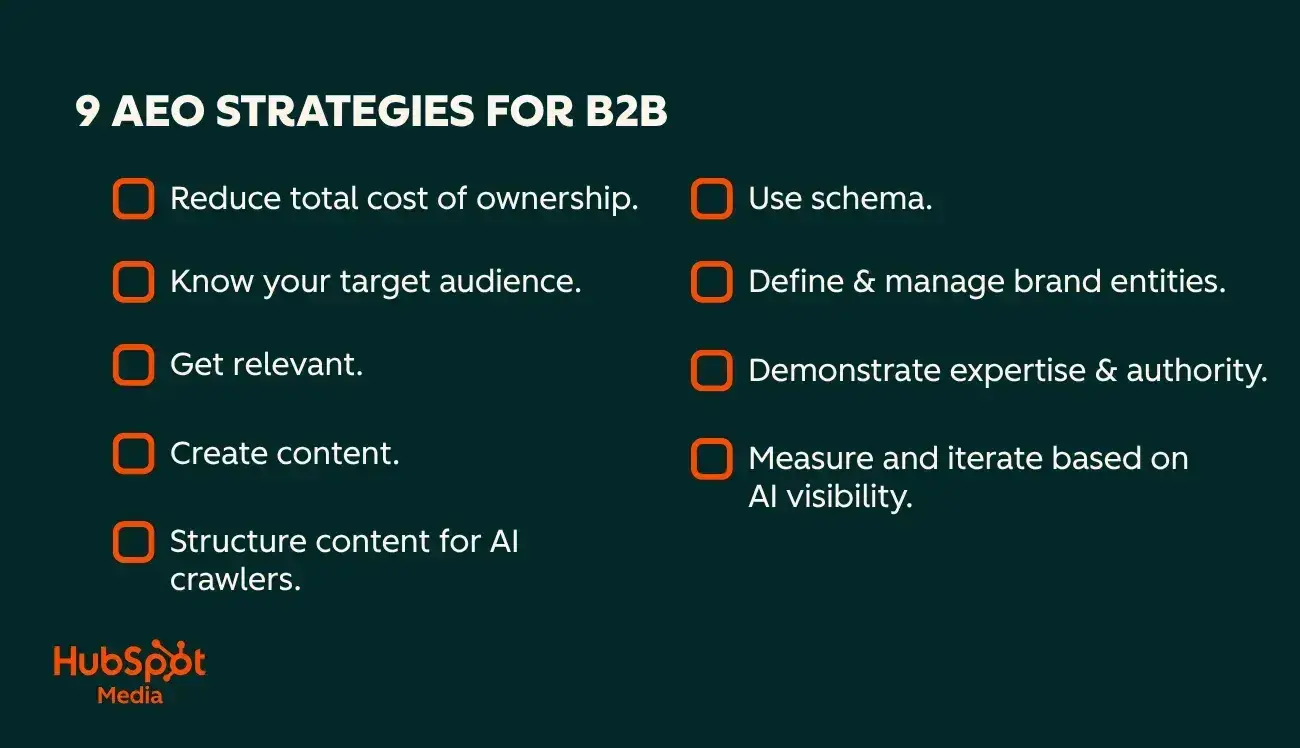
9 AEO Strategies for B2B
An effective AEO strategy requires a deliberate approach to understanding buyer intent, structuring information for AI consumption, and ensuring a B2B brand’s expertise is consistently accessible across generative search experiences.
The following nine strategies outline how B2B teams can build answer-ready content that improves AI visibility, supports complex buying journeys, and strengthens early-stage influence.
Note: Some of these strategies will feel familiar. Many SEO best practices carry over directly to AEO, and experienced SEO specialists should take comfort in knowing that their existing skills provide a strong foundation for success in AI-driven search.
Follow every SEO best practice.
Following every SEO best practice is foundational to AEO success because search engines and AI answer systems both rely on well-structured, relevant, and authoritative content to understand and surface information.
Search engine optimization specialists established the foundations of SEO, and these foundations translate to AEO.
Even as AI reshapes discovery, the fundamentals of organic search optimization continue to determine whether a brand’s content is visible, credible, and findable in the first place.
Objective SEO best practices include things like:
- Technical performance, like indexed pages, site speed, and mobile responsiveness
- Keyword research aligned to intent
- Optimized on-page elements like meta titles, headings, and structured content
- High-quality backlinks from relevant publications
- Clear site architecture that makes it easier for both traditional bots and AI systems to extract meaningful answers from a brand’s content.
B2B teams looking for support with their B2B SEO strategy can start with these HubSpot resources:
- Improving Your Technical SEO
- On-Page Technical SEO Training
- What a decade in SEO taught me about keyword research that works
- The Fundamentals of On-Page SEO [+How-To Checklists and Templates]
- Link Building Lesson: How to Build Links for SEO
- Website Navigation: How to Design Menus Visitors Love [Examples]
For B2B marketing teams managing SEO and AEO in one place, HubSpot’s SEO Tools is a suite of tools within Marketing Hub that helps surface and address technical and on-page gaps — including viewing SEO recommendations, analyzing performance, and understanding SEO recommendations. HubSpot AEO is available in Marketing Hub Pro and Enterprise, or as a dedicated tool you can purchase on its own without a HubSpot subscription.
Pro tip: For those completely new to AEO and SEO, or who feel they don’t have all the foundations down, an excellent resource is Learning SEO by Aleya Solis. It’s a comprehensive roadmap that takes readers from beginner SEO to pro. Working through this resource provides everything B2B marketing teams need for the best SEO and AEO.
Know your target audience.
A foundational element of any B2B AEO strategy is understanding who to optimize for — and that starts with identifying the target audience.
In B2B, this means investing in B2B market research and audience analysis to anticipate the questions, priorities, and information needs of the various stakeholders involved in a purchase.
Knowing the audience informs everything from how B2B marketing teams structure content to which topics they prioritize for answer engine visibility. Understanding the target audience helps B2B marketers tailor messaging and solutions to their specific problems and criteria, rather than guessing what buyers might care about.
Research shows that a deep understanding of the market significantly improves conversion rates. In HubSpot’s 2026 State of Marketing report, 93% of marketers say personalization improves leads and purchases.
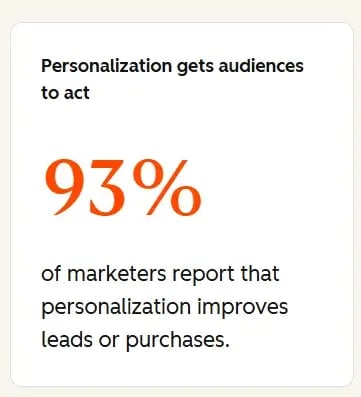

Personalization isn’t possible without a clear picture of who the audience is and what they need.
The takeaway: B2B marketers must map B2B buyer journeys and outline who the target audiences are, what the ideal client profile (ICP) looks like, and, importantly, what each person needs. In B2B marketing, there are always complex buying committees with multiple people each requiring targeted messaging. The MEDDPICC methodology can help structure this process.
Pro tip: B2B marketers can create buyer persona documents quickly and easily using HubSpot’s Make My Persona. It’s a buyer persona generator that guides teams through creating an ICP document that the entire team can refer to.
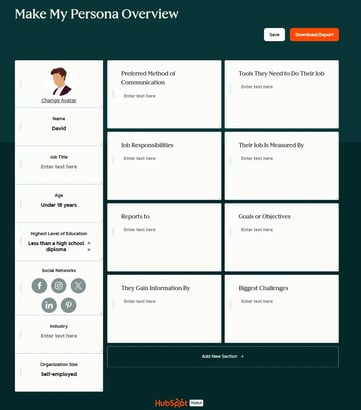
HubSpot’s Make My Persona is a free buyer persona generator that guides B2B marketing teams through building an ICP document — informed by customer service conversations or prospect surveys — and generates a downloadable PDF to share across the team.
Get relevant.
In a B2B AEO strategy, being relevant means aligning content directly with the real problems and solutions buyers face — covering every use case and decision criterion across different roles and stages of the buying journey. Relevance has always been a core signal in B2B search marketing; in AEO, its impact is amplified.
AEO provides a unique opportunity for brands — even smaller ones — to secure top-of-SERP visibility without competing for rank one in traditional SEO.
Here’s a real example: a search for “digital marketing agencies for manufacturing companies” returns the following results.
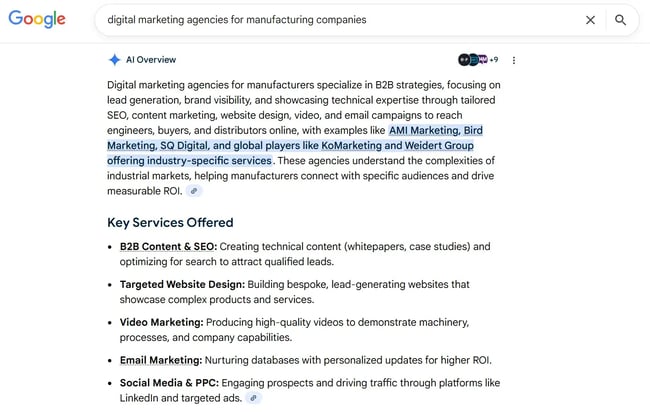
Bird Marketing, KOMarketing, and Weidert Group are not listed on the first page of Google. Bird Marketing appears on page three, and KOMarketing and Weidert Group do not appear in the first five pages.
In this instance, these brands have considered their ideal client and their services, and created relevant landing pages with relevant content to help them rank.
Here’s a peek at Bird Marketing’s page:
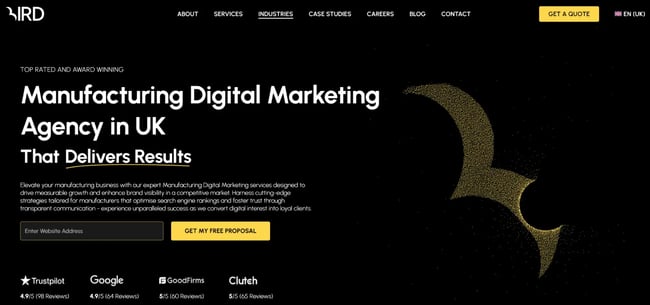
The page is heavily targeted at the manufacturing audience, using traditional SEO tactics (such as optimized headers) to ensure that both AI and traditional crawlers can understand and index its content.
Pro tip: Earning the attention of every decision maker requires creating relevant content for each stakeholder’s unique problems and interests.
The table below outlines seven stakeholders typically involved in evaluating digital marketing services, their primary problems, and the messaging most likely to resonate with each.
The takeaway: In AEO, relevance determines whether a brand appears at all. By creating content that directly addresses the real problems, use cases, and decision criteria of every stakeholder in the buying committee, B2B brands can gain prominent visibility in AI-driven search results, sometimes without needing to rank first in traditional organic search. HubSpot AEO makes it easier to identify where those visibility gaps exist, showing which prompts your brand is missing from and where competitors are showing up instead.
Create content.
Content creation is central to any B2B AEO strategy. The reality of AEO is simple: if the content doesn’t exist, AI can’t surface it — or it will satisfy a prompt using whatever sources it can find, including Reddit threads, outdated blog posts, third-party opinions, or, in the worst case, a completely incorrect answer.
The AI has found whatever source that’s even vaguely related to the question and cited it.
If a B2B brand’s site doesn’t clearly explain its positioning, B2B pricing, use cases, or differentiation, that brand loses control of the narrative early in the buying process. Or worse, competitors capture that visibility, shaping shortlists before the brand is even considered.
B2B marketers need to create a content plan that:
- Covers the full range of buyer questions, from early-stage education to late-stage evaluation and validation
- Addresses every key stakeholder involved in the buying committee, with content tailored to their specific problems and decision criteria
- Makes core information explicit and easy to extract, including pricing, use cases, differentiators, integrations, and limitations
- Prioritizes accuracy, clarity, and first-hand expertise over promotional language
- Uses consistent terminology and definitions across pages to reduce AI misinterpretation
- Uses clear headings, summaries, lists, and tables for AI consumption
- Undergoes regular review and updates, so AI systems don’t rely on outdated or incorrect information
Content creation is a significant undertaking. Fortunately, tools like HubSpot’s Content Hub make it more manageable.
HubSpot’s Content Hub is a CMS that helps B2B marketing teams create and manage content that’s both search- and AI-ready. With its AI writer, it offers built-in SEO suggestions, supports structured schema-ready content, and helps teams maintain consistency at scale.
Pro tip: Breeze Copilot is HubSpot’s AI Agent that supports AEO efforts by helping B2B marketing teams draft, expand, and refine content aligned to buyer questions, while keeping messaging grounded in a brand’s tone of voice. Breeze Copilot accelerates content creation at scale.
Structure content for AI crawlers, not just human reading.
Structuring content for AI crawlers means organizing information so it can be easily parsed, extracted, and summarized by AI systems, while remaining clear and useful for human readers.
Unlike traditional content, which can rely on narrative flow or persuasion, AI-ready content prioritizes clarity, hierarchy, and explicit answers. Well-structured content reduces ambiguity and increases the likelihood that AI systems accurately surface a B2B brand’s expertise in generative answers.
For B2B marketing teams with established SEO practices, this style of writing should already feel familiar.
In practice, structuring content for AI means presenting information in predictable, machine-readable formats such as clear headings, concise definitions, lists, tables, and summaries. These formats help AI models identify what a page is about, which questions it answers, and which facts can be confidently reused.
In my experience, these structures aren’t new — but AEO has made me far more deliberate about seeking opportunities to replace paragraphs with structured elements.
Use schema.
Schema is a standardized format for structured data added to a webpage’s HTML that helps search engines and AI systems understand the context of the content, whether it’s referencing FAQs, an image on a page, or an entity, like a person who wrote an article.
In search, schema provides explicit context about entities, relationships, and page purpose (such as products, services, FAQs, reviews, or organizations). This makes it easier for search engines to index content accurately and for AI-driven systems to extract, summarize, and surface reliable information in features like rich results, AI Overviews, and generative answers.
While schema has long supported traditional SEO, its impact on AI visibility is now becoming clearer, particularly for Google’s AI Overviews, where structured data helps models prioritize pages with good schema.
Molly Nogami and Ben Tannenbaum tested the role of schema in AI Overviews visibility in a controlled experiment, evaluating the impact of strong, weak, and absent schema implementations.
Their Search Engine Land study found that pages with well-implemented schema consistently appeared in AI Overviews and performed best in traditional search results. In contrast, pages with poorly implemented schema — or no schema at all — failed to appear entirely.
The takeaway: The quality and accuracy of schema implementation matter. When schema is applied correctly, it gives AI systems clear signals about what a brand’s content represents — reducing ambiguity and increasing the likelihood that those pages are selected, summarized, and cited in AI-generated answers.
Define and manage B2B brand entities.
In AEO, managing entities means clearly defining who a brand is, what it does, and how key concepts, products, and people relate to one another across its content. AI systems rely on entities and their relationships to build understanding and determine authority.
When entities are consistently named, described, and connected, answer engines can more confidently surface and cite a brand.
HubSpot does this particularly well through the use of semantic triples, a structure that clearly defines relationships in the form of:
- Subject
- Object
- Predicate
For example:
- Vague description: HubSpot offers powerful tools to help businesses grow and improve their marketing efforts.
- Explicit, entity-driven description: HubSpot is a CRM platform that provides marketing automation, sales enablement, and customer service tools for B2B companies. It’s used by marketing and revenue teams to manage leads, track customer interactions, and measure pipeline performance across the full buyer journey.
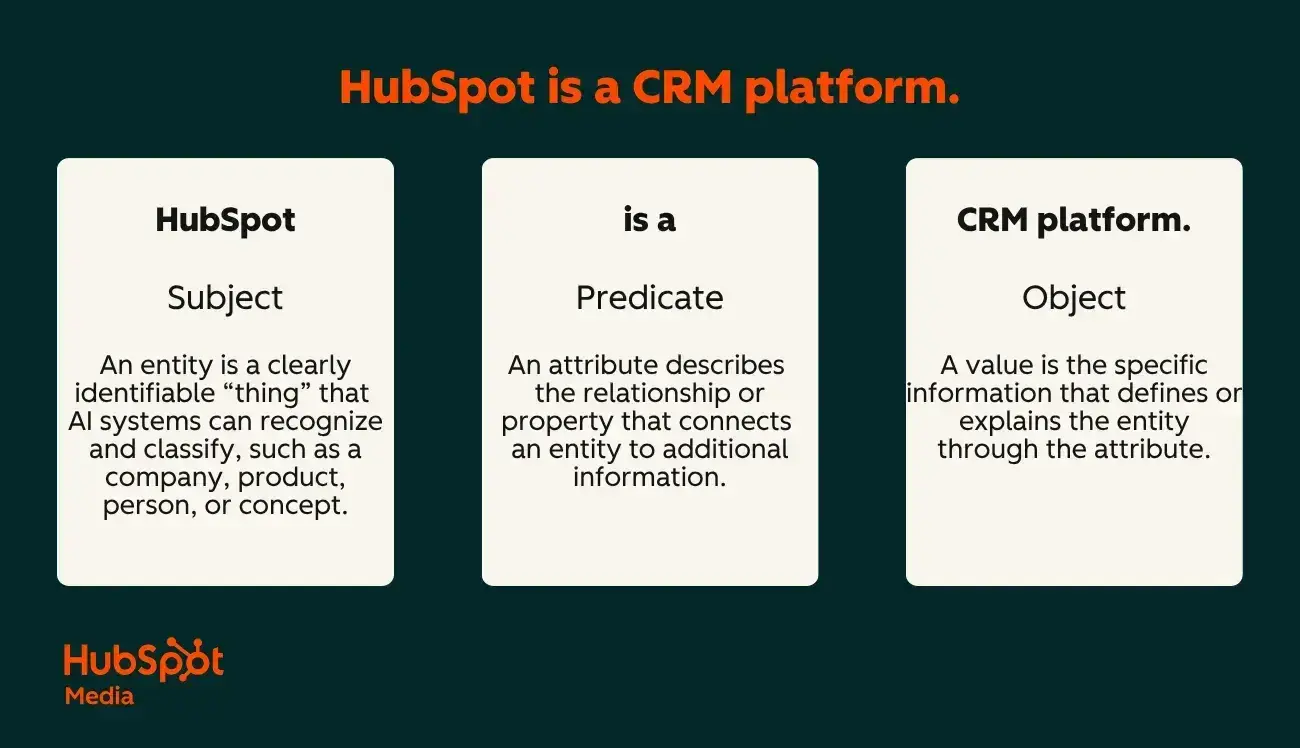
This clarity helps AI systems understand not just keywords but meaning — who the expert is, what they’re authoritative on, and how concepts relate to one another.
The takeaway: By clearly defining a brand’s entities and relationships in a way AI systems can understand, B2B brands improve both how often and how accurately the brand appears in generative search results.
Pro Tip: Schema and schema graphs are key to defining entities.
Demonstrate expertise and authority explicitly.
Explicitly demonstrating expertise and authority is critical for B2B AEO because AI systems don’t infer credibility the way humans do; they rely on clear, machine-readable signals. That means B2B brands must be deliberate about stating what they know, what they do, and why they’re qualified to speak on a topic, using consistent language and structured explanations rather than implied authority or marketing claims.
When a brand’s content and overall digital presence explicitly and consistently define its expertise and authority, B2B brands reduce ambiguity and increase the likelihood that AI systems treat the brand as a reliable source.
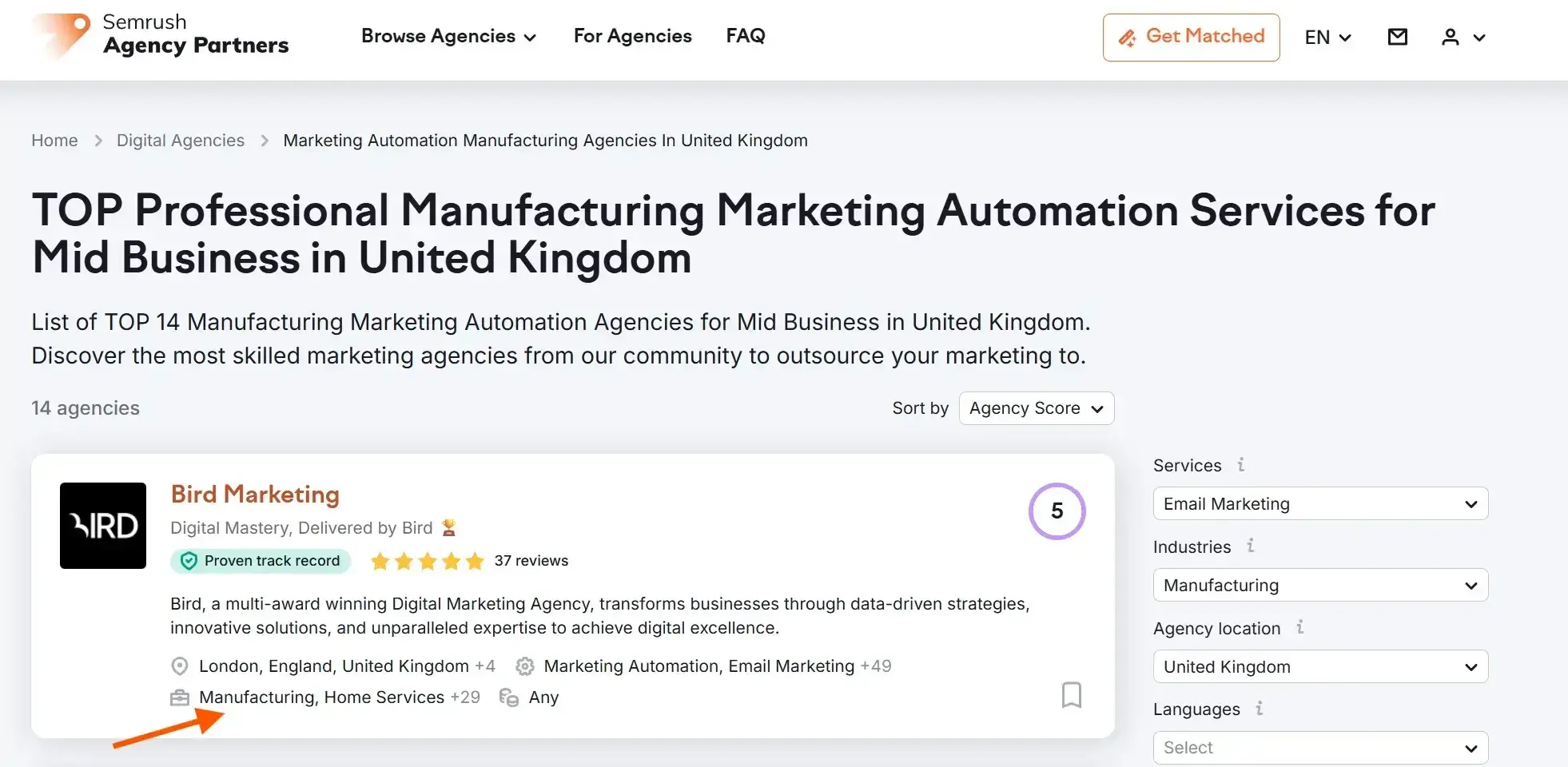
Referring back to the Bird Marketing example on relevant landing pages and content, Bird also maintains consistency across its digital footprint. On third-party sites, such as Semrush’s agency partner, their expertise is tagged as “manufacturing.” No doubt, these consistent messages across domains helped them secure the feature in AI Overview.
Measure and iterate based on AI visibility.
Measuring what’s working and iterating on it is perhaps the most important component of any B2B AEO strategy.
AEO requires a new set of tracking and measurement goals focused on AI visibility, citations, and influence — not just clicks or SEO metrics.
To do this effectively, B2B teams need to establish dedicated AEO metrics to assess the strategy’s performance. These insights make it possible to identify gaps, refine content, and iterate with confidence.
Let’s dig into measuring B2B AEO strategy next.
How to Measure the Success of a B2B AEO Strategy
Although there is some crossover between SEO and AEO tactics, measuring AEO requires expanding beyond traditional SEO metrics.
The AEO metrics below help B2B teams objectively assess whether an AEO strategy is driving real impact.
This section covers the key metrics, why each matters, and includes real AEO reporting examples. For more information on how to construct reports and measure AEO success, read: How to create an SEO report [+ benefits, best practices, and examples]
Traffic
Although AI-driven experiences can reduce clicks, there will still be clicks from AI referrals, and traffic numbers remain a baseline indicator of discovery and relevance.
Unlike tracking visibility (more on that later), traffic is a tangible, quantitative metric that B2B marketing teams can track and tie to real business impact.
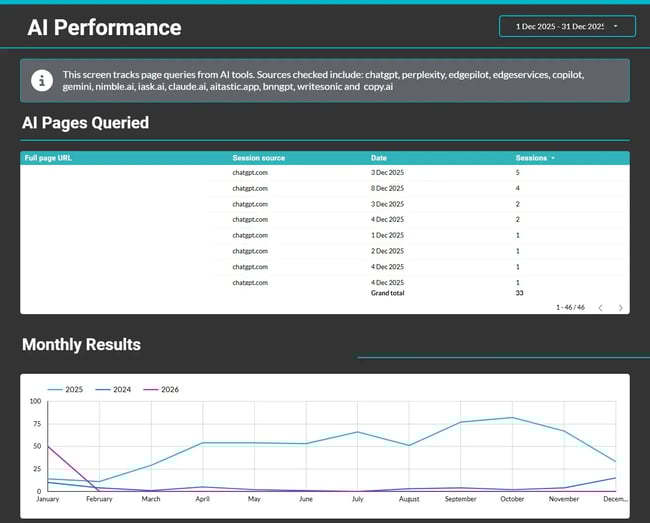
The previous screenshot shows traffic just from AI sources for one client. The increases are notable:
- In January 2025, traffic increased by 40% compared to January 2024.
- In January 2026, traffic increased by 257% compared to January 2025.
Pro tip: Enhance reporting by reviewing the pages people land on. This information is redacted in the screenshot, but reviewing it is crucial for identifying which pages and topics are driving the clicks.
Conversions
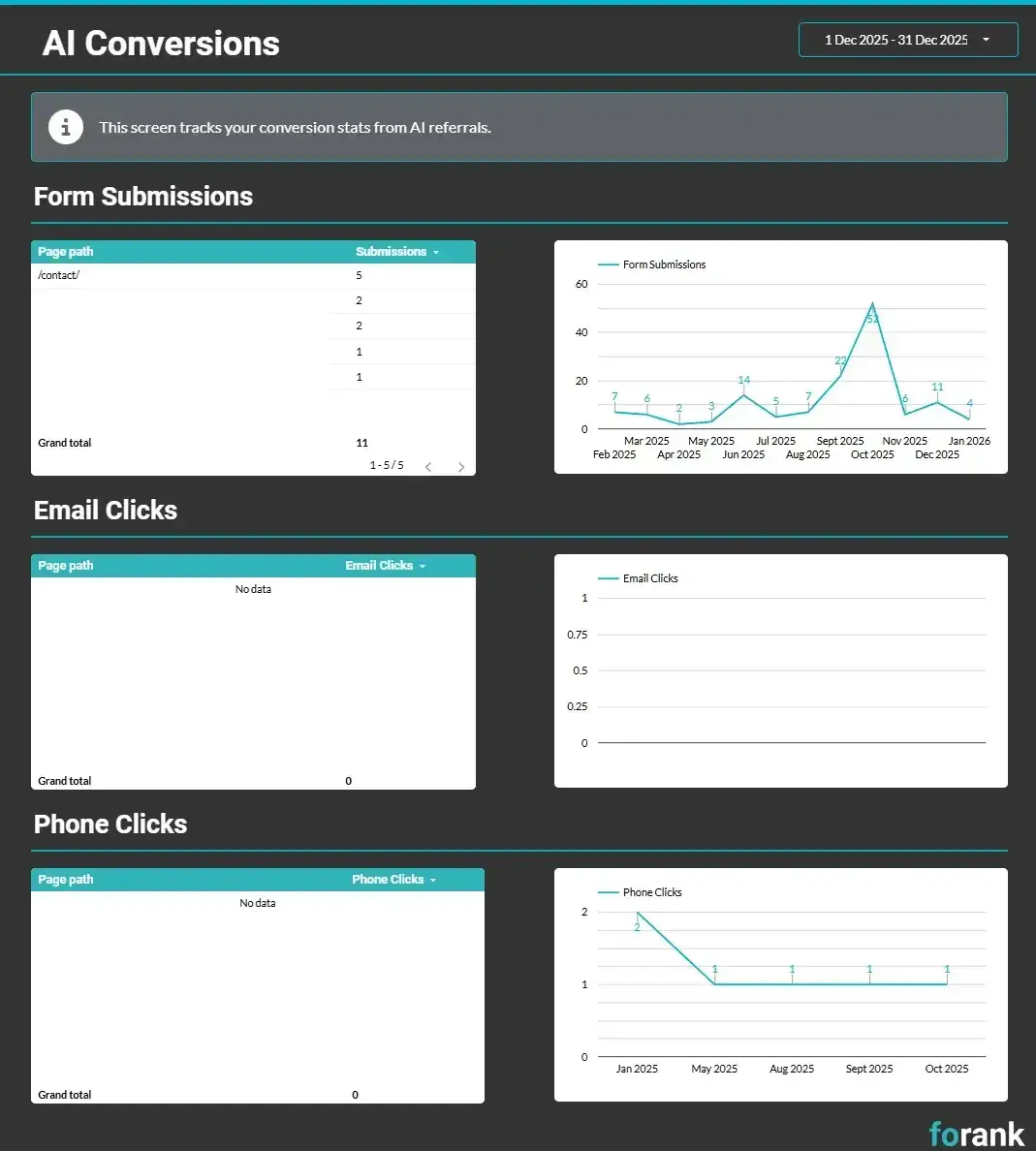
Conversions show whether AI-influenced visibility is translating into action. B2B marketing teams should track form fills, demo requests, and content downloads associated with AEO-optimized pages. In B2B, assisted conversions are especially important, as AEO often influences early-stage consideration rather than last-click behavior.
Revenue
Revenue connects AEO to business outcomes. Attribute pipeline and closed-won deals back to pages and topics that support AI discovery, especially comparison, solution, and pricing content. Over time, strong AEO performance should correlate with higher-quality inbound leads and shorter sales cycles.
Brand sentiment
Brand sentiment reflects how a brand is represented in AI-generated answers. Review AI summaries and citations to assess tone, accuracy, and positioning. Positive, consistent representation indicates that answer engines are pulling from authoritative, well-structured content that the brand controls. HubSpot AEO includes a Sentiment Analysis feature that measures how positively or negatively a brand is described in AI-generated responses. This gives teams an early signal of perception problems to address, not just visibility gaps to close.
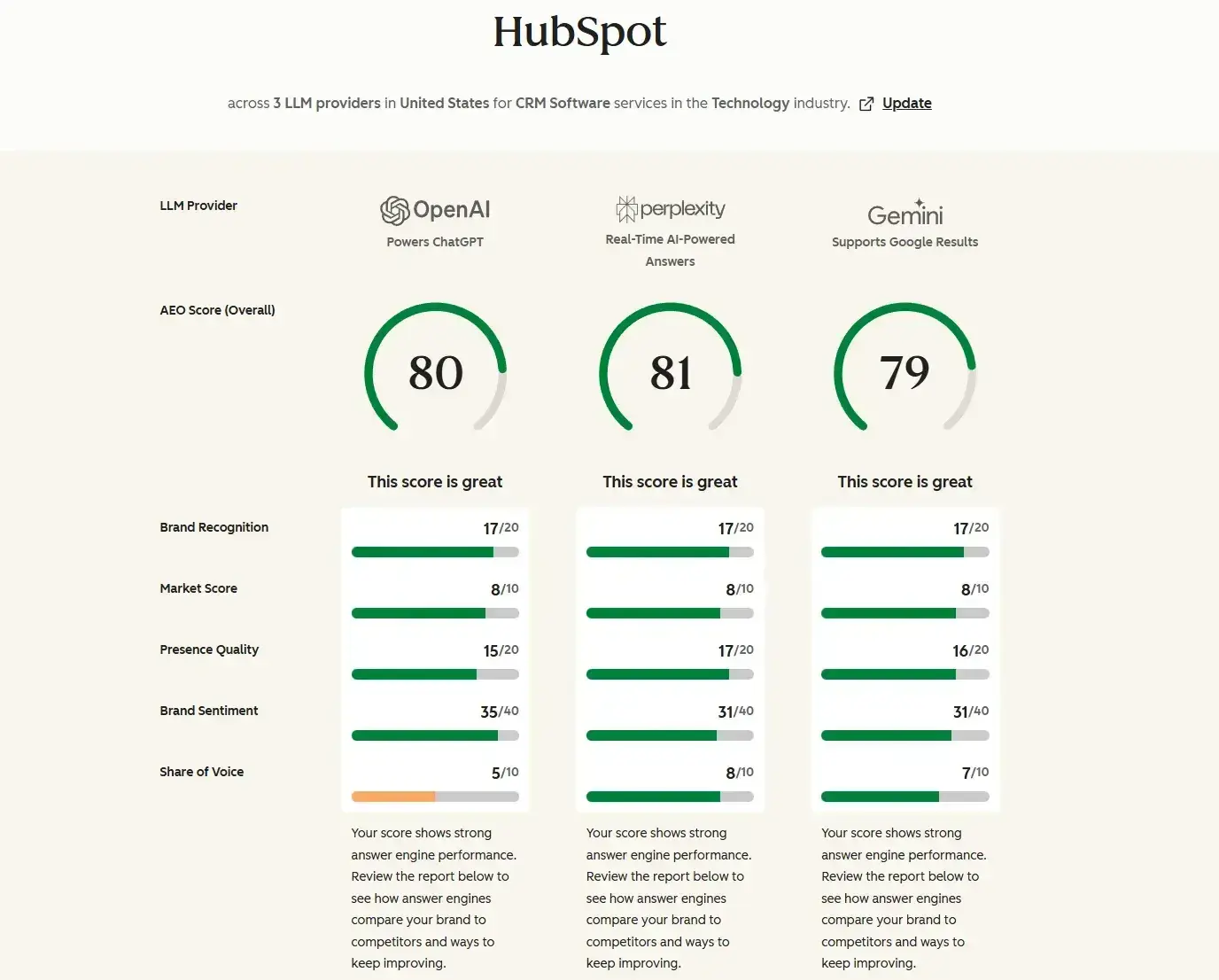
HubSpot’s AEO Grader is a diagnostic tool that assigns a score to a brand’s AEO presence, assessing AI search visibility, brand gaps, and how well a site is positioned for answer engine optimization.
Visibility
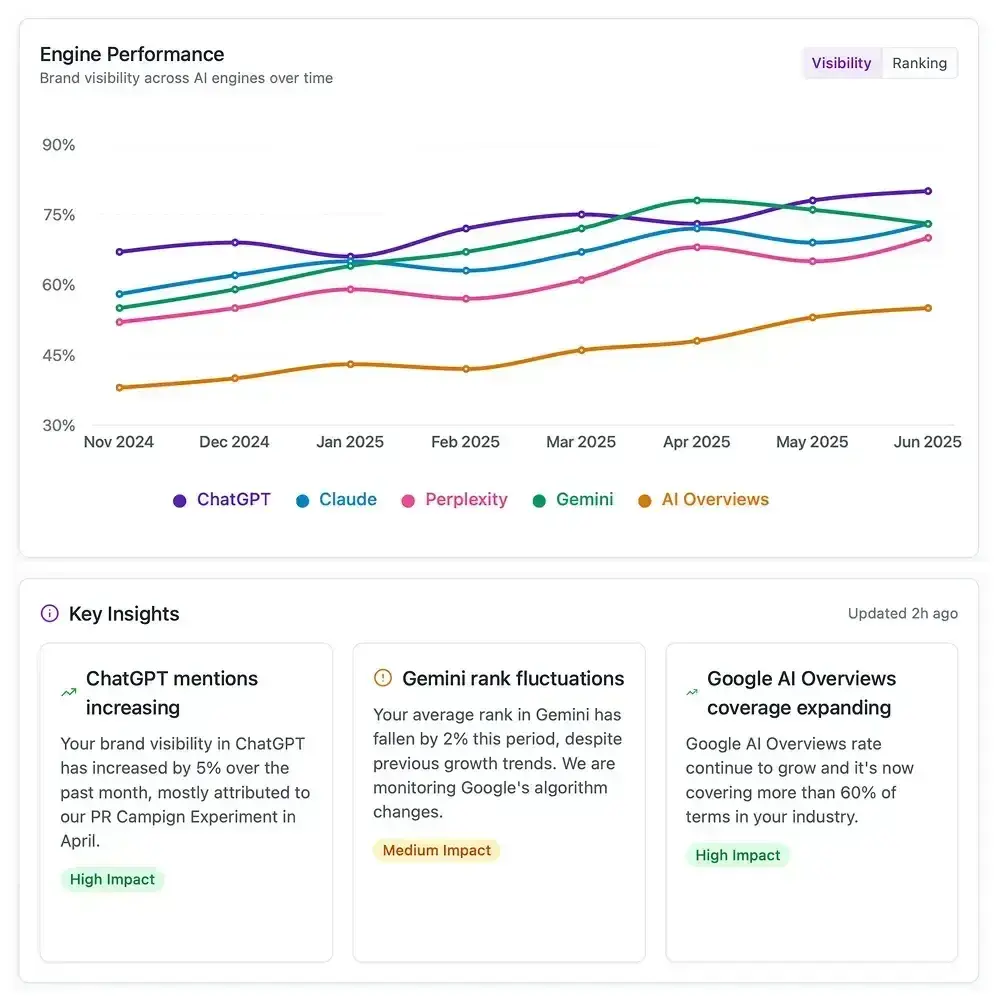
Visibility measures whether — and how often — a brand appears in AI-generated answers, summaries, and recommendations. This includes presence in AI Overviews, citations, and LLM responses across key queries. Visibility tracking helps B2B marketing teams understand the competitive share of voice in generative search. HubSpot AEO‘s Brand Visibility Dashboard and Competitor Analysis give B2B teams a single view of how their brand performs across ChatGPT, Perplexity, and Gemini, including which prompts cite competitors and where the brand is completely absent.
Pro tip: HubSpot AEO is built on the technology developed by XFunnel, a team HubSpot acquired, which measures LLM visibility and AI-driven search performance. As an AEO testing option, it enables B2B marketing teams to see which content is surfaced by generative engines and assess whether schema markup is working effectively.
Frequently Asked Questions About AEO Strategy for B2B
Should we replace SEO with AEO?
No, AEO should not replace SEO. AEO builds on SEO, and strong SEO foundations remain essential for AEO’s success.
How often should we update AEO-focused pages?
High-impact AEO pages should be reviewed whenever key information changes — pricing, features, positioning, or category definitions — and when a topic area evolves significantly. As a general rule, a quarterly audit of top-performing AEO pages helps ensure AI systems don’t surface outdated information.
How do we get cited by AI systems if we are new to the category?
New brands can earn AI citations by focusing on relevance and targeting specific buyer questions, use cases, and decision criteria rather than broad category terms. By publishing tightly scoped, well-structured content that addresses clearly defined problems for a specific audience, AI systems are more likely to surface and reuse that content, even without established brand recognition.
What page types should we prioritize first for B2B AEO?
Prioritize pages likely to generate revenue from visitors, such as product and service pages. Then, build out the content with use cases, FAQs, comparisons, and more.
How do we avoid sounding biased in competitive content?
Focus on objective criteria, transparent trade-offs, and fair comparisons rather than promotional language, as AI systems are more likely to surface balanced, credible content in generative answers.
Building a Future-Proof AEO Strategy for B2B
Answer engine optimization is no longer optional for B2B brands as buyers increasingly rely on generative answers to research, compare, and shortlist vendors. HubSpot AEO gives B2B teams the visibility to see exactly where their brand stands across major answer engines, how competitors compare, and a clear action plan for what to do next.
Tools like HubSpot’s Content Hub and Breeze make it easier to operationalize AEO at scale by helping teams create, structure, and assess content that AI systems can actually understand and surface. As answer engines continue to evolve, the brands that invest now in clear, relevant, and authoritative content will be the ones shaping buyer decisions tomorrow.
